
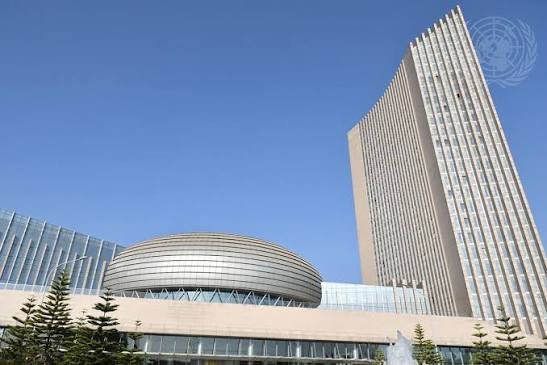
The Architecture of Aspiration
Agenda 2063 is an impressive document. It maps a prosperous, integrated, peaceful Africa, united in its development ambitions, sovereign in its governance, respected in the architecture of global power. It is a vision with coherent language, measurable aspirations, and the formal endorsement of fifty-five member states. What it is not, and what the African Union has consistently failed to produce in the years since its adoption, is a doctrine. The distinction is not semantic. A vision describes where an institution wants to go. A doctrine describes how it will get there, what it will trade to get there, and what it refuses to compromise on the way. Without doctrine, vision is aspiration with a conference attached.
The cost of this gap has become visible in the years between 2020 and 2026 with unusual clarity. The world has reorganised around strategic blocs: NATO reanimated by the Ukraine war, the BRICS complex expanding its membership and its ambitions, Gulf states repositioning themselves as indispensable mediators, China consolidating its infrastructure footprint with Belt and Road, the United States managing its retreat from liberal multilateralism while insisting on its prerogatives. In every one of these reorganisations, Africa has been present as a theatre of competition, and absent as a coherent actor. Other powers arrive at African summits with doctrine. The AU arrives with process.
What Doctrine Requires
Doctrine requires decisions. It requires that an institution be willing to define not just what it values but what it will prioritise when values conflict, when continental solidarity collides with the interests of a powerful member state, when the language of non-interference protects a government that is dismantling its own people, when a seat at a global negotiating table requires taking a position that some members oppose. The AU’s founding architecture built in mechanisms to avoid all of these decisions. The principle of non-interference, inherited from the Organisation of African Unity’s fraught history with sovereignty claims during the liberation era, was elevated to a structural commitment that has made the AU structurally unable to lead in precisely the crises where leadership is most needed.
The Record of the Last Decade
The consequences are readable in the record of the last decade. The Sahel’s security architecture collapsed across four countries in less than three years, with coup governments explicitly rejecting ECOWAS and AU authority while continuing to receive continental diplomatic courtesies. The Sudan crisis, the most catastrophic humanitarian emergency in the world by 2024 [UN OCHA], produced AU statements but not AU decisions. The AU Peace and Security Council, which was designed to be the continent’s collective security authority, has cycled through crises without developing the enforcement credibility that would make its engagement consequential. A security council without enforcement is an advisory panel that holds more meetings.
The African Union is not a weak institution because Africa is weak. It is a constrained institution because its founding design prioritised consensus over consequence, and consensus, in a body of fifty-five states with divergent external patrons, is a formula for paralysis.
The G20 Admission and Its Limits
The AU’s admission to the G20 in September 2023, at the New Delhi summit, was celebrated as a historic moment of recognition. It was, and it was also a test. The test is not whether Africa has a seat in the room. The test is whether, once in the room, the AU can speak with a position rather than a coalition of divergent national interests dressed as continental consensus. On the debt crisis, where African nations collectively owe over $1.1 trillion [IMF Outlook 2024], much of it in conditions that crowd out public investment and deepen fiscal dependence, the AU has not produced a unified negotiating doctrine. Individual governments negotiate individually with creditors who have every incentive to maintain that fragmentation. Collective leverage is theoretically available. It has not been collectively deployed.
The same pattern holds across climate finance, where Africa is owed reparative investment by historical emitters but has not built the negotiating architecture to extract it on terms that change the structural relationship. The Loss and Damage fund agreed at COP28 represents a nominal commitment; whether it translates into meaningful capitalisation depends on sustained, coordinated African pressure through every subsequent round of negotiations. That pressure requires an institution with a doctrine about what it will accept and what it will not, which is precisely what the AU lacks the internal decision-making structure to produce.
The Sovereignty Trap
There is a structural irony embedded in the AU’s institutional design. The organisation was built to protect African sovereignty. Its non-interference principle was a direct response to the experience of colonial borders violated, governments toppled, and resources extracted by external powers who dressed their interventions in the language of universal values. That protective instinct is historically defensible. But in its institutional expression, it has produced an organisation so committed to the sovereignty of individual member states that it cannot act on behalf of the collective sovereignty of the continent. External powers intervene in Africa because it is easy, not because it is legal. The AU’s non-interference architecture does not prevent foreign intervention, it prevents African response to it.
A doctrine of African sovereignty would need to be reframed: not as protection of the prerogatives of fifty-five member state governments, but as assertion of the continent’s collective right to determine its own security architecture, its own development financing terms, its own resource pricing, and its own governance norms. That requires an AU willing to sometimes override the preferences of individual member states when those preferences conflict with continental interest. It requires, in short, something closer to the political architecture of a functioning union than what currently exists.
The Funding Dependency
Doctrine also requires fiscal independence. Approximately 60 percent of the AU’s peace and security budget has historically been funded by external partners, the European Union, the United States, individual donor governments [AU Commission financial reports]. An institution whose security operations are financed by external powers cannot credibly claim to operate according to doctrine. The Kigali Summit’s 0.2 percent levy on eligible imports, designed to create AU own-source revenue, represents the right conceptual direction but has been implemented inconsistently across member states. What the AU has not yet built is the revenue architecture that would make its operational independence from external financing structurally secured rather than aspirationally stated.
This matters not as an accounting issue but as a power issue. Institutions that depend on external funding operate within the constraints that funding imposes, even when those constraints are never explicitly stated. The AU’s engagement on issues where donor interests and continental interests diverge, climate reparations, debt restructuring, the governance of digital infrastructure, the terms of security partnerships, will be calibrated by the knowledge that the institution needs those donors to function. Until the AU funds itself, it will advise rather than decide on the questions that most need deciding.
What a Doctrine Would Actually Look Like
A genuine AU doctrine would do several things that current AU architecture cannot. It would establish a clear hierarchy of continental interests, debt restructuring, security architecture, resource sovereignty, climate finance, and define the minimum terms the AU will accept in negotiations on each. It would establish enforcement mechanisms for member state compliance with AU decisions, backed by real diplomatic and economic consequences rather than the current system of resolutions that are routinely ignored. It would reframe non-interference not as passive abstention from other members’ affairs but as active prevention of external interference in continental affairs. And it would position the AU’s democratic governance frameworks not as conditions for membership but as prerequisites for the full diplomatic backing of the continental institution.
None of this is architecturally impossible. The European Union has built mechanisms, imperfectly, contentiously, with constant friction, for precisely this kind of collective action. What the EU demonstrates is that meaningful union requires member states to accept genuine constraints on their individual autonomy in exchange for collective leverage. The AU has not yet asked its member states to accept those constraints. Until it does, its vision will remain a vision, its seat at the global table a ceremonial presence, and the strategic price of its doctrinal absence will be paid by the populations whose interests the union was designed to serve.
Africa is not absent from the world’s most consequential negotiations because it lacks the interests, the knowledge, or the moral authority to participate. It is absent as a decisive actor because it has not yet built the institutional architecture that converts presence into power. The African Union has the address. It needs the doctrine to occupy the building.