
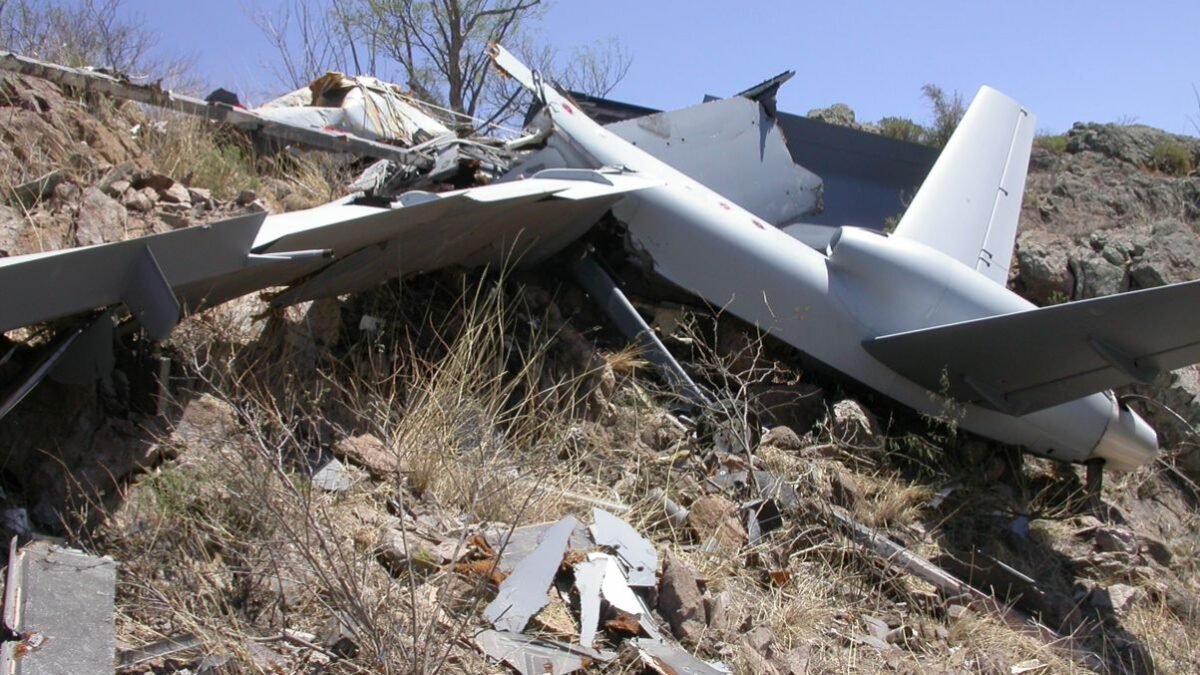
A guided bomb that falls on a market in North Darfur was manufactured by a state-owned corporation in one country, sold to a government in a second, moved onward to a third in breach of an embargo, mounted on an aircraft operated by a paramilitary force that denies the strike, and flown from a runway that no inspector will visit. Each of those steps is legal, deniable, or unobservable in isolation. Assembled, they produce a dead civilian and no defendant. This is the arrangement that now governs the fastest changing part of African warfare, and it was not built by accident.
The scale is no longer marginal. The UN High Commissioner for Human Rights reported in May 2026 that drone strikes had killed at least 880 civilians in Sudan between January and April, accounting for more than 80 percent of all civilian deaths in the war during that period. By June the figure for the first five months of the year had passed 1,000. In eastern Democratic Republic of Congo, ACLED recorded 65 drone strikes in the first five months of 2026, exceeding the 56 logged across the whole of 2025. The mid-cost armed drone has become the primary instrument by which civilians die in two of the continent’s largest conflicts.
What makes this a structural story rather than a casualty story is the gap between how the weapon arrives and how the law is written. Arms-control architecture was designed around finished platforms with serial numbers, declared state exporters, and named end users. The drone economy runs on modular components, commercial airframes, civilian-registered cargo flights, maintenance contractors, and re-export through intermediaries. The regime monitors objects. The market has moved to services.
The Chain Crosses More Borders Than the Investigation Can
Amnesty International’s May 2025 investigation into weapons used by Sudan’s Rapid Support Forces provides the clearest documented instance of how the sequence works. Analysing imagery of strike remnants, the organisation identified fragments of a Norinco GB50A guided aerial bomb, manufactured by the Chinese state-owned defence corporation, recovered after an RSF drone strike near al-Malha in North Darfur on 9 March 2025 in which 13 people were reported killed. It was the first time that munition had been documented in active use in any conflict anywhere. Amnesty concluded the weapons had almost certainly reached Sudan through re-export by the United Arab Emirates, in breach of the UN arms embargo.
Read that sequence as an accountability problem rather than a scandal. The manufacturer sold to a sovereign purchaser under a licence that was, on its face, valid. The purchaser is not the party alleged to have used the weapon. The user denies the strike and is not a state. The transfer between purchaser and user leaves no customs record either party is obliged to publish. Every link is separately defensible, and the responsibility that should attach to the whole never attaches to any part of it. Fragmentation is not a side effect of this supply chain. It is the product.
Impunity here is not the failure to prosecute after the strike. It is the deliberate division of responsibility before the weapon reaches the runway.
What the Remnants Can and Cannot Establish
Open-source forensic work has become remarkably good at the first half of the chain and remains largely blind to the second. Fragment analysis can establish a manufacturer with high confidence, because casings, fuse assemblies, and guidance fins carry identifying features. Satellite imagery can establish that an airstrip has been extended, that hangars have appeared, that aircraft of a given size are present. Flight tracking can establish that cargo aircraft moved between two airfields.
None of that establishes who paid, who brokered, who signed the end-user certificate, or who trained the operator. Those facts live in company registries, contracts, and bank records held in jurisdictions with no obligation to open them to a UN panel. The evidentiary standard required to designate an individual or entity under a sanctions regime is far higher than the standard required to publish a credible investigation, which is why so much documented conduct produces so few designations. Investigators can prove the weapon. They cannot reach the transaction.
The Embargo Expires Before the Panel That Monitors It
The formal machinery reveals its own priorities through its calendar. The Darfur arms embargo, converted in 2023 from an open-ended measure into a time-limited one, is in force until 12 September 2026. The Panel of Experts that monitors it, whose mandate was renewed by Security Council Resolution 2791 in 2025, runs until 12 October 2026. The monitoring body outlives the rule it monitors by a month, a misalignment that Council members have themselves noted is unique to this regime.
The geography is narrower still. The embargo applies to Darfur, not to Sudan. A war that has consumed Khartoum, Gezira, and Kordofan is governed by a restriction drawn around a region for a conflict that ended two decades ago. The UN human-rights office located most of this year’s drone deaths in Kordofan, which sits outside the embargoed area entirely. A measure that expires on a fixed date, covers a fraction of the territory, and is monitored by a body whose own mandate is renewed in annual increments is not a constraint on the arms trade. It is a scheduling exercise.
The Ledger Runs in Both Directions
Any account of drone proliferation in Africa that ends with foreign suppliers has stopped halfway. Of the 65 strikes ACLED recorded in eastern DRC in the first five months of 2026, 46 were attributed to the Congolese armed forces and 19 to AFC/M23. The larger user of armed drones in that theatre is the internationally recognised government, striking territory it claims as its own, in a conflict where the rebel coalition has publicly declared strikes launched from Kisangani airport a red line after civilian deaths. Sudan’s army and the RSF have both acquired and used the capability.
The same forensic standard has to fall on all of it. A government that acquires strike capability without acquiring a casualty-investigation capability has made a choice about what it intends to be accountable for. An external patron that supplies the airframe and the munition while denying the relationship has made the same choice at one remove. A manufacturer that treats an export licence as the end of its due diligence has made it a third time. None of these actors is entitled to the protection of the others’ silence, and the report of any one of them is incomplete without the other two.
What Would Actually Close the Gap
The instrument this system lacks is unglamorous and specific: an African drone-casualty and component registry built to evidentiary rather than journalistic standards. It would hold serial numbers and casing marks, geolocated strike imagery, casualty documentation, component origin, and declared end user, in a form admissible to UN panels, national prosecutors, and export-control authorities. It would be populated by the states that are being struck, which are the only actors with lawful access to the wreckage and the bodies, and which currently surrender that evidence to whoever arrives first with a camera.
Such a registry does not require anyone’s permission. It does not depend on a Security Council that has spent three years unable to align an embargo with the war it governs, and it does not depend on manufacturers volunteering their customer lists. It converts the one asset African states hold in this system, physical custody of the evidence, into the one thing the supply chain cannot route around: a documented, jurisdictionally anchored record that follows a component backwards through every hand that touched it.
The wider verdict is that Africa is not merely receiving this technology. It is where the world is learning what the technology means when air defence is thin, attribution is contested, and sanctions enforcement is a calendar entry. Every state watching Sudan and eastern Congo is drawing conclusions about how much military effect can now be purchased without a defence industry, an air force, or a declaration of war. The market has already priced that lesson. The law has not, and the distance between the two is measured in the number of people who die before anyone can say, to an evidentiary standard, who sent the aircraft.