
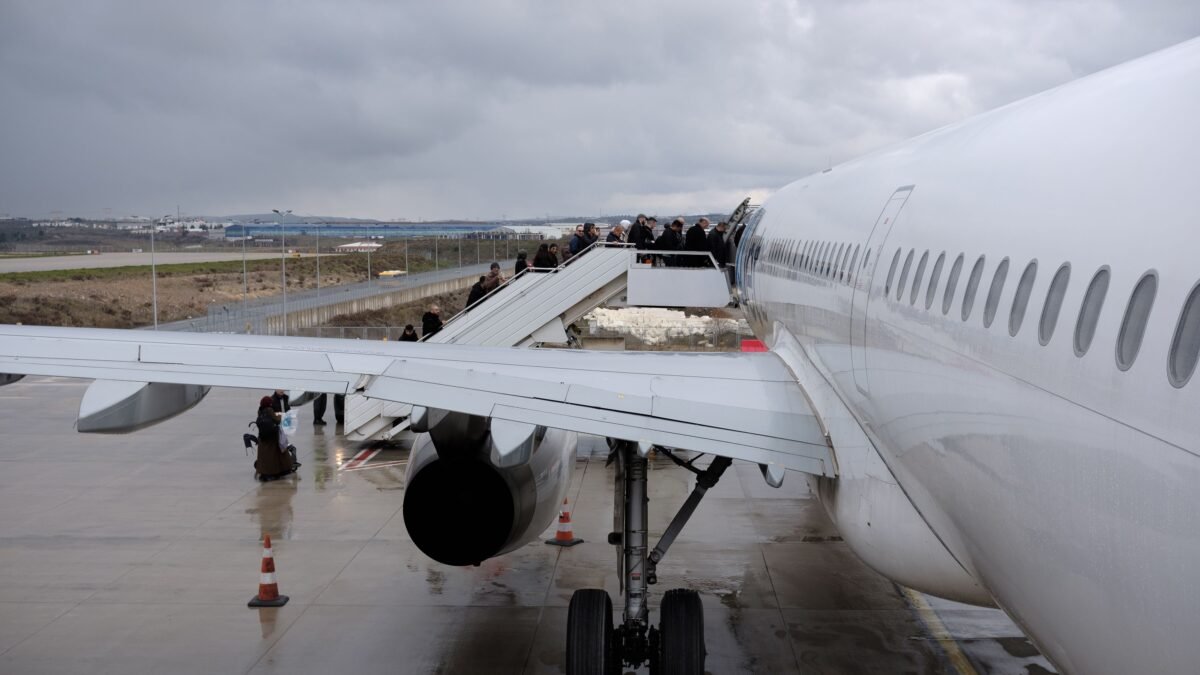
A plane carrying the first group of third-country deportees from the United States landed at Roberts International Airport outside Monrovia on 20 August. Liberian officials said about twenty people were aboard. Roughly fifteen walked off. Five did not. Three Cuban men, a Brazilian man and a Cameroonian woman stayed in their seats and refused to disembark in a country none of them had any connection to. They were told the aircraft would take them back to the United States. It flew to Malabo, where they were removed against their will and are now held alongside more than thirty other people the administration had sent to Equatorial Guinea earlier.
The flight is the opening instalment of an agreement under which Liberia will accept up to 1,200 third-country nationals over twelve months, one of the largest such arrangements Washington has concluded on the continent. Monrovia says the deal is not a quid pro quo, that arrivals may leave Liberia or apply for asylum there, and that the country will receive assistance to administer the programme and strengthen its own migration system. Liberia’s information minister has said the people sent will largely be Latin American nationals, including Cubans and Venezuelans.
Those five seats show what the arrangement actually is. Most people in this category are not being returned home. They hold findings from United States immigration judges that they face torture or serious abuse in their countries of origin, which is precisely why they cannot be sent there. Washington’s legal problem is not transport. A court has said these particular removals are barred. A third country solves that problem by supplying a destination the ruling does not name.
Washington’s legal problem is not transport. It is that a court has said these particular removals are barred.
What Liberia is selling, then, is not land, minerals, or a base. It is a jurisdiction. The commodity is the willingness to be somewhere else, and its value comes entirely from the fact that a court in another country has closed the alternatives. That is a genuinely new line of African export, and it should be named accurately rather than filed under migration cooperation. Monrovia is being paid, in assistance and in goodwill, for accepting the consequences of a legal constraint on a government that is not its own.
The diversion to Malabo is the part that should concern anyone who signed. Liberia’s stated terms include the right to leave and the right to seek asylum, which are meaningful commitments and are more than several comparable arrangements offer. Five people declined the arrangement at the door, and the response was not to return them to the sending state or to hold them in Liberia while their position was resolved. Instead, they were to find a second African country with fewer stated conditions and put them off the plane there. Liberia’s protections did not fail. They were routed around that afternoon by moving the aircraft.
That mechanism is worth watching more closely than the headline number. An arrangement of this kind creates an incentive to hold the softest available terms, because the operator can select the destination at short notice and the person aboard has no standing to object in either place. Equatorial Guinea publishes no comparable commitments on asylum access or freedom of movement, and has already accepted more than thirty people through the same channel. A continent that hosts several of these agreements at once does not get a market in migration cooperation. It becomes a competition in which the state offering the fewest guarantees gets the hardest cases.
African governments entering these deals have real reasons to do so. Liberia’s relationship with Washington is old and consequential, its fiscal position is tight, and a country that takes the call gets other calls returned. Weighed against that, the immediate cost looks small, because it is measured in the arrival of a few dozen people at a time. The cost that is not small is the precedent that a bilateral understanding can determine where a person ends up after a court has ruled on where they may not be sent, with the ruling intact and the person elsewhere.
The measure of this programme over the next twelve months will not be whether 1,200 people arrive. It will be whether the terms Monrovia published, the right to depart, the right to apply for asylum, and the support for its own migration system survive contact with the operational reality that produced Malabo. On the evidence of the first flight, the terms held for fifteen people and were bypassed for five, and the bypass took a few hours and one change of flight plan.