The Nile’s waters are governed today by agreements that Egypt’s colonial administrator and a country called Sudan, not yet an independent state, signed in 1929. A follow-on arrangement in 1959 divided the river’s flow between Cairo and Khartoum. Neither Uganda, Ethiopia, Tanzania, Kenya, Rwanda, Burundi, the Democratic Republic of Congo, nor South Sudan was invited to the table. Most of them did not legally exist as independent states. The arrangements they inherited bound them anyway. Africa’s most important waterway remains, nearly a century on, a colonial bequest.
The argument that these treaties should govern the Nile’s use in the twenty-first century is not a legal position. It is a power position. Egypt’s dependency on the Nile is real, existential, and documented; roughly 95 per cent of the country’s freshwater originates upstream. Cairo’s insistence that the 1929 and 1959 agreements are sacrosanct reflects genuine strategic vulnerability. But genuine vulnerability does not transform historically illegitimate agreements into valid ones. The strength of Egypt’s need does not create an obligation for ten other sovereign nations to permanently subordinate their water development to a treaty they did not negotiate and a colonial calculus they never endorsed.
The Dam That Forced the Question
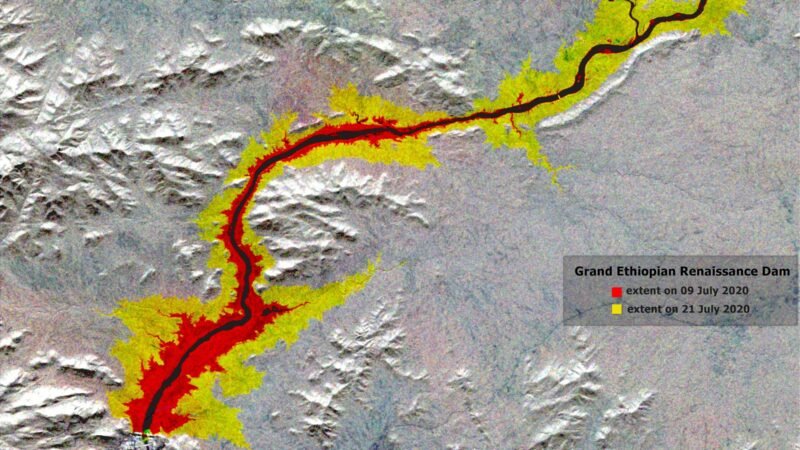
The Grand Ethiopian Renaissance Dam has sharpened this argument into a crisis. When Addis Ababa began construction in 2011, it was not acting recklessly. It was building a hydroelectric dam on a river that flows through its territory, using its own resources and financing, to power an economy of 120 million people, nearly 60 per cent of whom lack reliable electricity access [World Bank, 2023]. That is a sovereign infrastructure decision. Egypt’s objection, that the dam reduces Nile flow downstream and threatens Egyptian agriculture, is also real. But the solution to that conflict cannot begin from the premise that Ethiopia’s development must be permanently conditional on Egyptian consent, a consent granted by rules written when Ethiopia had no seat at any table that mattered.
The Cooperative Framework Agreement, signed in 2010 by six of the Nile basin’s upstream states, represents precisely the kind of renegotiation that post-colonial hydropolitics requires. Egypt and Sudan refused to ratify it. The international community, particularly Western governments with close relationships with Cairo, declined to press the matter. The result is that the most ambitious attempt yet by African riparian states to collectively govern a shared resource, through multilateral consent rather than colonial legacy, has been blocked by the downstream states whose colonial-era advantages it would have diluted. That blockage is not a diplomatic disagreement. It is a structural refusal to decolonise the river.
The Intra-African Hierarchy
What the Nile dispute reveals about power on the continent is worth stating with precision. The capacity of some African states to maintain arrangements that disadvantage other African states, arrangements built not on agreed principles but on historical accidents of imperial geography, is one of the continent’s most underexamined sources of internal inequality. Pan-African solidarity discourse rarely confronts this directly. It is easier to frame the problem as Africa versus the West, or Africa versus China, than to name the intra-continental hierarchy that allows Egypt to invoke a British-drafted agreement against Ethiopian sovereignty.
Governing the River by Consent
A genuine solution to the Nile question must begin from first principles rather than from colonial inheritance. First principle: water is a shared resource in a shared basin, and the governance of shared resources requires the consent of all parties. Second principle: historical agreements signed under conditions of colonial authority are not binding on states that did not exist when they were signed and had no representation in the process that produced them. Third principle: the development needs of upstream states, Ethiopia, Uganda, Tanzania, Rwanda, are not subordinate to the hydrological preferences of downstream states whose advantages derive from colonial arrangements. Fourth principle: any durable Nile basin agreement requires a multilateral architecture with enforcement mechanisms and dispute resolution processes that reflect the sovereignty of all eleven nations.
None of this negates Egypt’s legitimate concern about water security. Egypt is right to take the Nile seriously. It is wrong to take it on terms that were set by an empire. Cairo has the institutional capacity, the diplomatic relationships, and the financial resources to participate in a genuinely negotiated Nile Basin arrangement that addresses its security concerns without requiring upstream states to foreclose their own development. That it has not yet chosen to do so is not a reflection of the impossibility of agreement. It is a reflection of the calculation that the colonial legacy, while indefensible in principle, remains useful in practice.
Africa’s water governance future cannot be colonial hydropolitics with better press releases. The Nile belongs to its basin, to the highlands of Ethiopia where the Blue Nile rises, to the lakes of Uganda and Tanzania, to the plains of South Sudan, and yes, to the delta where Egyptian agriculture has flourished for millennia. All of those claims are real. None of them was granted by Britain in 1929. The continent that insists on rewriting the rules of its political economy with the world will need, eventually, the will to rewrite the rules it has inherited for itself.
This is the part of the Nile story that pan-African rhetoric is least comfortable holding, because the obstacle is not in London or Washington but in Cairo. The colonial powers drafted the treaty; an African state now enforces it, against other African states, with the full knowledge that the document is indefensible in principle and useful in practice. To name that honestly is not to single Egypt out for blame; its water dependence is real, and its fear is rational, but to insist that decolonisation cannot be a slogan applied only to the relationship with the former coloniser. At the same time, a colonial instrument is preserved intact within the continent. A river cannot be half-decolonised. Either the basin is governed by the consent of all eleven nations that share it, or it is governed by an empire that no longer exists, through the one heir willing to keep its bequest alive. Africa has spent a century demanding that others surrender the advantages history handed them. The Nile is where it must ask the same of itself.