Nigeria’s N47 trillion budget for 2025, the largest in the country’s history, arrived with the predictable apparatus of expectation: announcements of transformational investment, declarations of intent on education, health, and infrastructure, and the procedural optimism that attends every iteration of a document that has spent three decades promising more than it delivers. The record size of the allocation is not the story. The story is what the record reveals: that Nigeria’s development problem has never been a shortage of budgeted funds, and growing the number does not change the system that ensures most of what is budgeted does not become what is built.
Between 2020 and 2024, according to the Budget Office of the Federation’s own accounting, well over 40 per cent of Nigeria’s federal capital allocations remained unexecuted. Projects in health, education, and transport infrastructure were announced, funded on paper, and abandoned in practice. The pattern is not new and is not limited to a particular administration; it has been consistent across successive governments, in both military and civilian configurations, across periods of oil boom and oil bust, suggesting that the execution failure is structural rather than contingent on leadership or the economic cycle.
The budget is no longer a statement of priorities. It is a spreadsheet of political interests, and the distance between those two things is where Nigeria’s development gap lives.
The Budget as Political Economy
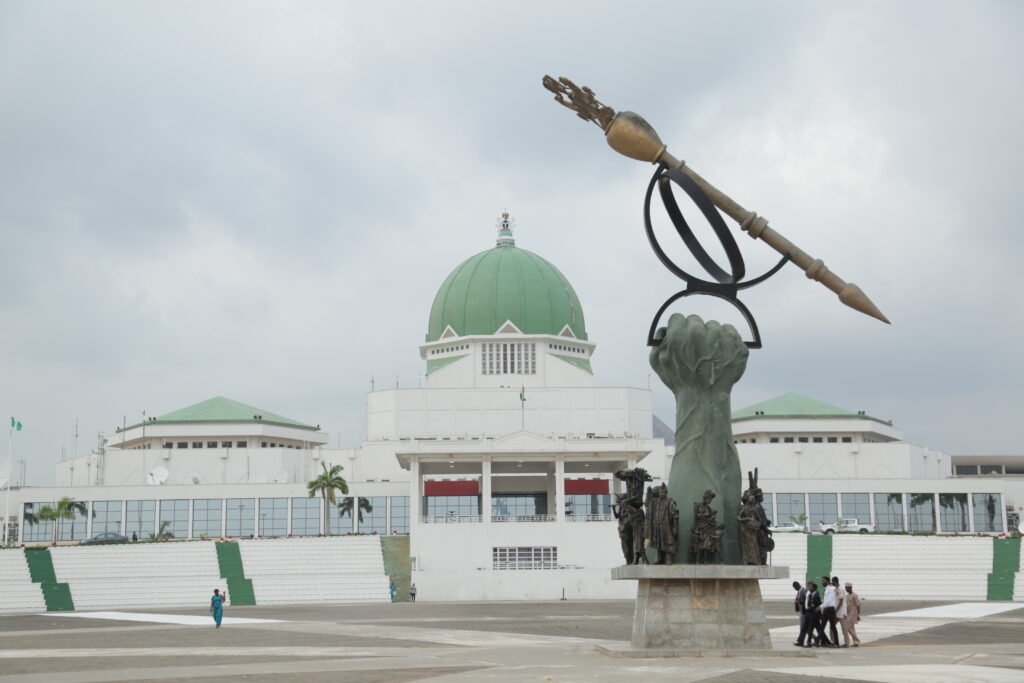
The 2024 controversy over Senator Abdul Ningi’s claim that the National Assembly’s budget contained N3.7 trillion in padding exposed what experienced observers of Nigerian fiscal politics already understood: the budget process is not primarily a planning instrument. It is a political economy, in which the presentation of large numbers serves the political interests of executives who want to demonstrate ambition, legislators who want to insert constituency projects and extract procurement rents, and contractors who have built entire business models around the gap between allocation and delivery. The system does not accidentally fail to execute projects. The gap between appropriation and execution is, for many participants, the point.
When Debt Service Crowds Out
The N47 trillion figure for 2025 includes a debt service component that has grown to consume a disproportionate share of revenue, a direct consequence of borrowing at rates that reflect both Nigeria’s risk position and a global interest rate environment that tightened significantly after 2022. When debt service crowds out recurrent spending, and recurrent spending crowds out capital investment, the headline budget number becomes increasingly disconnected from the investment envelope that actually reaches productive activity. The larger the number, the more dramatic the gap between the announcement and the reality that citizens encounter in underfunded hospitals, unlit roads, and classrooms that have not seen a renovation budget in years.
The Regional Warning
The Pan-African context matters here. Kenya’s 2024 Finance Bill protests, which forced a partial reversal of the government’s fiscal program, demonstrated what happens when the gap between fiscal rhetoric and citizen experience becomes politically unsustainable. Ghana’s debt restructuring process, under IMF programme conditions since 2023, exposed how years of optimistic budget projections, combined with off-budget borrowing and revenue shortfalls, could produce sovereign insolvency faster than the official numbers suggested. Nigeria’s N47 trillion budget is not heading toward a Ghanaian-style crisis in the short term. Still, the structural vulnerabilities that produced Ghana’s crisis are present in Nigerian fiscal architecture: revenue over-projection, execution under-delivery, debt service crowding, and an accountability architecture that punishes whistleblowers rather than those who create the conditions they blow the whistle on.
The reform agenda is not technically complex. Open contracting standards, real-time procurement tracking, performance-linked disbursement, and civil society access to budget execution data- these tools exist and have been implemented in comparable contexts. What they require is a political environment in which the constituencies that benefit from opacity are weaker than those that benefit from accountability. Nigeria has not yet produced that political environment, and the size of the budget does not change the balance of forces that maintain the current one.
The N47 trillion budget will be passed, celebrated, and partially executed. The schools that needed renovation last year will still need renovation next year. The roads that were funded will, in practice, remain unfunded. And in 2026, another historic budget will be announced, larger, more ambitious, and equally disconnected from the structural reform that would make any amount of money produce the outcomes Nigerians need. The problem has never been the size of the number. It is the system through which the number becomes, or fails to become, a country.
There is a reason the headline figure keeps growing while the schools keep crumbling, and it is not incompetence. A budget that is reliably under-executed is not a failed plan; it is a successful one, for the people the plan actually serves. The gap between the naira appropriated and the naira built is not waste leaking out of the system. It is the system’s product, the space in which the mobilisation fee is paid, the variation order is granted, the project is announced and quietly abandoned, and the same line item returns, larger, the following year. To treat the execution gap as a problem to be solved is to misread who it is solving a problem for. The number grows because growing it is profitable; the road stays unbuilt because leaving it unbuilt is profitable; and both facts will hold until accountability is made more expensive than extraction, which no budget, however historic, can legislate into being on its own.