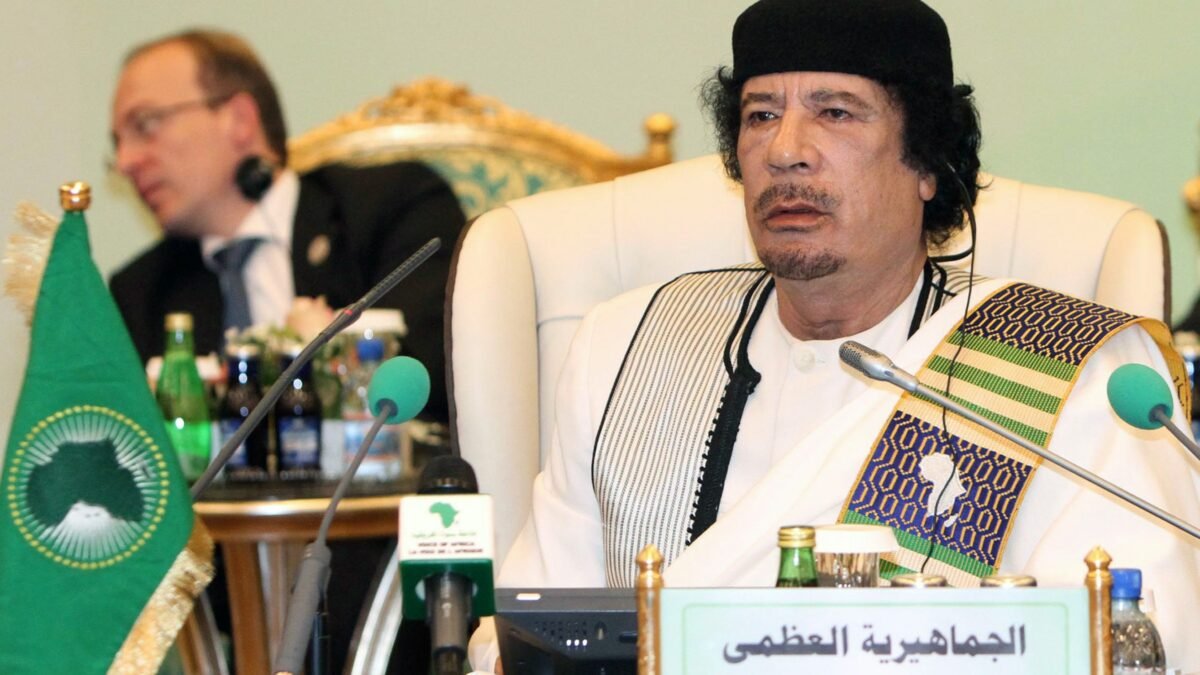
Libya does not simply mourn Muammar Gaddafi. It cannot decide, more than a decade after his death, whether it mourns him at all. That irresolution is not a cultural failure. It is the precise shape of the problem he left behind, a country whose entire architecture of continental relevance was built on a single man’s ideology, and which has had no structural replacement since the NATO-backed uprising pulled it apart in 2011.
Gaddafi’s relationship with the African Union was not philanthropy dressed as politics. It was strategy. He funded the AU’s operations at moments when Western donors were slow or conditional, positioned Tripoli as the gateway between Sub-Saharan Africa and the Mediterranean, and used Pan-Africanism as the legitimating frame for a foreign policy that gave Libya disproportionate continental influence relative to its population or economic weight. The continent needed a financier. He needed an audience. The arrangement held, until it did not.
What collapsed in 2011 was not only a regime. It was an entire theory of how one North African state could function as a continental power broker. The vacuum that followed has never been filled, not by the Government of National Accord in Tripoli, not by the Libyan National Army in the east, and not by the international community, which exhausted its intervention energy at the moment of regime change and found no appetite for the reconstruction that followed.
A State Built Around One Man
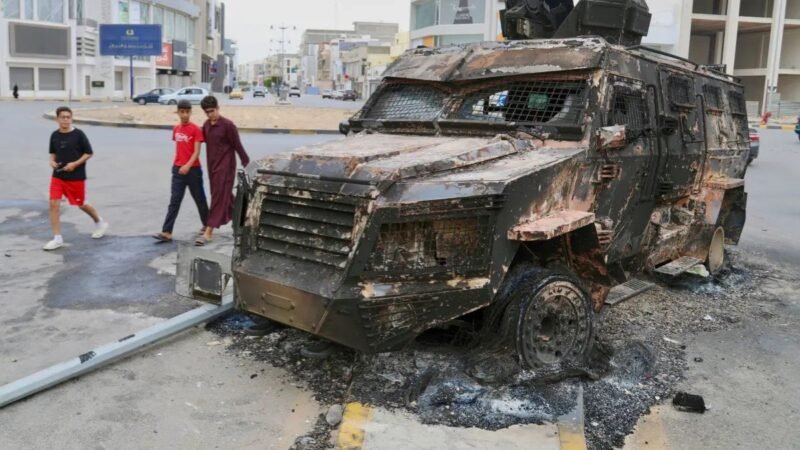
The reason the vacuum proved permanent lies in what Gaddafi had built and what he had refused to build. He governed through a web of personal loyalty, tribal balance, and patronage that ran upward to him and nowhere else. He did not construct a bureaucracy that could outlast its founder, because a bureaucracy with its own authority would have been a rival. A state organised entirely around one man is efficient while the man stands and worthless the moment he falls, like a tent held up by a single pole: remove it and the whole structure is not weakened but flattened. When NATO removed the pole, there was no second pole, no institutional spine, no civil service loyal to an idea rather than a person. The country did not transition. It simply lost the only thing holding it upright.
The Spillover
The consequences extend far beyond Libya’s borders. The weapons depots that fell open after Gaddafi’s death, stocked over four decades of unaccountable military procurement, became the supply lines for conflicts across the Sahel. Arms from those stockpiles have been traced to Mali, Niger, and Sudan. The destabilisation of Libya did not stay in Libya. It moved with the weapons, following the routes that Gaddafi’s security apparatus had once controlled and which no successor government has been capable of monitoring, let alone closing.
The vacuum also priced itself on the open market. Into the space where a state should stand came the external patrons, Turkish drones and Gulf money behind one faction, Russian contractors and Egyptian interests behind another, each backing a Libyan side not to end the fracture but to hold a position inside it. Libya ceased to be an actor in its own crisis and became an arena for other people’s contests, which is the terminal stage of institutional collapse: sovereignty reduced to a venue.
Inside Libya, the fracture is structural. Two governments, multiple armed factions, and a coastline that has become the primary embarkation point for irregular migration toward Europe, these are not temporary features of a post-conflict transition. They are the settled condition of a state whose institutions never developed independence from the man who ran them. Gaddafi did not build a bureaucracy. He built a system of personal loyalty, and when the person at its centre was removed, the system had nothing to hold it together.
What the AU Could Not Do
The AU has been unable to play the role that Gaddafi once paid for it to occupy. The organisation that he championed financially became diplomatically irrelevant to his own country’s fate the moment the Western military operation began. The African Union called for a ceasefire that was ignored by NATO and by the rebel factions that NATO supported. That episode revealed something about continental institutions that has not been honestly reckoned with: external powers will determine the trajectory of African states when those states have not built the internal institutions capable of asserting sovereign resistance to external pressure. An AU funded by one member’s largesse was never going to constrain the powers that removed him.
Libya now sits at the intersection of three crises, a governance deadlock that its own political actors cannot resolve, a migration crisis that European states are willing to fund border enforcement to manage but not to address at its roots, and a security vacuum that has become a structural variable in Sahel instability. None of these crises arrived randomly. Each one is the direct consequence of what was destroyed in 2011 and what was never built in its place.
Gaddafi was not a model of governance. His record on political repression, on arbitrary detention, on the systematic elimination of political opposition, requires no rehabilitation. But the question that Libya forces onto the table is different from the question of whether Gaddafi was a good leader. The question is what happens to a continental order when one of its financing pillars is removed by external military force, without a plan for what replaces it. Africa is still living inside the answer, and the answer is written in the arms that crossed the Sahara and the institutions that were never built to replace a man.