
Ghana received a significant boost to its economic recovery narrative this week after Fitch upgraded the country’s sovereign credit rating, citing fiscal consolidation, lower inflation, progress on debt restructuring, and improving reserves. For a government seeking to demonstrate that painful economic reforms are beginning to stabilise the economy, the announcement marked an important moment of international financial confidence. Then, almost simultaneously, another story emerged from Ghana’s cocoa sector, and it complicated the optimism in ways that a ratings upgrade cannot resolve.
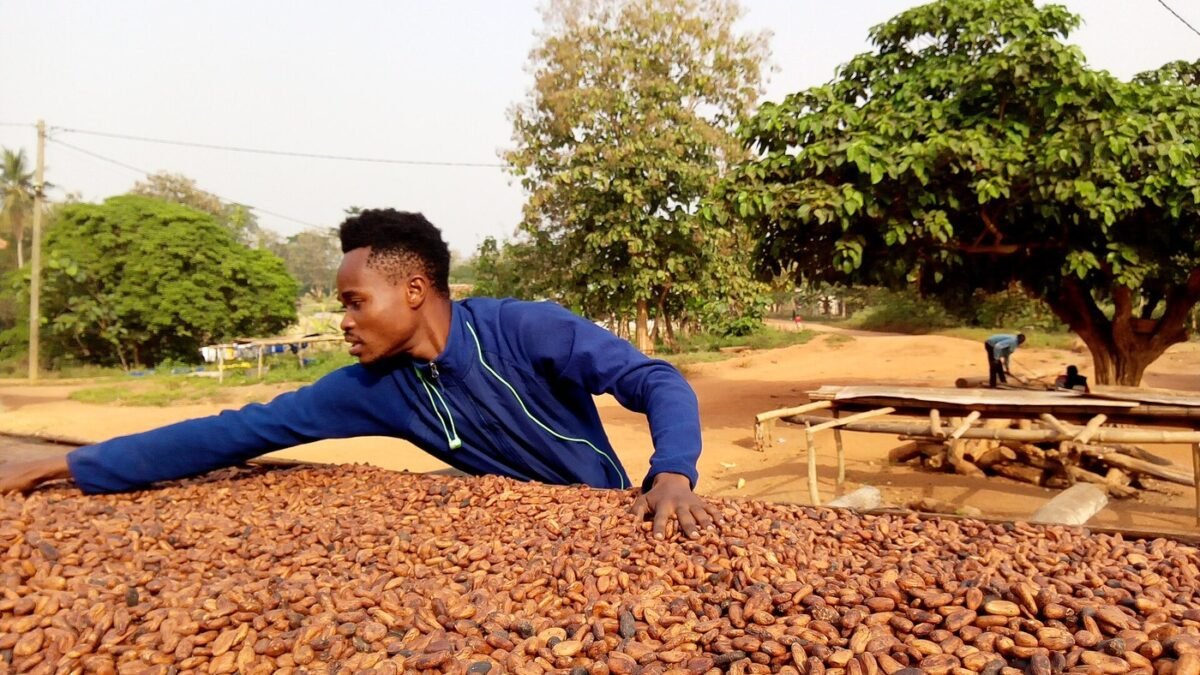
The state-linked Produce Buying Company was facing severe debt pressure. Farmers remained unpaid for cocoa they had already delivered. The contrast between the two developments revealed a deeper tension inside Ghana’s recovery story: the distance between what sovereign stabilisation looks like in a bond market and what it feels like at the farmgate. That distance is not a rounding error. It is the structural problem Ghana’s recovery narrative has not yet answered.
At the macro level, the country is gradually rebuilding credibility after a painful debt crisis that forced restructuring negotiations, austerity measures, and International Monetary Fund intervention. Inflation has eased from earlier peaks, fiscal management has tightened, and investor sentiment has cautiously improved. But recovery at the sovereign level does not automatically translate into immediate relief for rural livelihoods and commodity supply chains. Cocoa is not a peripheral sector. It is central to Ghana’s export earnings, rural economies, local commerce, and national political stability. When financing stress within the cocoa chain disrupts payments to farmers, the effects extend far beyond agriculture.
To understand why the strain lands on the farmer first, follow the structure of the chain itself. COCOBOD operates a centralised model: it pre-finances the season, sets a guaranteed farmgate price, and aggregates the crop for export. That model is only as durable as the financing architecture behind it, and that architecture is built on borrowing against a harvest that has not yet been sold. When global prices swing, when production undershoots, or when credit tightens, the guaranteed price does not disappear. It becomes a deferred promise, and the farmer becomes the involuntary lender of last resort, financing the state’s liquidity gap with his own unpaid labour. The buffer that protects the system from shocks is the household least able to absorb one.
The deeper asymmetry sits one layer above national accounting. Ghana exports beans; the margin lives offshore. The grinding, processing, and branded confectionery that convert a raw commodity into consumer value are concentrated in firms far from the Ashanti farms that grow the crop. Ghana controls the asset and the risk while the value is captured downstream, in markets it does not set and currencies it does not print. A farmgate squeeze in a cocoa-growing district is therefore not only a domestic financing problem. It is the visible local symptom of a position in the global value chain that decades of policy have left largely unchanged. Commodity dependence is not a fact of nature. It is a structure with beneficiaries, and the beneficiaries are not in Kumasi.
The problem is especially significant because Ghana’s recovery strategy depends heavily on restoring confidence in state institutions and economic management. Delayed payments and mounting debt inside a critical sector risk undermining that confidence even as headline indicators improve. Economic stabilisation may be evident in bond markets before it is evident in farming communities, and that lag is where political fragility lives. International ratings agencies, lenders, and investors focus on fiscal discipline, reserve strength, and debt sustainability. Citizens experience recovery through prices, wages, employment, and the reliability of payments. The two realities do not always move at the same speed, and in Ghana’s case, they are demonstrably moving at different speeds right now.
Ghana’s cocoa sector holds symbolic importance that compounds the practical stakes. Cocoa has long served as both an economic engine and a political stabiliser, helping sustain rural economies while generating foreign exchange. The cocoa belt is also a political constituency, and a pod that ripens on the branch while the cheque does not arrive is a grievance with an address and a ballot. Persistent stress within the chain raises questions about how resilient traditional commodity structures remain amid inflationary pressures, financing constraints, and global market volatility. When the architecture strains, the guaranteed price becomes a measure of how much risk the state can quietly transfer to the people who can least refuse it.
The government and COCOBOD have announced reform measures and funding support to stabilise the industry. But the latest developments suggest that liquidity pressure remains severe, and that the reforms have not yet reached the operational level where farmers are made whole. Even countries showing signs of macro recovery continue to face vulnerabilities inside sectors that directly support household survival and employment. Ghana is demonstrating this precisely: sovereign stabilisation and sectoral distress are not mutually exclusive. They are, in fact, structurally predictable companions in any post-crisis recovery that addresses the balance sheet before the supply chain.
The significance of this week’s developments goes beyond the ratings upgrade alone. It highlighted the increasingly uneven character of recovery across parts of Africa’s economy. Sovereign stabilisation restores confidence internationally. Domestic resilience is tested much closer to the ground, in whether farmers are paid, supply chains function, and livelihoods recover alongside the numbers. For Ghana, the challenge now is not simply proving that economic repair has started. It is proving that recovery can move beyond balance sheets and reach the systems that ordinary citizens depend on most. That proof requires more than an improved credit rating. It requires a functioning cocoa chain, and right now, the chain is not functioning.