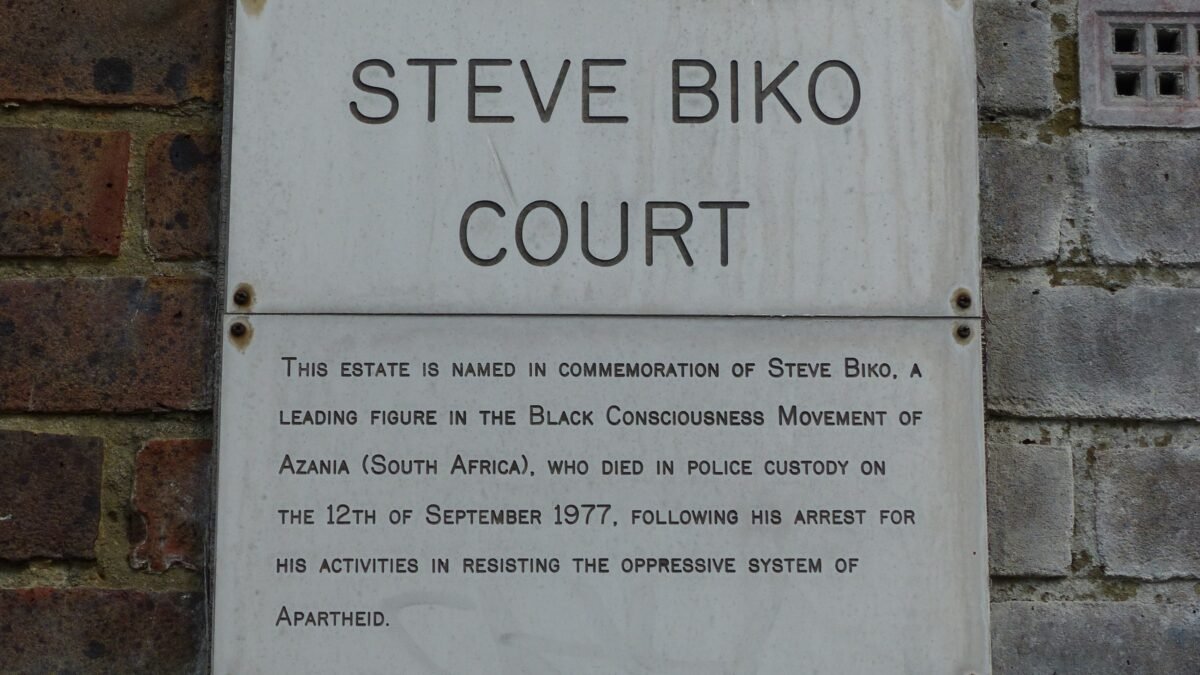
In the bone-dry winds of August 1977, the apartheid state committed one of its defining crimes. On 18 August, Steve Bantu Biko, the man who had diagnosed apartheid’s deepest instrument as the colonised mind, was arrested at a roadblock near King William’s Town. Within twenty-six days, he was dead. The cause was brain damage sustained during interrogation in Port Elizabeth’s security police offices. He was thirty years old.
The state’s account of what happened changed several times. It settled eventually on the claim that Biko had injured himself in a scuffle. No officer was ever charged. The inquest magistrate ruled, with a detachment that itself constituted an act of violence, that no one could be held criminally responsible. What had been done to Biko in Room 619 of the Sanlam Building remained officially obscure for another decade and a half, until the Truth and Reconciliation Commission drew testimony from the officers present. What they described was systematic, deliberate, and known to senior officials.
The journey from that interrogation room to the grave is its own testimony. After sustaining serious head injuries during interrogation, Biko was driven naked on the floor of a Land Rover for over twelve hundred kilometres from Port Elizabeth to Pretoria, shackled, comatose, without medical intervention. He died in a Pretoria prison cell on 12 September 1977. Minister of Justice Jimmy Kruger, informed of his death at a Transvaal National Party congress, told the delegates that it “left him cold.” The crowd reportedly laughed.
The context of his arrest was a state under pressure. The Soweto Uprising of June 1976 had shattered the pretence of managed apartheid. The international isolation of South Africa was intensifying. Biko, restricted since 1973 to the King William’s Town district by banning orders that prohibited him from speaking publicly, writing for publication, or entering any premises where more than one person gathered, had spent those years quietly building the Black Community Programmes, literacy projects, health clinics, home industries. He was constructing, under the state’s nose, the infrastructure of a liberated Black South African life. The security police understood what was happening even if they could not articulate it in those terms. He was arrested travelling with Peter Jones, a fellow activist, on the road between Cape Town and Port Elizabeth.
What died on 12 September 1977 was a body. What did not die was more consequential. The writings Biko produced under his pen name Frank Talk, collected and published posthumously as I Write What I Like, edited by his friend Donald Woods, became one of the defining texts of African liberation thought. His argument was precise: the oppressor’s most durable weapon is the psychological submission of the oppressed. Freedom begins when that submission ends. The Soweto generation had already demonstrated, through its defiance under fire on 16 June 1976, that the submission was breaking. Biko’s murder, rather than closing that rupture, deepened it.
The international response was significant and, in one key dimension, precedent-setting. The United Nations Security Council passed Resolution 417 in November 1977, calling for a mandatory arms embargo against South Africa, the first such mandatory arms embargo in UN history. His death had done what decades of lobbying had struggled to accomplish. It had made the moral case for isolation undeniable even to governments that had preferred comfortable ambiguity.
Within South Africa, the effect was not immediate revolution but an irreversible moral repositioning. The young people who had marched in 1976, many of them now in exile, in prison, or underground, carried the Black Consciousness framework with them into the next decades of struggle. Organisations like the Azanian People’s Organisation kept the tradition alive through the 1980s even as the United Democratic Front and, eventually, the unbanned ANC repositioned the liberation movement’s centre of gravity. The ideas did not belong to any organisation. They belonged to a generation.
The legal reckoning came slowly. In 2021, a South African court overturned the original inquest finding and ruled that Biko’s death was caused by acts of the security police amounting to an offence. No prosecution followed; the officers responsible had died or were shielded by time and circumstance, but the legal record was corrected. South Africa’s long, painful, incomplete process of acknowledging what was done in apartheid’s name moved, by one more measured step, toward honesty.
Steve Biko’s death is often narrated as a martyrdom, and in the classical sense it was. But the more precise word is a revelation. His murder revealed, without ambiguity, what apartheid actually was beneath its administrative language and legal pretence: a system maintained by violence that tolerated no challenge to its authority over African minds. He had challenged that authority at its root. The flame that he carried, the insistence that Black people did not need permission to regard themselves as fully human, could not be extinguished by the people who killed him. It is still burning.