
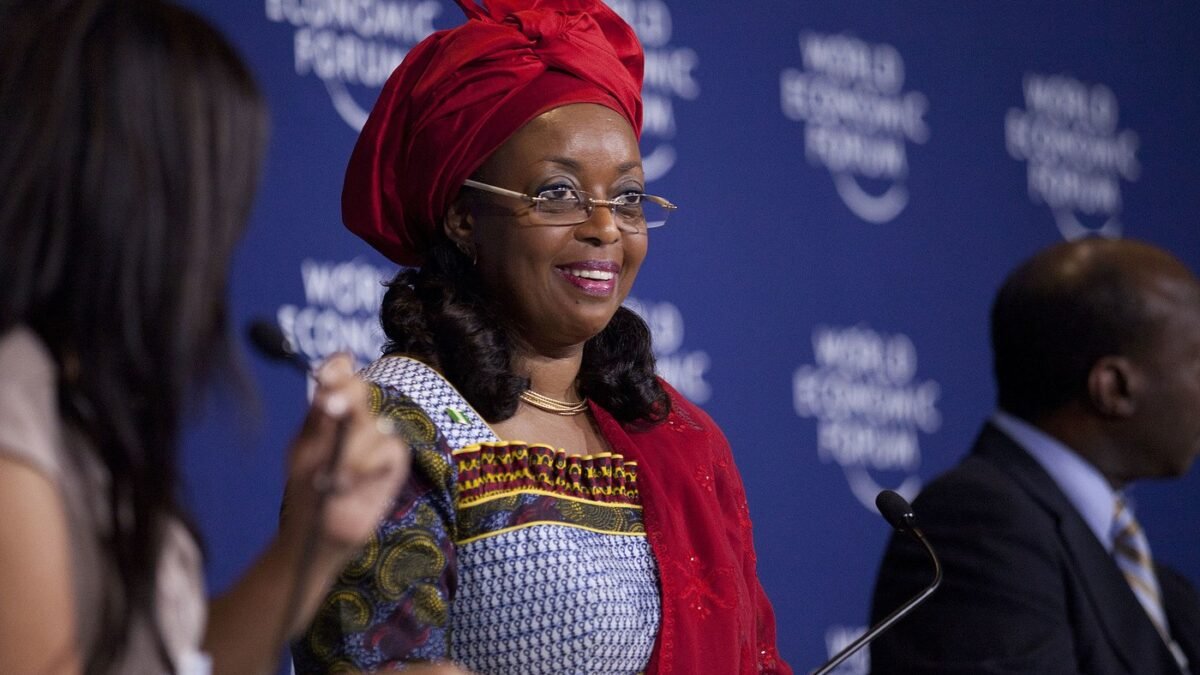
A London courtroom is hosting something that Abuja could not produce: a reckoning, however partial, with Nigeria’s petro-state years, and the woman at its centre, former petroleum minister Diezani Alison-Madueke, is denying everything, which is her right, while the prosecution’s evidence describes a system in which everyone was implicated in something.
The trial began in London in 2025, brought by the UK’s National Crime Agency. Alison-Madueke faces charges of conspiracy to give corrupt payments, bribes, the prosecution alleges, paid to oil traders in exchange for the awarding of crude oil lifting contracts during her tenure as Nigeria’s Minister of Petroleum Resources from 2010 to 2015, when she simultaneously served as President of OPEC. The amounts alleged are substantial. The contracts involved were worth hundreds of millions of dollars. The individuals named as co-conspirators span multiple jurisdictions, and the money flows alleged, through offshore accounts, shell companies, and correspondent banking networks, trace exactly the kind of architecture that Nigeria’s oil industry generated at industrial scale during the Jonathan administration years.
Alison-Madueke has pleaded not guilty. Her legal team has challenged the jurisdiction, the evidence chain, and the characterisation of commercial relationships that she maintains were legitimate arrangements between a sovereign ministry and private sector counterparties. These are credible legal arguments in the context of a UK criminal trial, where the burden of proof rests with the prosecution and where the extraterritorial application of UK anti-bribery law to the conduct of a foreign government official requires careful evidentiary construction.
A London courtroom is hosting what Abuja could not produce: a reckoning with Nigeria’s petro-state years. The trial is not only about one individual. It is about whether the system that made those individual decisions possible will ever face a structural accounting.
The Nigerian dimension of the proceedings is as significant as the legal one. Nigeria’s EFCC has been investigating Alison-Madueke since 2015, when her departure from office coincided with the Buhari administration’s determination to build an anti-corruption case out of the Jonathan years. A decade of EFCC investigations produced asset freezes, international asset recovery cooperation through the NCA and the US Department of Justice, and a series of disclosed discrepancies in NNPC’s crude lifting accounts. What they did not produce, in Nigeria, was a prosecution. The London trial represents, in effect, the British legal system doing what the Nigerian legal system, for reasons that are structural, political, and institutional, was unable to complete.
That asymmetry is itself a story worth examining. The NCA’s ability to pursue Alison-Madueke in a UK court rests on the fact that the alleged bribe payments transited through the UK financial system and involved UK-regulated entities. The Bribery Act 2010 provides extraterritorial jurisdiction for conduct involving UK persons or UK territory. Nigeria’s Corrupt Practices and Other Related Offences Act provides jurisdiction for conduct affecting Nigeria, but its application in cases of this complexity has been impeded consistently by the capacity gap between the EFCC’s investigative resources and the opacity of the offshore financial architecture through which the alleged proceeds were moved.
The wider political economy question the trial surfaces is about the oil era itself. Alison-Madueke served during a period when Nigeria’s crude production hovered between 2.1 and 2.4 million barrels per day and global oil prices were at or near historic highs. The revenues flowing through NNPC during those years represented the largest sustained resource transfer in Nigeria’s post-independence history. The question of where those revenues went, into infrastructure, into development, into legitimate government expenditure, or into private accounts through exactly the mechanisms the prosecution is describing, sits underneath Nigeria’s current fiscal position. The country that borrowed heavily during an oil boom to fund consumption rather than transformation is now managing a debt service ratio that consumes more than seventy percent of federal revenues [IMF 2024]. The trial does not address that macro-level accountability. It addresses one individual’s alleged conduct. But the individual was at the apex of a system whose aggregate decisions produced the fiscal inheritance Nigeria is now managing.
For the Nigerian public, the London proceedings carry a particular weight. A woman who was, by most accounts, one of the most powerful figures in the Nigerian state for five years, whose access to presidential authority was unquestioned, whose personal lifestyle generated sustained reporting, is standing before a jury in a country that was not harmed, being prosecuted under a law that was designed to protect British interests. The National Crime Agency is pursuing this case because British financial institutions were used. Nigeria, the country whose oil wealth was allegedly diverted, has provided cooperation and asset recovery data but could not sustain its own prosecution to trial. That is not a critique of individuals. It is a description of a system, of what resource wealth does to institutional capacity when it flows faster than accountability can be built.
Whatever the jury decides, the trial has already demonstrated something that decades of Nigerian anti-corruption rhetoric could not: that documentary evidence of the system’s operation exists, that the money can be traced, and that the financial architecture of resource extraction in the Global South is ultimately transparent to the jurisdictions where it routes its proceeds. That knowledge, properly applied, should be more consequential than any individual verdict.