Climate change has thrown a wild card into Africa’s fight against hunger, and unlike a conventional disruption, it does not recede when the season ends. The World Food Programme’s 2025 assessments documented severe harvest disruptions in key breadbasket regions across the continent, confirming what agricultural scientists had been projecting for years: the variability that African smallholder farming systems were historically designed to accommodate has crossed into irregularity that the same systems cannot sustain. Traditional open-field farming, calibrated against generations of accumulated knowledge about local rainfall patterns, pest cycles, and planting windows, is being unmade not dramatically but incrementally, season by season, yield shortfall by yield shortfall, until families are not facing a bad year. Still, a structural renegotiation with land that no longer behaves as inherited knowledge says it should.
Where the Land Stopped Obeying
In Southern Africa, Zimbabwe’s farming communities illustrate the problem with the specificity that statistics obscure. Shifting rainfall patterns and heat-fuelled pest outbreaks hammered crop yields in the Mutoko district during 2025’s growing season, a region whose agricultural output has historically been sufficiently reliable to support both subsistence and surplus sale. The whiplash of drought in one planting window followed by flash flooding in the next made timing decisions that are normally complex into gambles with survival stakes. In Eswatini, the climate stress was acute enough to drive emergency infrastructure responses: greenhouse shelters and shade nets deployed to create controlled growing conditions for crops that could no longer be reliably grown under open-sky conditions. The image of smallholder farmers moving their cultivation indoors is not a technological triumph. It is an adaptation under pressure, evidence that the open-sky farming system that has sustained African communities for millennia is being forced into retreat by atmospheric conditions it was never designed to withstand.
The Sahel’s agricultural crisis has a longer documented history and a more severe trajectory. Across the arid belt from Senegal to Sudan, the combination of reduced and erratic rainfall, expanding desert margins, and increasing temperature during the growing season has compressed the viable farming zone southward while expanding the pastoralist territory northward, a geographic compression that places herders and farmers in direct competition over land that neither can fully support without the rainfall patterns that climate change is systematically eliminating. The resource conflicts this produces are not purely political. They are climate-driven land tenure crises playing out in communities whose governments lack the fiscal capacity to manage the displacement, the food insecurity, and the intercommunity tension simultaneously.
The pattern repeats at continental scale. The countries losing arable viability fastest are also those with the least fiscal room to finance adaptation, so exposure and incapacity compound in the same places, and the map of climate risk and the map of debt distress increasingly look like one map.
Africa’s smallholder farmers are doing what their parents and grandparents taught them to do, and the land is no longer responding as those teachings predicted. That gap between inherited knowledge and altered conditions is where food insecurity lives, and it is growing.
Rebuilding for Resilience
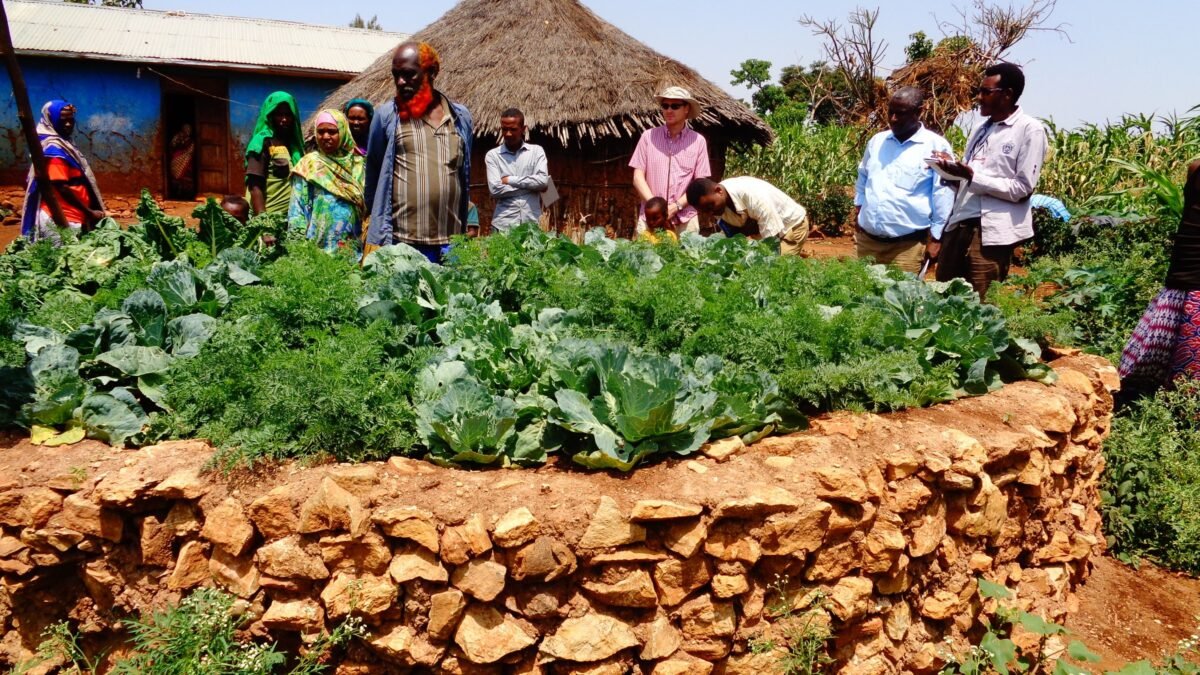
Climate-smart agriculture, the convergence of drought-tolerant crop varieties, precision irrigation, improved soil management, and early warning systems that allow farmers to adjust planting decisions in response to seasonal forecasts, represents the most operationally viable pathway through which African food systems can be rebuilt for resilience. But the transition from traditional to climate-smart farming is not a knowledge transfer problem. It is a capital problem, a seed system problem, an extension service problem, and an infrastructure problem simultaneously. Drought-tolerant cassava and sorghum varieties exist. Getting them into the hands of smallholder farmers in remote districts, backed by the agronomic support to use them effectively, requires the same institutional infrastructure- roads, credit systems, market access, government extension networks- whose absence is itself a product of the underdevelopment that climate change is now compounding.
Africa’s food security future will be determined in the granular decisions that governments make about agricultural research budgets, irrigation investment, rural credit systems, and the political will to maintain food system support when fiscal pressures from debt service, currency depreciation, and competing social expenditure push agriculture down the priority ranking. The continent that feeds itself is the continent that negotiates from strength, in climate finance discussions, in global food market disruptions, and in the domestic political compacts that define governance legitimacy. Africa’s agricultural sector is not a welfare problem to be managed with food aid and emergency distribution. It is the productive base of the continent’s sovereignty. Climate change is attacking that base directly. The response must be proportionally direct.
Food and Sovereignty
There is a sovereignty argument here that the food-aid framing actively obscures, and it is the one African governments should be making loudest. A continent that cannot feed itself negotiates everything else from weakness. Its climate-finance demands are heard as appeals rather than terms; its trade positions bend under the threat of an import bill it cannot pay; its politics is hostage to the price of bread, which is to say to a harvest now governed by a sky it does not control. Food import dependency is not merely an economic vulnerability. It is a standing transfer of leverage to whoever sells the grain, and in a fracturing global market that seller increasingly attaches conditions to the sale. To rebuild the smallholder system for a changed climate is therefore not rural welfare. It is the most basic act of statecraft a government can perform, because a state that grows its own food keeps its own counsel, and a state that does not eats on someone else’s terms.