Extreme heat is no longer a peripheral risk category in African public health planning. It is the primary threat, arriving at a pace that health ministries calibrated for earlier temperature baselines are structurally unprepared to manage. Heat-related illnesses and deaths have surged by nearly a quarter since the 1990s globally, with extreme temperatures now killing an estimated 546,000 people worldwide each year, the equivalent of one life every minute, lost not to infectious disease or armed conflict but to atmospheric conditions that human industrial activity has systematically intensified over a century. Africa, with its large rural workforce operating under direct sun exposure, its already warm baseline climate, and its chronically underfunded healthcare infrastructure, is acutely vulnerable to every dimension of this trend.
The Productivity Toll
The economic dimension of heat mortality and morbidity is as severe as the humanitarian one. In 2025, outdoor workers globally lost an estimated 639 billion hours of labour due to heat exposure, a productivity loss equivalent to over a trillion dollars in foregone economic output, according to Lancet Countdown tracking data.
In Africa’s agricultural, construction, and informal trade sectors, where outdoor work is not a choice but an economic necessity, this productivity loss falls on the workers who can least afford it and the economies least able to absorb it. A smallholder farmer who cannot work the fields during peak afternoon heat during a planting season loses yield. A construction worker who collapses mid-shift loses income and may permanently lose physical capacity. A market trader who closes stalls early during heatwave conditions loses the daily revenue that constitutes household subsistence. Heat productivity loss in Africa is not an abstraction measured in GDP percentage points. It is a daily erosion of survival margins for the majority of the continent’s working population.
A System Without Cooling
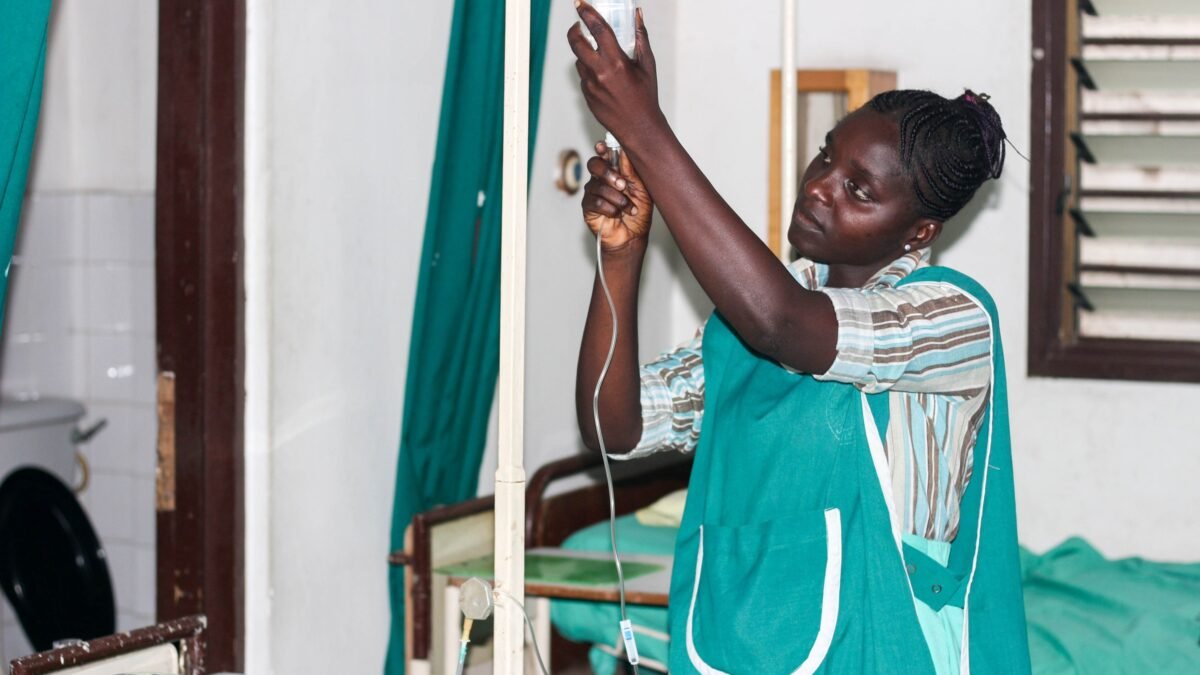
African healthcare systems are responding to this mounting emergency with infrastructure designed for a different climate era and budgets that reflect a different set of priorities. Public hospitals in Sahel cities are reporting increased presentations of heat stroke, severe dehydration, and acute kidney injury during peak summer months, straining wards that were already operating at or beyond capacity before climate-driven demand began growing. Cooling infrastructure, the hospital air conditioning, the cold chain for heat-sensitive medications, the refrigeration for blood and vaccines, is itself dependent on the reliable electricity supply that large parts of African healthcare infrastructure does not consistently receive. The climate health crisis in Africa is, in part, an energy infrastructure crisis wearing a different face.
The urban form multiplies the exposure. Africa’s cities are growing faster than any on earth, and much of that growth is informal, dense settlements of corrugated roofing that turn dwellings into heat traps at night, when the body is supposed to recover. Night-time temperature, not the afternoon peak, is what kills the elderly and the chronically ill, and it is precisely the variable that informal housing is least equipped to manage. The heat map of an African city is a poverty map with a thermometer.
Africa’s health systems are being asked to manage a climate emergency with infrastructure built for a different temperature baseline, budgets set before the emergency arrived, and electricity supplies too unreliable to run the cooling that survival now requires. This is a systemic failure, not a capacity one.
The nutrition dimension compounds the health crisis in ways that rarely register in headline statistics but define lived experience across the continent. Climate change-driven agricultural disruption, reduced yields, shortened growing seasons, increased post-harvest losses from heat and irregular storage conditions, is contributing to the food insecurity that already affected hundreds of millions of Africans before 2025’s record temperatures further disrupted harvests. Malnutrition weakens immune systems, reduces heat tolerance, and makes individuals more vulnerable to the respiratory and cardiovascular conditions that heat stress triggers. The relationship between climate, food security, and health is not a chain of discrete problems. It is a single integrated emergency expressed in the weight of children in clinics, in the anaemia counts of antenatal visits, in the reduced cognitive development of populations living on insufficient calories in increasingly hot environments.
An Adaptation Bill Written Elsewhere
African governments investing in heat action plans, early warning systems that trigger public cooling centre activations, urban tree cover and shade infrastructure, revised occupational health standards for outdoor workers, and healthcare facility solar energy systems that maintain cooling independent of grid reliability, are not spending on peripheral environmental concerns. They are investing in the functional capacity of their populations and their economies to operate in the temperature environment that already exists. The framing of climate health adaptation as a development cost misunderstands its true nature: it is the maintenance cost of human productivity in a warming world that wealthier nations warmed faster, further, and earlier than Africa did. The bill arriving at African health ministries was written by others. The obligation to pay it, and the urgency of doing so, is nonetheless Africa’s to face.
The climate health crisis is also a climate justice claim. Africa’s loss and damage at the human level, in lives lost, in labour hours forfeited, in healthcare costs incurred, is measurable, documented, and attributable to atmospheric warming generated overwhelmingly by other regions’ industrialisation. That measurability is an asset in climate negotiations that African governments have not yet converted into the adaptation finance flows and health system investment commitments that the evidence supports. The human heat toll is both a catastrophe to mitigate and an argument to make, clearly, persistently, and with the economic precision that transforms moral claims into negotiable terms.