The International Criminal Court’s decision to issue arrest warrants for Israeli Prime Minister Benjamin Netanyahu and Hamas military commander Mohammed Deif in November 2024 did not rupture the architecture of international justice. It revealed a fracture already there between the universality that international law declares and the selectivity that geopolitical power enforces.
The warrants allege war crimes and crimes against humanity arising from the 7 October 2023 Hamas attacks on Israel and from Israel’s subsequent military campaign in Gaza. The ICC Prosecutor’s application for warrants, which required and received Pre-Trial Chamber authorisation, represents the court’s most significant exercise of jurisdiction over a conflict at the centre of Western geopolitical attention since the Rome Statute’s entry into force. The reaction from Western governments that nominally support international justice mechanisms was, in several cases, opposition: the United States condemned the warrants; the United Kingdom initially questioned the ICC’s jurisdiction; Hungary declared it would not arrest Netanyahu should he visit.
For Africa, the warrants arrived with specific historical resonance, and specific strategic implications. African states and African leaders have been the primary subjects of ICC proceedings since the court’s establishment. The African Union has, at various points, collectively criticised the ICC as an instrument of Western pressure on African governments, noting the disproportionate focus on African situations relative to conflicts elsewhere. The Netanyahu warrants do not resolve this critique. But they do create a precedent that African states can now invoke, and that international justice advocates cannot easily contain within the framework of African-specific application.
The Jurisdiction Question
Israel is not a party to the Rome Statute and contests the ICC’s jurisdiction over its conduct in Gaza. The court’s claim to jurisdiction derives from Palestine’s accession to the Rome Statute in 2015 and the determination that crimes allegedly committed on Palestinian territory, including Gaza, fall within the court’s territorial jurisdiction. This jurisdictional basis has been contested by Israel and the United States, which is also not an ICC State Party, on the grounds of the court’s competence to exercise jurisdiction over nationals of non-party states.
Who Is Bound to Act
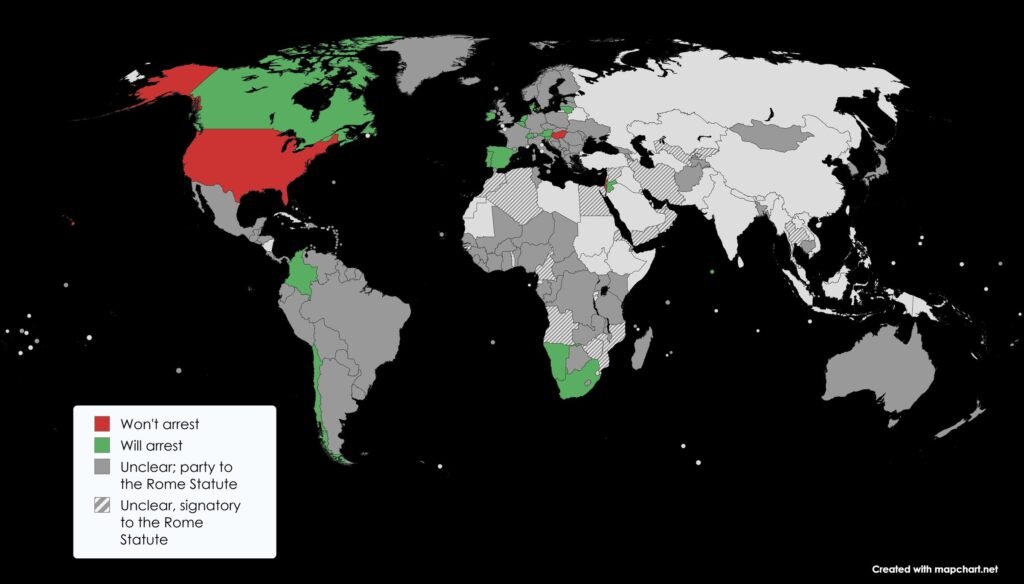
The Pre-Trial Chamber’s authorisation of the warrants represents a judicial determination that jurisdiction is established. Non-party states are not bound to arrest ICC-wanted individuals. Still, Rome Statute parties, which include the majority of European states and virtually all African states, are legally obligated to execute arrest warrants when wanted individuals are present on their territory. The practical consequences for Netanyahu’s international travel are significant: visiting any of the 124 ICC State Parties would require the host government to arrest him or face a legal confrontation with the court. Several European leaders have already indicated they would comply.
International justice is universally declared yet selectively applied, and the selection has, until now, disproportionately targeted Africa. The Netanyahu warrants do not resolve this imbalance. But they do create a precedent that cannot be easily un-created.
The African Dimension
Africa’s relationship with the ICC is the longest and most fraught of any regional grouping. Of the court’s preliminary examinations, investigations, and cases, a substantial majority have involved African situations and African defendants. The AU’s periodic calls for collective non-cooperation with the ICC, articulated most forcefully during the proceedings against Sudanese President Omar al-Bashir, were premised on the perception that the court’s prosecutorial attention was geographically skewed to reflect the interests of its major funders rather than the universality of its mandate.
The al-Bashir case, in which African Union members broadly declined to arrest Sudan’s president despite ICC warrants, demonstrated that the court’s enforcement mechanism is contingent on political will. The Netanyahu warrants will test whether that political will is more consistently present when the defendant is a Western ally. African ICC parties that complied with the court’s obligations in cases involving African defendants will watch closely whether European parties, who have criticised African non-compliance, apply the same consistency when compliance is politically costly for them.
What the Warrants Reveal About International Order
The ICC arrest warrants for Netanyahu and Deif expose the gap between the international legal order’s declared principles and the political architecture that determines which principles are enforced. This gap is not new; it has structured international justice since Nuremberg, where the victors tried the defeated. What is new is that the ICC’s jurisdictional reach has now extended to a conflict at the centre of Western geopolitical management, creating genuine accountability obligations for Western governments.
The warrants will not resolve the Gaza conflict, will not immediately lead to trials, and may never result in the custody necessary to enable prosecution. But their issuance creates a legal record, a formal judicial determination that there is reasonable ground to believe the individuals named committed the alleged offences, that cannot be administratively erased by diplomatic non-compliance. For Africa, whose leaders have borne a disproportionate share of international accountability proceedings, the warrants represent both a partial vindication of the principle that international justice should apply universally and a test of whether Western powers that championed that principle will respect it when it applies to their allies. The continent is watching. The answer will shape African engagement with international justice institutions for the decade ahead.