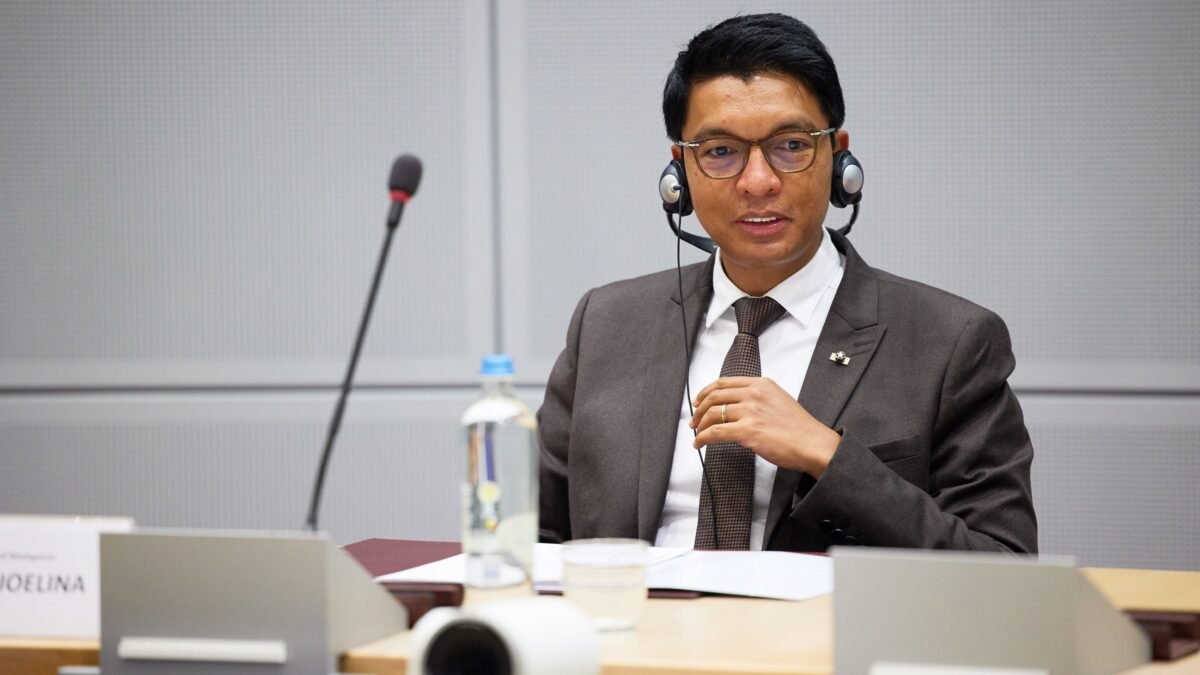
The slogan “We want to live, not survive” did not begin in Antananarivo. It has been echoing across a generation of African youth from Nairobi to Ouagadougou, a declaration that the minimum acceptable standard of government has been raised and that blackouts, water shortages, and regulatory paralysis no longer qualify as inevitable features of life. In Madagascar, that declaration became a political ultimatum. On 29 September 2025, President Andry Rajoelina dismissed his prime minister and dissolved his cabinet after days of youth-led demonstrations that had spread from the capital to cities across the island.
The UN human rights office reported at least 22 people killed and more than 100 injured since the protests began on 25 September, citing evidence of unnecessary and disproportionate force by security services. Madagascar’s foreign ministry disputed the figures. In a televised address, Rajoelina apologised for government failings and invited proposals for a new prime minister within three days, a concession calibrated to appear decisive without conceding structural accountability. It was political management, not political reform, and the streets knew the difference.
The proximate cause was energy. Only approximately 36 per cent of Madagascar’s population has access to electricity. The state utility JIRAMA, structurally compromised by high technical losses, under-recovery tariffs, and dependence on costly fuel oil, had subjected the capital to rolling blackouts that intensified after a late 2024 rainfall deficit reduced hydropower output. By September 2025, the outages were no longer a technical problem. They had become a political indictment. When citizens cannot access power, water, or basic services, their relationship with the state is not one of governance. It is one of abandonment.
The Architecture Behind the Outage
JIRAMA’s failure is not primarily an engineering problem. It is a governance problem with engineering symptoms. The utility’s commercial losses, the gap between the cost of generating power and the revenues recovered, have been structurally subsidised by a state whose own fiscal position is fragile. International lenders have long identified JIRAMA stabilisation as central to Madagascar’s recovery trajectory, and a World Bank programme currently underway aims to reduce outages and nearly double clean energy generation capacity. But the distance between programme design and lived experience for a household in Antananarivo without power for fourteen hours a day is not measured in policy documents. It is measured in food spoiled, businesses closed, and children unable to study after dark.
The deeper mechanism is the one that turns a power utility into a political fault line. A tariff set below the cost of generation guarantees that every unit of electricity sold deepens the utility’s losses, which the treasury then covers, which crowds out the very capital investment that would fix the generation deficit in the first place. Dependence on imported fuel oil ties the cost of keeping the lights on to an exchange rate the government does not control. The result is a utility that cannot invest its way out of its own decline, financed by a state that cannot afford to keep subsidising it. The blackout is not an accident inside that arrangement. It is the arrangement’s logical output.
“When citizens frame basic utilities as a matter of dignity, they are not escalating the political temperature. They are stating its correct level.”
A Pattern the Continent Recognises
Madagascar’s crisis sits within a broader continental pattern of Gen Z-led mobilisation against states that treat basic service delivery as optional. The protesters’ reference to Kenya’s 2024 uprising was not rhetorical, it was analytical. They recognised a shared structural condition: governments that capture state revenues without building the infrastructure those revenues are supposed to fund, while employing security forces against citizens who notice. UN High Commissioner for Human Rights Volker Türk urged Malagasy authorities to halt excessive force and release detained protesters. The government’s dismissal of UN casualty figures as “based on rumours” reflects a reflex that is itself a data point about governance culture.
Follow who captures and who carries, and the protest stops looking like disorder and starts looking like an audit. The revenue of the state is captured at the top, through the budgets, the contracts, and the patronage that sustain an incumbent. The cost of the unbuilt infrastructure is carried at the bottom, by the student who cannot read after dark and the trader whose refrigerator fails. What this generation has done is refuse the old exchange in which political quiet was traded for the bare survival the state still managed to provide. They have priced survival at zero and demanded a life, and a government that can offer only the former has nothing left to bargain with.
Rajoelina’s cabinet reshuffle buys political time. Whether it buys enough depends on whether the new government can demonstrate, not announce, but demonstrate, measurable improvements in power and water delivery within a timeframe citizens are willing to hold for. Madagascar’s youth have already shown they know how to organise, how to name the problem, and how to apply pressure. The next question is whether the state knows how to govern. Based on the current evidence, that question remains open, and a reshuffled cabinet sitting atop an unreformed utility is an answer the streets have already heard before.