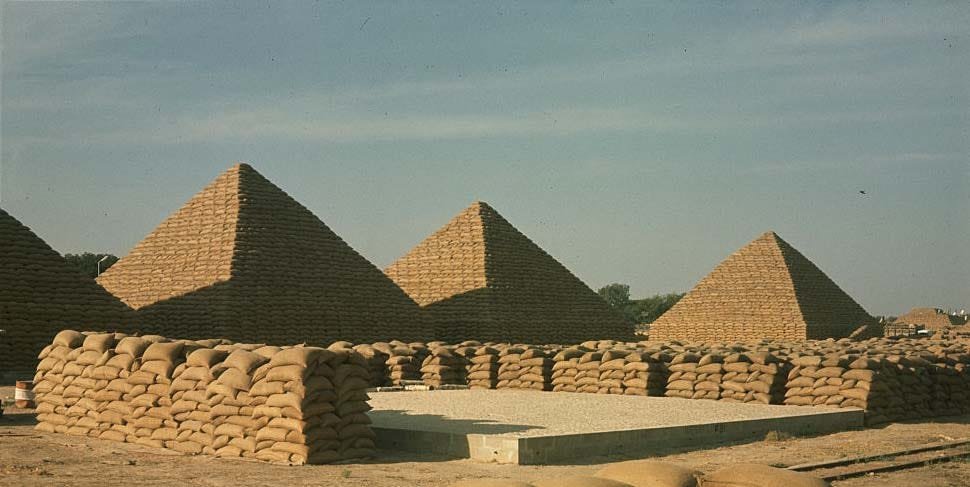
The pyramids of Kano were not built from stone. They were constructed from sacks, tens of thousands of them, stacked into towering formations that announced Nigeria’s position in the global agricultural economy before the country discovered what lay beneath its soil. At peak production in the early 1970s, Nigeria accounted for approximately forty-one per cent of total groundnut production in West Africa. The Kano pyramids were a wonder of agricultural organisation, the visible proof that a coordinated, state-supported, farmer-centred economy could generate prosperity across the rural north. They are gone now. In their place: dependency, debt, and the periodic crisis of a country that traded a functioning agricultural system for the volatility of oil.
Commercial groundnut farming in Nigeria traces to 1912, when farmers in the north responded to economic incentives by shifting toward large-scale cultivation. The marketing architecture that supported this expansion was deliberate and coherent: produce moved from rural collection centres to Kano through a structured network, sold at fixed prices set by the marketing board, then transported by railway to Lagos for export. Alhaji Alhassan Dantata, one of Nigeria’s most significant early entrepreneurs, built his commercial empire partly on the groundnut trade, supplying the Royal Niger Company and helping establish Kano’s position as the hub of a regional agricultural economy. The infrastructure was not accidental; it was built because the colonial administration understood that groundnut revenues required reliable logistics to flow.
What the oil boom did to this system is one of the clearest examples in African economic history of how resource windfalls can destroy productive economic structures rather than complement them. The government’s attention and revenue calculations shifted toward petroleum in the early 1970s. Marketing boards, which had provided the price floors, organisational structure, and market access that made large-scale groundnut farming viable, were dissolved. Without the marketing infrastructure, farmers lost their route to market and their pricing stability simultaneously. Government subsidies for agricultural inputs, fertilisers, and improved seed varieties were removed or reduced, making farming more expensive precisely as its economic logic was being undermined. Young people who might have entered agriculture as an economically rational choice were pulled toward the oil economy’s urban centres instead.
The environmental pressures that coincided with these policy failures were severe but not sufficient, on their own, to have produced the collapse that followed. The groundnut rosette virus outbreak of 1975 destroyed approximately 750,000 hectares of farmland and inflicted losses estimated at $250 million. Similar outbreaks in 1983, 1985, and 1988 deepened the damage. But diseases and droughts create temporary setbacks in agricultural systems with adequate institutional support. What they create in systems whose institutional support has been withdrawn is permanent abandonment. Nigerian farmers who lost their groundnut crops in the 1970s and 1980s switched to cowpea, millet, and sorghum, not because those crops were superior, but because they were more manageable in the absence of the coordinated marketing infrastructure that had made groundnut cultivation economically rational.
By the mid-1980s, total groundnut production had fallen from over 1.6 million tonnes to below 0.7 million tonnes. The pyramids were gone. The railway network that had connected northern farms to Lagos port was deteriorating. The agro-processing industries that had depended on groundnut as a raw material had closed or converted. The human capital accumulated across decades of organised groundnut farming- the knowledge of soil management, variety selection, disease response, and market logistics- was dispersing as the farming generation aged without replacement.
The structural adjustment programmes of the 1980s accelerated the deterioration. Designed to address Nigeria’s oil-shock-induced fiscal crisis, they reduced public expenditure on agricultural support at precisely the moment when the sector most needed intervention. The logic was fiscal discipline; the outcome was the abandonment of a productive economic base in favour of the immediate relief of reduced government expenditure.
Contemporary attempts to revive Nigerian agriculture operate against the background of this history. The mechanisms that made the groundnut economy work- coordinated marketing, structured price support, investment in agricultural research and extension services, rural infrastructure- were systematically dismantled over a period of twenty years, and have been only partially and inconsistently rebuilt. Drought-resistant groundnut varieties developed by agricultural research institutions exist; reaching farmers with them, at scale, through functional extension services, has proved beyond the consistent capacity of Nigerian agricultural policy across the decades since.
The lesson of the groundnut pyramids is not primarily about groundnuts. It is about what happens when a commodity windfall, oil, in Nigeria’s case, is used as a rationale for abandoning the patient, institutional work of building diversified productive capacity. Every oil boom country in Africa that watched its non-oil economy atrophy during the boom years has been living the consequences of the same decision Nigeria made when it let Kano’s pyramids dissolve. Resources that are not converted into institutional capacity are not development. They are a loan that comes due when the commodity price falls.