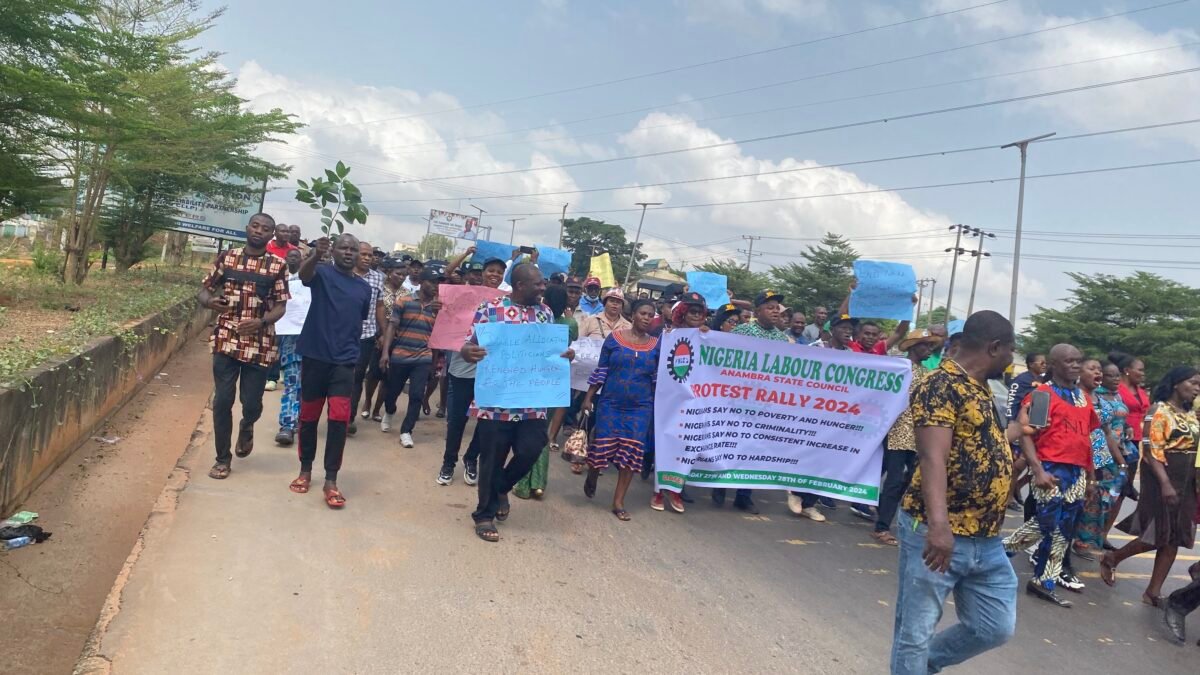
When Nigerian workers strike, the government’s first response is rarely economic; it is political. The pattern has repeated so consistently that it now constitutes a structural feature of Nigeria’s labour relations: wages eroded by inflation, unions mobilised, strikes called, courts invoked, and agreements reached that subsequently go unimplemented, until the cycle restarts.
The NLC-led strikes of 2023 and 2024 did not emerge from an unusual moment of worker militancy. They emerged from an inflation rate that had climbed above 30 per cent [National Bureau of Statistics, Nigeria, 2024], from the fuel subsidy removal that doubled transportation costs overnight, and from a national minimum wage whose real value had been comprehensively eroded by currency depreciation and price rises. The wage was set in naira terms. The economy that workers lived in was priced in reality.
Nigeria’s labour struggle is not merely a dispute between workers and employers. It is a visibility crisis for the structural forces- currency devaluation, import dependence, subsidy withdrawal, and uneven growth- that have systematically shifted the economic burden downward while concentrating economic gains upward. Each strike is, in effect, an unscheduled audit of economic policy. The audit results have been consistently unflattering.
The Inflation Architecture
Nigeria’s inflation is not a single phenomenon; it is a layered accumulation. Food inflation, driven by logistics costs, insecurity in agricultural belts, and naira depreciation, which repriced imported inputs, has run persistently above headline figures. Energy inflation, compounded by the June 2023 subsidy removal and the uneven rollout of palliative support measures, fed through to virtually every production and distribution cost in the economy. Core inflation, stripping out food and energy, remained elevated, indicating that price pressures were not confined to commodity sectors.
The Wage That Could Not Hold
Against this backdrop, a minimum wage of ₦30,000 per month, the rate that remained in force for years before the 2024 negotiations, was not merely inadequate. It was economically incoherent as a floor for human subsistence in an urban Nigerian context. Employer organisations criticised the NLC’s demand for ₦494,000 per month as economically destabilising. Unions received the federal government’s counteroffer of ₦60,000 as confirmation of the government’s distance from lived economic conditions on the ground. The eventual settlement of ₦70,000 per month satisfied neither standard.
Each strike is, in effect, an unscheduled audit of economic policy. The audit results have been consistently unflattering.
The Sectoral Dimension
Labour action in Nigeria spans sectors whose service failures carry compounding consequences. Education unions, ASUU, SSANU, NASU, have accounted for some of the most prolonged industrial actions, with cumulative strike periods over the past decade totalling years of lost academic time for students in federal universities. Healthcare unions, JOHESU, NMA, have disrupted services in a healthcare system already operating well below capacity. The intersection of labour action and public service delivery creates a feedback loop: failing institutions generate grievances that produce strikes, which further degrade institutional functioning.
The private sector labour picture is more fragmented and less visible. Collective bargaining coverage is limited outside formal sector employment, and a large share of Nigeria’s workforce operates in informal arrangements where neither minimum wage legislation nor union representation applies. The formal-sector labour struggles that generate headlines represent only a fraction of Nigerian workers. The majority absorb economic pressure without institutional recourse.
What Economic Justice Actually Requires
The NLC’s strike actions and minimum wage demands, while necessary responses to deteriorating conditions, address the symptom rather than the underlying economic design. Nigeria’s inflation crisis is not primarily a wages problem; it is a structural vulnerability problem. An economy that imports significant shares of its food and manufacturing inputs, that prices energy at market rates while most citizens’ incomes have not adjusted for market-rate inflation, and that generates growth concentrated in sectors with limited employment multipliers, will continue producing labour crises regardless of the minimum wage level set.
Economic justice in Nigeria requires engagement with the architecture of economic distribution, not merely its most visible failure points. It requires an agricultural policy capable of reducing dependence on food imports and stabilising domestic food prices. It requires an industrial policy that creates formal employment at a sufficient scale to bring informal workers into wage-protection frameworks. It requires fiscal discipline that does not place the full burden of structural adjustment on workers whose wages are the economy’s least flexible price.
Nigeria’s labour movement has demonstrated that it retains the organisational capacity to impose political costs on governments that ignore worker welfare. The question is whether that capacity can be directed not merely toward wage settlements that inflation will erode within months, but toward the structural reforms that would make those wages hold their value. Until then, the cycle, inflation, strike, settlement, repeat, remains the default programme, and economic justice remains the declared destination of a journey whose road has not yet been built.