
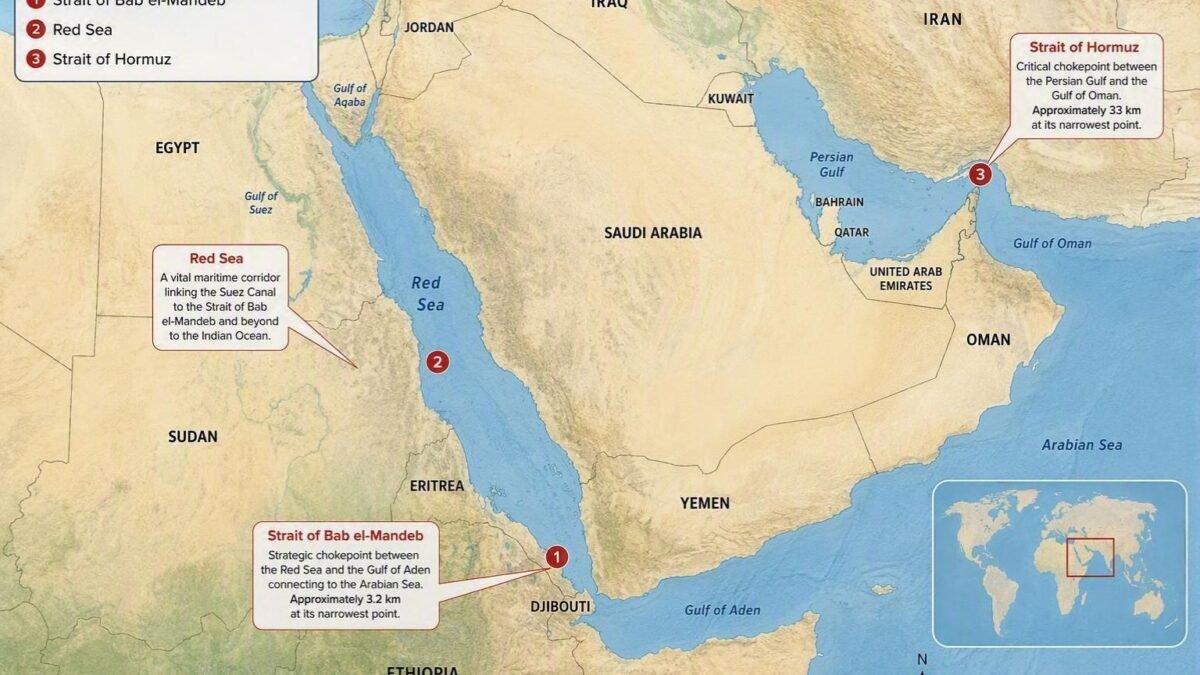
Fourteen governments announced a Multinational Maritime Defence Coalition in Riyadh on 30 July, built to protect shipping through the Bab al-Mandab strait, the Red Sea and the Gulf of Aden. Four of them are African. Djibouti, Egypt, Somalia and the Comoros signed the founding declaration alongside Saudi Arabia, Pakistan, Turkiye, Yemen and six others. A week later, on 6 August, Saudi Arabia named the man who will run it. Rear Admiral Abdullah bin Salem Al-Shehri will direct joint naval defence and coordinate with member states and other maritime coalitions. The founding states meet again on 12 and 13 August to settle the institutional framework and open the door to further members.
The obvious reading is that the states most exposed to Houthi attacks on shipping have organised a collective answer, and that African littoral governments have been included in it. That reading holds. What it leaves out is the shape of the thing being built. A coalition is not only a set of members. It is a command, a headquarters, a set of rules about who tasks whom, and a decision about where those rules are written. Every one of those was settled in Riyadh, and the sequence tells the story plainly: the coalition was declared on 30 July, the commander was appointed on 6 August, and the institutional framework is being drafted on 12 August. Structure was assigned before it was designed.
Geography is the part Africa unambiguously owns. The Bab al-Mandab narrows to 29 kilometres at its tightest point, and one of its two shores is African for its entire length. Somewhere between a tenth and an eighth of global maritime trade passes through it. Djibouti sits at the hinge of the strait and hosts foreign military installations from several powers on that basis. Egypt collects the traffic at the other end, where the Red Sea meets the Suez Canal and a substantial share of state revenue depends on transit volumes. Somalia holds the continent’s longest mainland coastline, more than 3,300 kilometres of it, and has spent three decades unable to patrol it. The asset is African. The authority to deploy force in defence of it now sits under a Saudi flag officer.
The asset is African. The authority to deploy force in defence of it now sits under a Saudi flag officer.
This is not the first outside command over these waters. The European Union runs Operation Aspides and the United States assembled Operation Prosperity Guardian, both raised after the Houthi campaign against shipping began in 2023, and neither placed an African state anywhere near the decision. What is different here is the membership. Prosperity Guardian and Aspides were external forces operating in African approaches without pretending otherwise. The new coalition includes the littoral states as founders, which changes the political grammar without necessarily changing the distribution of authority. Signing a founding declaration and shaping a command are separate acts, and the second one is the one that decides what happens at sea.
The distinction matters most for the two members already inside somebody else’s war. Sudan is a founding signatory whose army is fighting the Rapid Support Forces and has spent two years importing armoured vehicles and drones from a widening set of suppliers. Its foreign ministry spoke to Yemen’s on 2 August about coordinating Red Sea security while its own territory remains contested. Somalia signed while its federal government’s writ over Puntland’s ports and bases is being tested by force. Membership in a maritime coalition does not resolve either situation. It does place both governments inside a security architecture whose priorities are set by states with functioning navies and continuous revenue, and whose stated purpose is the protection of energy and trade routes rather than the internal security of its African members.
What the arrangement reveals is a pattern that recurs whenever a chokepoint becomes contested. The states that supply the coastline, the ports, the basing rights and the diplomatic cover are brought into the structure early and cheaply, because their consent is legally necessary and politically useful. The states that supply the ships, the budget and the command are the ones that decide what the structure does. Inclusion is real and it is not the same as leverage. An African government that joins at the founding stage acquires standing, a seat at the planning meeting, and a claim to have been consulted. Whether it acquires the ability to direct or refuse an operation in its own waters is a separate question, and the answer to it is being written this week.
There is a version of this in which the littoral states use the moment well. The framework is unfinished, the coalition is openly recruiting, and the founding members have the strongest possible argument for weighting: without their coasts there is nothing to command. Rules on tasking, on port access, on intelligence sharing and on what happens when a member’s own security needs conflict with a shipping-lane priority are all still to be set. Those are the terms worth fighting for, and they are being negotiated now rather than at some later review.
The alternative is the outcome the region has seen before. The corridor gets secured, the insurance rates fall, the cargo moves, and the arrangement hardens into permanence with the command structure intact. African states will have been present at the founding and absent from the authority, and the record will show that they agreed to it. The planning meeting on 12 August is not a procedural formality. It is where a coalition either becomes a partnership or becomes a garrison with local signatures on the paperwork.