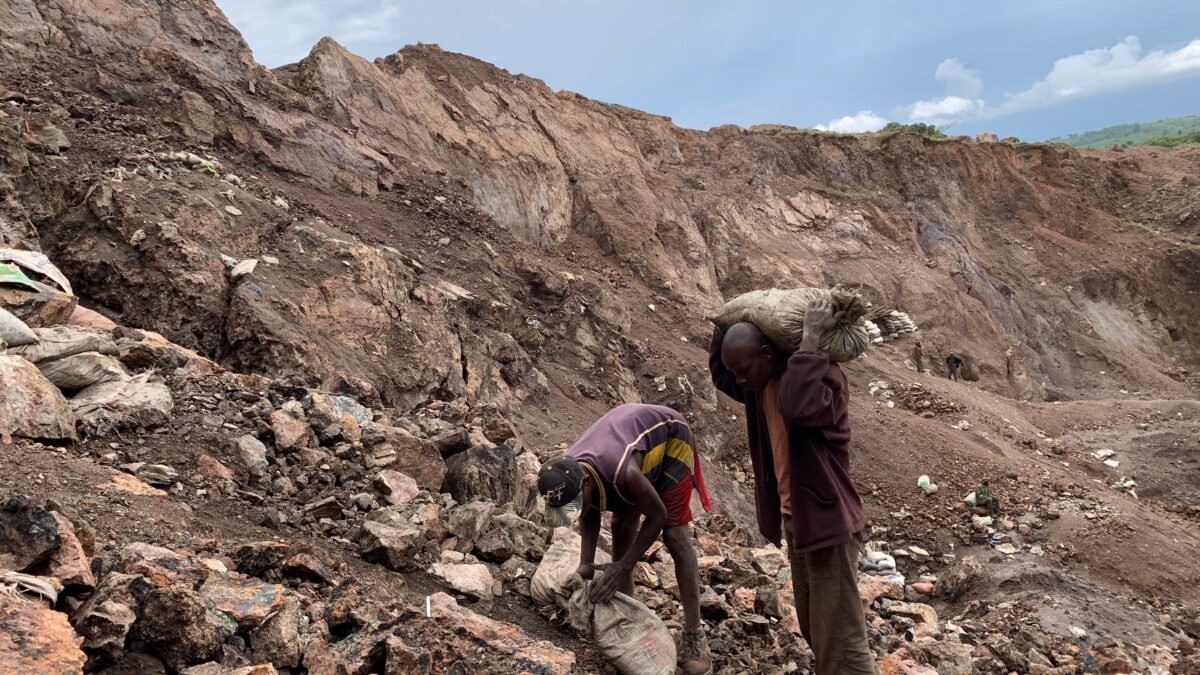
The Democratic Republic of Congo intends to raise a paramilitary force whose job is to guard the one thing the country cannot afford to lose control of: its mines. Reported this month, the plan would have the General Inspectorate of Mines build a unit to protect mine sites, ore-transport routes, processors and border corridors, at a projected cost of up to 100 million dollars, with the possibility of deploying as many as 20,000 personnel over two years. It is being organised under a strategic partnership that includes the United States and the United Arab Emirates. On paper, it reads as an internal security measure. In structure, it is something more consequential, a demonstration of how the terms of Africa’s mineral wealth are now being set.
The Congolese plan does not stand alone. It is the operational edge of a broader arrangement agreed with Washington in December 2025, whose joint steering committee has begun designating strategic assets for preferential access. Across the continent, the same template is spreading. In the Sahel, Washington has floated counter-terrorism support to the military governments of Mali, Burkina Faso and Niger in exchange for access to gold, lithium and uranium, terrain where Russia’s Africa Corps already trades protection for mining concessions. China, the incumbent buyer across much of the cobalt and copper belt, holds the value chains that convert the raw ore into batteries and magnets: three external powers, one recurring offer: security in return for minerals.
What makes the bargain distinct from ordinary foreign investment is what sits on each side of the exchange. The state offers access to the assets that anchor its future revenue. In return, it receives help securing those same assets, help it accepts because it cannot supply the security itself. The arrangement therefore does two things at once. It stabilises extraction and makes the party most interested in the minerals a stakeholder in who holds the force around them. Protection and extraction stop being separate functions and fuse into a single system, one increasingly designed by the buyer rather than the seller.
Sovereignty, in its plainest definition, is the monopoly on legitimate force within a territory. The resource-for-security deal directly touches that monopoly. A government that contracts with external partners to establish and underwrite the units guarding its most valuable ground has not surrendered sovereignty outright, but has leased a portion of it to the actors whose commercial interests are served by the arrangement’s continuation. The mine becomes a zone where the line between protecting the state’s asset and protecting the partner’s supply grows difficult to draw.
Congo’s own conditions show why the demand for such deals is real rather than abstract. In the east, the Rwanda-backed M23 still holds towns and mining assets, and fighting has continued through July, with drones and heavy artillery used in civilian areas of South Kivu. A government facing an armed movement that finances itself from the same minerals the state wants to sell has an obvious incentive to accept outside help securing them. The incentive is genuine. So is the cost of meeting it this way.
The deeper pattern is that Africa holds close to a third of the world’s critical-mineral value at exactly the moment when the energy transition and the defence-industrial build-out have made those minerals strategic to every major power. That concentration should be leverage. Under the resource-for-security model, it risks becoming the opposite. When the terms of access are bundled with the terms of protection, the continent negotiates from a position where its greatest asset is also its greatest vulnerability, and the counterparties know it.
The asymmetry is sharpest where the value is actually captured. The ore that leaves Congo, the Sahel, or the copper belt is refined, alloyed, and turned into cathodes, magnets, and battery cells far from the pits it came from, and the margin sits at those downstream stages, not at the mine gate. A security guarantee that locks in access to the raw material without committing the partner to build processing on African ground therefore secures the least valuable link in the chain for the seller and the most valuable one for the buyer. The protection is real. The industrial development it is nominally traded for often is not.
None of this absolves the states signing the deals. A government that cannot secure its own mines has usually failed at something prior, and the external offer, however opportunistic, answers a vacuum the state itself created.
There is a version of these arrangements that strengthens African states, one where security support is time-bound, where the paramilitary units answer to national command rather than to partner interests, and where preferential access is paid for in processing capacity built on African soil rather than in ore shipped out for value to be added elsewhere. Whether the deals now being signed resemble that version or its opposite will define the next decade of the continent’s mineral economy. The metals will be extracted either way. What is being decided in the fine print is who commands the ground they come from, and on whose terms the protection is provided. That is not a mining question. It is a sovereignty one, and it is being answered now.