
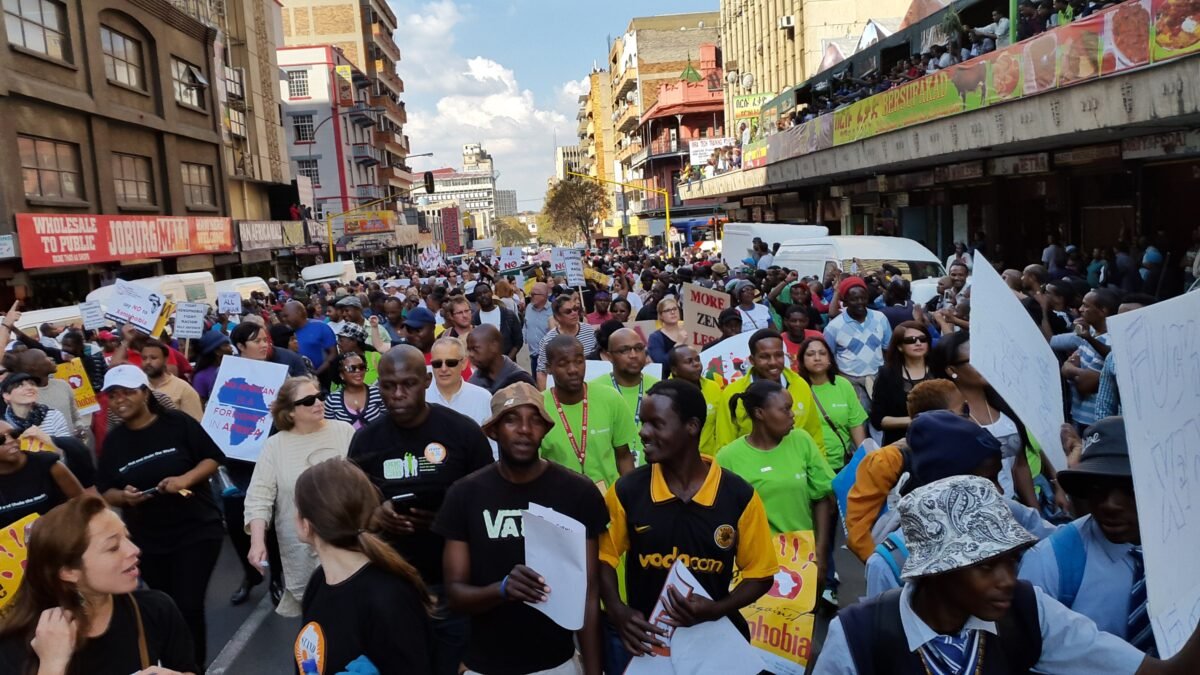
Violence targeting foreign nationals in South Africa moved beyond a domestic security story this week. It became a continental diplomatic issue, and in that crossing, something important was exposed about the distance between Africa’s integration rhetoric and the political conditions operating beneath it. Ghana, Nigeria, Kenya, Malawi, Lesotho, and Zimbabwe each responded publicly, through travel warnings, diplomatic representations, or direct pressure on Pretoria to contain escalating tensions before they deepened into a wider crisis.
The speed with which the story crossed borders mattered as much as the violence itself. South Africa occupies a structural position in the region that other countries do not: economically dominant in multiple sectors, deeply embedded in regional labour flows, and home to large migrant communities drawn by opportunities unavailable elsewhere in southern Africa. Instability inside South Africa rarely remains entirely domestic once foreign nationals become direct targets. The South African xenophobia response from neighbouring governments was not merely diplomatic reflexivity; it was a recognition that what happens in Johannesburg and Durban has economic and social consequences in Lagos, Accra, and Harare.
Pretoria rejected broad characterisations of the country as inherently xenophobic, while also acknowledging the severity of the unrest and pledging stronger protective action. Yet the underlying tensions proved resistant to official framing because they sit at the intersection of unemployment, structural inequality, political frustration, and migration pressure, all of which have intensified over several years and none of which respond quickly to statement or policing alone. The contradiction at the centre of the story is this: South Africa remains one of the continent’s largest economic gravitational forces even as its own structural capacity to absorb its population’s needs continues to stagnate.
For many migrants, South Africa remains an essential destination for work, trade, and remittance support, an economy that functions, however imperfectly, at a scale unavailable in most neighbouring states. For many struggling South Africans, however, migration has become politically entangled with competition over jobs, housing, informal trade, and access to public services. That entanglement is not simply prejudice, though prejudice is present. It is the predictable outcome of an economy that cannot generate sufficient formal employment, set against political pressure to locate external explanations for domestic failure.
Name the mechanism precisely, and the violence stops looking like spontaneous prejudice. An economy that cannot manufacture enough formal jobs manufactures something else instead: a target. The migrant trader becomes the visible explanation for an invisible structural failure, and the politician who points at him is spared the harder accounting for why the failure exists. Scapegoating is not a breakdown of the system under strain. It is one of the system’s release valves, cheaper to operate than industrial policy and faster than reform, which is precisely why it recurs on a cycle rather than as an aberration.
The contradiction cuts deeper because South Africa is not an incidental host. Its mines, farms, and cities were built on regional labour, and its retailers, banks, and brands earn across the very borders whose nationals are now being attacked. The country draws value from continental integration at the wholesale level while refusing it at the level of the street. It wants the regional market without the regional worker, the continental customer without the continental neighbour. A continent watching that contradiction draws its own conclusions about what pan-African solidarity is worth when it arrives at a South African job queue.
The xenophobic violence episode in South Africa, therefore, revealed something structurally larger than isolated street disorder. It exposed how economic frustration can rapidly evolve into continental diplomatic strain when migration governance weakens within a regional power centre. Once embassies, foreign ministries, and the African Union enter the frame, the issue shifts from policing to questions of legitimacy, regional stability, and the conditions under which pan-African solidarity can be sustained in practice rather than proclaimed in principle.
That shift is occurring at a difficult political moment for South Africa. The country continues grappling with sluggish growth, infrastructure failure, persistently high unemployment, and declining public trust in institutions that promised a different trajectory after 1994. Migration tensions increasingly serve as a political pressure valve through which broader frustrations are expressed and sometimes directed. The pattern is not unique to South Africa; it is visible in varying forms across the continent, but in a country of South Africa’s regional significance, it carries disproportionate continental consequence.
The episode also highlighted the fragile boundary between integration rhetoric and domestic political reality. Across the continent, governments speak routinely about free movement, regional cooperation, and pan-African solidarity. Those ideals frequently encounter the harder truth of economic insecurity and institutional fragility at the ground level. The gap between continental aspiration and lived urban pressure becomes especially visible during moments of social strain, and it is in that gap that the real architecture of African integration, or its absence, is disclosed.
South Africa’s internal tensions are becoming increasingly difficult to separate from continental politics. Migration governance, economic stagnation, and social cohesion are no longer operating as isolated domestic questions. In a region tied together by movement, labour, remittance, and economic dependency, instability within the continent’s largest industrial economy inevitably spills outward like a flood that does not stop at a fence. The reckoning is not only South Africa’s to manage. It belongs to the continent, and the continent has not yet built the governance structures capable of managing it together.