
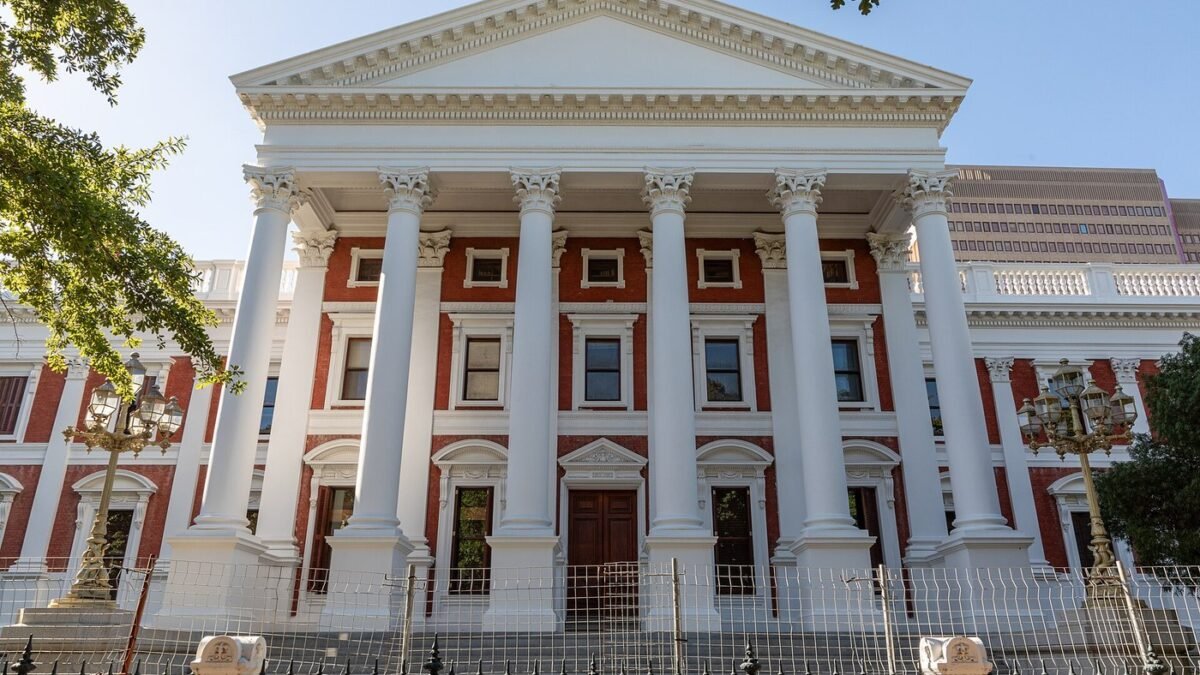
South Africa’s constitutional architecture was built to withstand pressure. The pressure it now faces is of a different order from what its designers anticipated, not the blunt assault of a state seeking to override institutions. Still, the slower erosion occurs when governing coalitions have more to gain from institutional ambiguity than from institutional clarity.
The May 2024 general election produced the most consequential result in South Africa’s democratic history: the African National Congress fell below fifty per cent of the national vote for the first time since 1994, ending three decades of outright majority governance. The Government of National Unity that followed, bringing the ANC into coalition with the Democratic Alliance, the Inkatha Freedom Party, and several smaller parties, was a constitutional response to a political reality that the ANC’s leadership had not internalised as possible. The GNU’s formation was, in that sense, an institutional success: the electoral outcome was accepted, power was shared, and the transition was orderly. The more complex question is what governing under coalition conditions does to the institutional behaviour of a party whose entire post-apartheid identity was built around the assumption of permanent majority authority.
The local government elections anticipated for late 2024, and the broader cycle of provincial and national elections that the 2024 general vote set in motion, are testing the institutions that South Africa’s post-apartheid settlement placed between political power and its abuse. The Electoral Commission of South Africa has, by regional and continental standards, a strong record of procedural integrity. Its independence from the executive is constitutional rather than merely conventional. But the funding pressures that have affected the IEC, alongside the South African Human Rights Commission, the Public Protector’s office, and the National Prosecuting Authority, are cumulative rather than acute, and their effect is to reduce institutional capacity precisely when the political environment requires it to be at its most robust.
South Africa’s institutions are not failing in the dramatic manner of the Zuma era. They are being pressured in the quieter, more durable manner of underfunding, leadership appointment uncertainty, and the gradual normalisation of institutional weakness as a governing condition.
The National Prosecuting Authority’s trajectory illustrates the pattern. The NPA was gutted during the state capture years, senior prosecutors were sidelined, cases were stalled, and institutional memory was depleted through attrition and targeted appointments. The post-Zuma period produced genuine recovery efforts: the appointment of Shamila Batohi as National Director of Public Prosecutions brought experienced leadership, and the Investigating Directorate she oversaw secured significant prosecutions related to state capture networks. But the pace of high-level accountability has disappointed public expectations, and the resource constraints facing the NPA, including the loss of experienced prosecutors to private practice, continue to create capacity gaps that slow the kind of complex commercial crime prosecution that state capture cases require.
The GNU arrangement creates its own institutional pressures. A coalition government requires policy compromise that, in South Africa’s case, means navigating between the DA’s market-oriented economic orthodoxy, the ANC’s redistributive commitments, and the smaller parties’ sector-specific demands, all within a fiscal envelope that is constrained by a debt service burden consuming approximately twenty-two per cent of consolidated government expenditure [National Treasury 2024]. The State Owned Enterprise reform agenda, Eskom’s operational stabilisation, the Transnet port and rail crisis, and the restructuring of SAA require decisions that each coalition partner evaluates primarily through the lens of its own constituency interests. The institutional consequence is a governance environment where the political costs of clear decisions reduce the state’s execution capacity.
The external dimension of South Africa’s institutional pressure is the geopolitical positioning challenge that has persisted since the Russia-Ukraine war. South Africa’s abstention from UN resolutions condemning Russia’s invasion, its participation in naval exercises with Russia and China, and the ANC’s rhetorical non-alignment have created friction with Western partners, particularly the United States, whose AGOA committee review of South Africa’s eligibility created a period of intense bilateral pressure in 2023. Managing a coalition government whose partners have different instincts on geopolitical positioning, while maintaining economic relationships with both Western capital markets and BRICS partners, requires a diplomatic sophistication that the ANC’s previous majority governments did not need to exercise under comparable constraint.
South Africa’s institutional architecture remains, by African and by global standards, genuinely strong. The Constitutional Court has continued to assert its authority. The Public Protector, despite the controversies of the Mkhwebane tenure, has been restabilised. Civil society and media operating space, while under pressure in specific respects, remains more open than in most of Africa. The question ahead of the next electoral cycle is not whether South Africa’s institutions are breaking- they are not- but whether the political environment will allow them to consolidate the recovery that began post-Zuma, or whether the coalition’s institutional ambiguity will normalise a lower level of performance as the sustainable operating condition. For a country that the continent looks to as a democratic anchor, that question has implications well beyond the Limpopo.