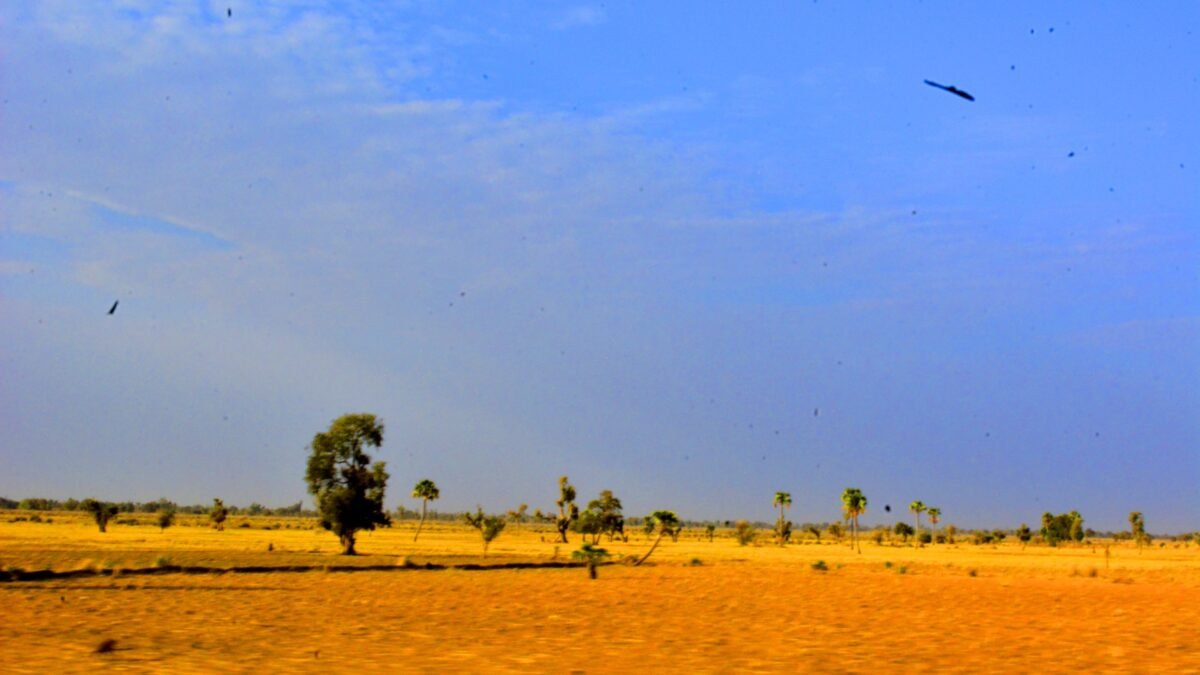
Across the Sahel’s arid belt, the exodus does not happen with the drama of a sudden flood or the visible urgency of an armed conflict. It happens the way soil gives way, gradually, then all at once, season after failed season, until the decision to leave is no longer a decision but a physical inevitability. By 2025, the International Organisation for Migration had documented climate-driven agricultural collapse as a major driver of displacement in Sahelian communities, placing it on par with conflict and economic hardship as a factor compelling movement. That equivalence is significant. It represents an institutional acknowledgement that the slow-motion geography of drought is as powerful a displacer of communities as the sudden violence of war. Still, it arrives with the structural invisibility of a process rather than the headline-generating shock of an event.
Falling Through the Categories
The population that the Sahel is releasing moves with the logic of survival rather than the logic of legal categories. People fleeing successive failed rainy seasons, depleted pastoralist grazing grounds, and the creeping desertification that converts viable farmland into sand do not fit neatly into the refugee frameworks designed at mid-twentieth-century conferences for the protection of people fleeing political persecution. They are not economic migrants in the conventional sense; they did not choose to leave for better wages in a more productive economy. They were expelled by the altered conditions of the land they depended on, a land altered by atmospheric warming that originated overwhelmingly in emissions produced thousands of miles away. The legal gap between their actual condition and the categories available to describe and protect them is not merely a definitional problem. It determines whether displaced communities receive international protection, whether their children access education in destination cities, and whether their displacement is recorded in the statistics that eventually generate political responses.
What Displacement Dismantles
The identity dimension of climate displacement operates at multiple registers simultaneously. The Fulani pastoralist communities moving south across the Sahel as viable grazing land contracts northward carry an identity structured entirely around a mobile relationship with land, livestock, and seasonal rhythm. When climate change eliminates the northern grazing grounds that make seasonal migration viable and compresses available land to the point where conflict with sedentary farming communities becomes inevitable, the displacement is not only geographic. It is cultural, a dismantling of the identity framework through which meaning, social organisation, and economic life have been understood across generations. The Sahelian farmer who abandons a village where her family has farmed for a century does not merely lose a livelihood. She loses the geographic anchor of an identity that has no equivalent urban substitution available in the peri-urban settlements where displaced rural populations typically land.
The Sahel’s displaced communities are not climate refugees under international law, not economic migrants in the familiar sense, and not internally displaced persons under most domestic frameworks. They fall through every category designed for their protection, and the absence of a name is the absence of an obligation to act.
Africa’s youth carry the sharpest edge of climate displacement’s identity consequences. Young people in drought-stressed rural areas face a particular version of the climate migration calculation: remain in a village where agricultural prospects have permanently diminished and urban opportunities are distant, or move to a city where informal settlement and precarious employment constitute the realistic arrival conditions. The internal migration that results, accelerating the pace of urbanisation that African cities are already structurally unprepared to absorb, generates secondary pressures on urban infrastructure, housing markets, and municipal service delivery systems. The climate exile does not end when the displaced family reaches the city. It transforms into a different, equally challenging adaptation, one that African municipalities are not receiving sufficient international support to manage.
Naming the Debt
The political response required by the scale of climate-driven displacement in Africa operates at both the national and international levels. Domestically, African governments need water infrastructure investments and alternative livelihood programmes in climate-stressed rural areas that provide options beyond departure, not to prevent all migration, which is itself a rational adaptation, but to ensure that movement is chosen rather than compelled. Internationally, the expansion of climate migration as a protected category in international law, an active discussion in UN forums but a contested and slow-moving one, needs African governments to advocate with the same coordinated urgency that they bring to other climate justice claims. The people the Sahel is releasing deserve a category that acknowledges who they are: not victims of political failure or economic competition, but communities displaced by the atmospheric consequences of an industrial history they did not write. Naming that accurately is the first step toward protecting it adequately.
The refusal to name is not an oversight; it is a decision with beneficiaries. A climate refugee, once the term carries legal force, is owed something: protection, resettlement, a share of the responsibility traced back to the emissions that produced the drought. So long as the displaced of the Sahel remain uncategorised, that bill is never issued, and the wealthy economies whose industrial history altered the rainfall retain the convenience of watching a humanitarian tragedy rather than acknowledging a debt. This is why the contest over the word matters as much as the contest over the water. To call these people climate refugees is to convert a misfortune into a liability and a liability into a claim, and the same powers that resisted Loss and Damage for three decades understand precisely what a name would cost them. The absence of the category is not a gap in the law awaiting a technical fix. It is the law working exactly as those who benefit from it intend, and Africa’s task is to make the silence more expensive to maintain than the recognition would be to grant.