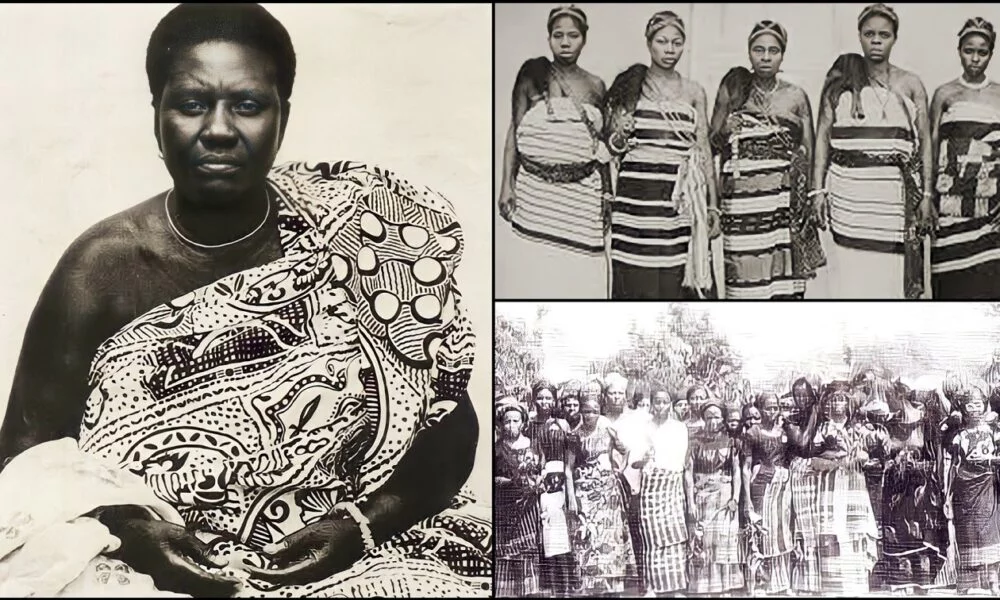
In November 1929, a census enumerator in the Bende Division of Owerri Province approached a widow named Nwanyeruwa and demanded that she enumerate her possessions. What followed- Nwanyeruwa’s refusal, the mobilisation that radiated from it, the palm leaves passed hand to hand across villages as the traditional signal of emergency assembly- was not a spontaneous uprising. It was a political system activating itself. Within weeks, nearly two million people had entered the streets across 15,550 square kilometres of southeastern Nigeria. Fifty women died when colonial troops opened fire. The Warrant Chief system was abolished. Native courts were restructured to include female representatives. The governance of the region changed.
The standard historical framing of what became known as the Aba Women’s Uprising, or Ogu Umunwanyi, the Women’s War, emphasises the taxation threat as its cause. This is accurate but insufficient. The threat of direct taxation on women was the spark; it was not the fuel. The fuel had been accumulating since the colonial administration imposed the Warrant Chief system, which selected individual men to serve as intermediaries between British authority and local communities, bypassing the distributed governance structures through which Igbo and Ibibio societies had actually operated.
In pre-colonial Igbo and Ibibio societies, women held substantive governance roles. Market days were not simply commercial events; they were political assemblies at which communal laws were discussed, disputes adjudicated, and collective decisions reached. Women sat in these processes with authority, not as observers. The Warrant Chief system did not simply ignore this authority. It actively displaced it, replacing distributed governance with a single male intermediary who derived his legitimacy from colonial appointment rather than from community recognition. The women who rose in 1929 were not demanding rights they had never possessed. They were reclaiming authority that had been taken from them by administrative fiat.
The organisational sophistication of the uprising is the detail that conventional accounts most consistently understate. From Nwanyeruwa’s initial confrontation in Bende, the mobilisation followed established protocols of women’s collective action: the palm leaf circuit, assembly procedures, and the targeting of specific symbols of colonial authority. Warrant Chief Okugo, whose resignation and prosecution the women demanded, was not a random target. He was a specific node in the system of colonial-intermediary extraction that had made daily life a slow erosion of community resources and dignity. The women’s demand for his accountability was a demand for the accountability of the system he represented.
In Bende Division, the British colonial administration had enough institutional intelligence to engage with the Oloko Trio, Ikonnia, Nwannedia, and Nwugo, three women whose standing within the community made them effective interlocutors. The relative peace in Bende, compared to what followed elsewhere, reflects what colonial administration could achieve when it chose to treat African political actors as political actors rather than as subjects requiring pacification. In Aba, where no such engagement occurred, troops opened fire. Fifty women died in December 1929. Oral history places the figure considerably higher.
The commissions of inquiry that followed, a first focused on Calabar Province in January 1930, a second covering both Owerri and Calabar, completing its report in July, produced findings that the colonial administration had refused to acknowledge before the uprising made them unavoidable. The women’s anger was not irrational. The governance structure that had produced it was not functional. The Warrant Chief system was abolished. Courts were reformed. Female representatives entered governance structures from which they had been expelled by colonial administrative design.
These reforms are significant but incomplete as a measure of the uprising’s meaning. The Aba Women’s Uprising demonstrated, at scale, that African women possessed the organisational capacity, the political clarity, and the collective will to force structural change in a governance system backed by British military force. The uprising preceded the formal African nationalist movements by decades. It established a model of collective political action rooted in indigenous organisational forms, the market day assembly, the palm leaf circuit, the community obligation to mutual support, that was not borrowed from European political tradition but derived from exactly the governance structures that colonialism had attempted to displace.
The women who were killed at Aba in December 1929 had not gathered randomly. They had gathered in an exercise of the political authority that their communities had recognised long before any colonial census enumerator arrived to count their possessions. The colonial administration that shot them misread the gathering as disorder. It was order, specifically, the order of a governance system reasserting itself against a structure that had no legitimate claim to have displaced it.