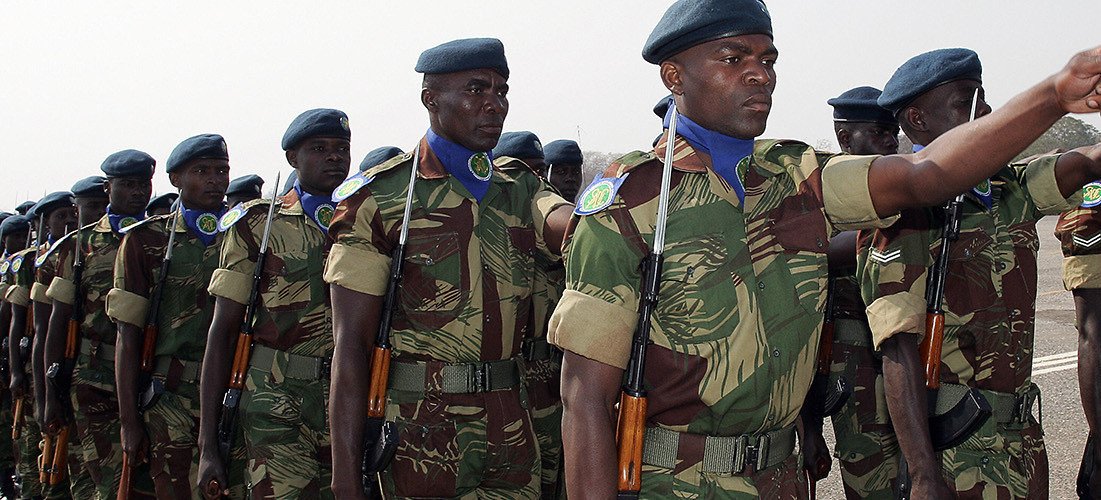
The African Standby Force was conceived in 2003 as the instrument that would let the African Union respond to a genocide, a coup, or a mass-atrocity crisis on the continent’s own terms, deployable within days rather than the months a United Nations mandate typically requires, staffed by five regional brigades drawn from member states and answerable to Addis Ababa rather than New York or a foreign capital. More than two decades later, the force exists on organisational charts, in periodic joint exercises with names like Amani Africa, and in the annual reports of the AU Peace and Security Council. It has never once deployed to an actual conflict. Every major crisis the continent has faced since 2003, Darfur, the Central African Republic, Mali, eastern Congo, Sudan’s civil war, has been met by a foreign-led mission, a foreign-backed regional coalition, or nothing, while the force built specifically to make that dependency unnecessary sat in reserve.
What Twenty Years of Non-Deployment Reveals
The gap between the force’s mandate and its record is not a story about incompetence so much as a story about what member states were actually willing to fund and cede control over when the moment to use it arrived. Each of the five regional brigades depends on troop and equipment commitments from national militaries that remain, first and foremost, national assets, answerable to the president who commands them before they answer to any continental structure. A government facing its own domestic security pressures, and most African governments face some version of that pressure continuously, has a strong incentive to hold its best-trained units in reserve for its own use rather than commit them to a continental force it does not control the deployment decision for. The African Standby Force was designed on the assumption that member states would subordinate that instinct to a collective interest. The design assumed away the actual politics.
Funding compounds the problem. The African Union’s operational budget for peace and security has historically depended heavily on external partners, the European Union chief among them, for the money that would actually move troops, aircraft, and logistics into a live conflict zone. A continental force meant to reduce dependence on foreign intervention has, in practice, needed foreign financing to move at all, which reintroduces exactly the external veto point the force was designed to eliminate. A donor uneasy about a specific deployment’s politics can simply decline to fund it, achieving through the budget line what a Security Council veto achieves through the vote.
A continental force meant to reduce dependence on foreign intervention has needed foreign financing to move at all.
Where the Continent Improvised Instead
The pattern that has actually emerged is not the Standby Force but a series of ad hoc coalitions assembled crisis by crisis: the G5 Sahel Joint Force, backed heavily by France before its collapse; the multinational force fighting Boko Haram around Lake Chad, built from Nigeria, Chad, Niger, and Cameroon without waiting for continental machinery; the Southern African Development Community’s mission into Mozambique’s Cabo Delgado insurgency, a regional bloc acting because the continental structure was not positioned to. Each of these arrangements demonstrates that African states can and do mobilise military force regionally when the interest is concentrated enough among a small number of directly affected neighbours. What they also demonstrate is that the continental layer, the level at which the Standby Force was supposed to operate, is consistently bypassed in favour of narrower coalitions with clearer, more immediate stakes for the states involved.
The Honest Diagnosis
The African Union has acknowledged the gap explicitly in its own internal reviews, which have periodically recommended smaller, faster, better-funded rapid-deployment capabilities as a more realistic substitute for the full five-brigade concept. Adopting that recommendation would be an honest downsizing of ambition to match actual political will, which is a defensible outcome, over continuing to fund an aspirational structure that has not deployed in twenty years while insisting, in AU communiqués, that it remains the strategic answer to the continent’s next mass-atrocity crisis. The Standby Force’s non-deployment is not primarily a logistics failure or a training gap, though both exist. It is the accurate record of what happens when fifty-five sovereign states are asked to build a force premised on ceding, at the critical moment, exactly the decision-making autonomy each of them has the strongest incentive to keep. Until that trade-off is resolved honestly, on paper or off it, the continent’s actual crisis response will keep running through whichever coalition of the willing happens to be closest and most interested, which is precisely the arrangement the Standby Force was created to replace.
The cost of that unresolved trade-off is not abstract. Every crisis met by an ad hoc coalition rather than a standing continental force is a crisis in which the response’s speed, mandate, and legitimacy depend on which neighbours happen to have the capacity and political will that particular month, rather than on a pre-agreed continental framework any member state could invoke. A genuine reckoning with the Standby Force’s record, honest about what member states will and will not cede, would at minimum let the continent stop budgeting for a five-brigade force it has shown no intention of empowering, and start building the narrower capability it has actually demonstrated, repeatedly, that it is willing to fund.