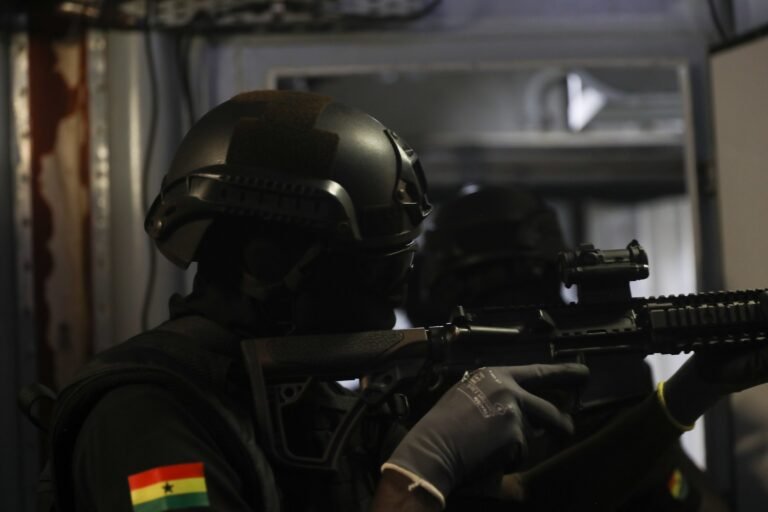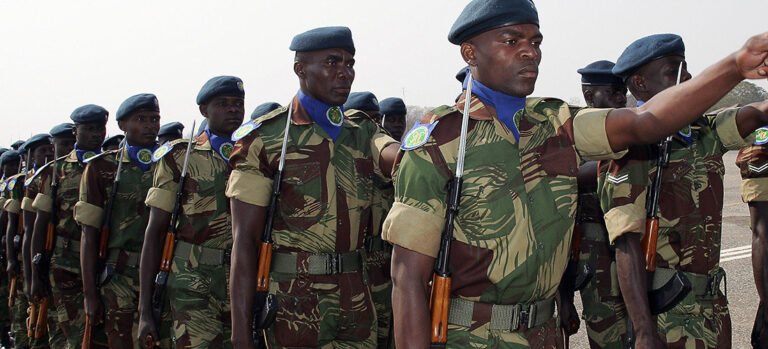
The convoy that rolled through Bamako under the insignia of the Africa Corps looked, to anyone who had watched the Wagner Group operate across the Sahel, entirely familiar. The vehicles were the same, many of the men were the same, and the service on offer was the same: regime protection, counter-insurgency, and a presence that signals to any would-be challenger that the government has a foreign guarantor. What changed was the letterhead. After the death of Wagner’s founder and the Kremlin’s decision to bring his network under direct state control, the mercenary brand was retired, and a ministry-run successor took its place. The event is a corporate restructuring. The structure beneath it is a transaction that tells you precisely how power is held, and at what price, in a growing band of African states.
The Bargain Itself
The transaction is simple enough to state in a sentence. A government facing insurgency, a coup risk, or a hostile population buys security and survival from Moscow, and pays in mining concessions, basing rights, and diplomatic alignment. In the Central African Republic, Mali, Burkina Faso, and beyond, the currency has frequently been gold, the most exportable and least traceable of assets, moved through channels that leave little for the national treasury. The Russian state gains revenue, a foothold on the continent’s western flank, and a bloc of votes at the United Nations. The regime gains the one thing it most needs: to remain in power. The population, in whose name the resources are nominally held, gains neither the gold nor the security, because the security being purchased is the regime’s, not theirs.
It would be a mistake, and a familiar one, to read this purely as Russian predation imposed on passive victims. The deal requires a willing buyer, and the buyer is an African government calculating its own survival. The juntas that invited the Africa Corps did so after concluding that Western security partnerships had failed to stop the insurgencies, came bundled with conditions about elections and governance, and could be withdrawn at the first political disagreement. Moscow’s offer is attractive precisely because it asks nothing about how the regime treats its citizens. The absence of conditionality is the product. A leader who fears his own population more than he fears a foreign patron will always prefer the partner who never raises the subject of that population, and that preference, not Russian cleverness, is what the arrangement is built on.
A leader who fears his own population more than he fears a foreign patron will always prefer the partner who never raises the subject of that population.
Sovereignty Leased in Ore
Follow the leverage and the cost becomes legible. The concession that pays for the guns is a national asset signed away by a government whose claim to represent the nation is, in several of these states, the barrel of those same guns. Gold that should underwrite a budget, fund a clinic, or service a debt is instead the fee for keeping a particular set of men in the presidential palace. The risk is socialised, and the benefit is captured. The population carries the depletion of a finite resource and the entrenchment of an unaccountable government, while the regime and its foreign guarantor split the proceeds. This is the mechanism by which sovereignty is leased rather than lost, signed over in instalments priced in ore, each concession narrowing the next government’s room to govern.
A Defective Product
The security itself is worth examining on its own terms, because the product is often defective. The Africa Corps and its predecessor have a documented record of brutality against civilians that has, in several theatres, deepened the very grievances the insurgencies feed on. A counter-insurgency that massacres villagers recruits for the enemy. The regimes that bought protection have not, in most cases, defeated their insurgencies; they have outsourced the appearance of action while the underlying conflict grinds on. The bargain buys the government time and a guarantor against a coup. It does not buy citizen safety, which means the thing actually being purchased was never national security at all. It was regime security wearing national security’s uniform.
The symmetric judgement has to fall on both ends of the deal. Moscow is running an extractive protection racket dressed as partnership, and that should be named without euphemism. But the conditions that made the racket viable were manufactured at home: governance failures that produced the insurgencies, the hollowing of accountable institutions that left the gun as the only route to power, and the choice to treat the population as a threat to be managed rather than a constituency to be served. The Africa Corps did not create the demand for unconditional regime protection. It identified the demand, met it, and priced it in gold. The supplier is foreign. The market is domestic.
What the rebrand reveals, in the end, is how little the name on the convoy matters and how much the bargain does. A continent watching the Africa Corps replace Wagner should not be reassured that a state actor has displaced a private one, because the discipline of a state can make an extractive arrangement more durable, not less. The relevant question is not which Russian entity holds the contract but why African governments keep signing it, and the answer points inward. As long as leaders fear their own people more than they value their own resources, there will be a buyer for unconditional security and a seller willing to take payment in the nation’s wealth. The mercenaries changed their name. The thing being sold did not, and the thing being spent is the future the gold was supposed to buy.