
The Central African Republic has been described, consistently and inaccurately, as a failing state. The description fails because it implies a state that once worked and is now breaking down. CAR is more precisely understood as a territory that has been governed, since its formal independence in 1960, primarily as an extraction mechanism, for French uranium and timber interests during the colonial period, for diamonds and gold through successive weak administrations thereafter, and now, under the arrangement that has replaced French security with Russian private military presence, for the same resources under new management. What is described as chaos is, on closer inspection, a system that works very well for the parties extracting value from it. It works terribly for the majority of its five million inhabitants.
A History of Armed Seizure
The coup of March 2013, which brought the Séléka coalition to power and removed President François Bozizé, is conventionally dated as the beginning of CAR’s current crisis. The periodisation is too narrow. CAR’s post-independence history is a sequence of armed power seizures, French-backed or French-tolerated, interrupted by brief intervals of quasi-constitutional governance. David Dacko, Jean-Bédel Bokassa, Ange-Félix Patassé, François Bozizé- the names changed; the pattern of armed seizure, resource exploitation, and political violence did not. The 2013 coup removed a government that had been losing territorial control for years, replaced it with a coalition held together by the logic of armed access to mining areas rather than any coherent political programme, and triggered the formation of anti-Balaka self-defence militias whose atrocities against Muslim communities generated their own spiral of displacement and counter-violence.
The United Nations Multidimensional Integrated Stabilisation Mission in the Central African Republic (MINUSCA) was deployed in 2014 and has remained, at a cost of approximately one billion dollars annually, without achieving the security stabilisation its mandate requires. MINUSCA’s operational constraints illuminate a broader truth about peacekeeping in contexts of governance absence: a force designed to support a state cannot substitute for one. Where there is no functioning government capable of extending authority, collecting revenue, paying civil servants, or delivering services, peacekeeping maintains a ceasefire around a vacuum. The violence periodically resurfaces because the underlying conditions- armed competition for resources, absence of legitimate alternative livelihoods, minimal state reach beyond Bangui- remain unchanged.
Security Traded for Resources
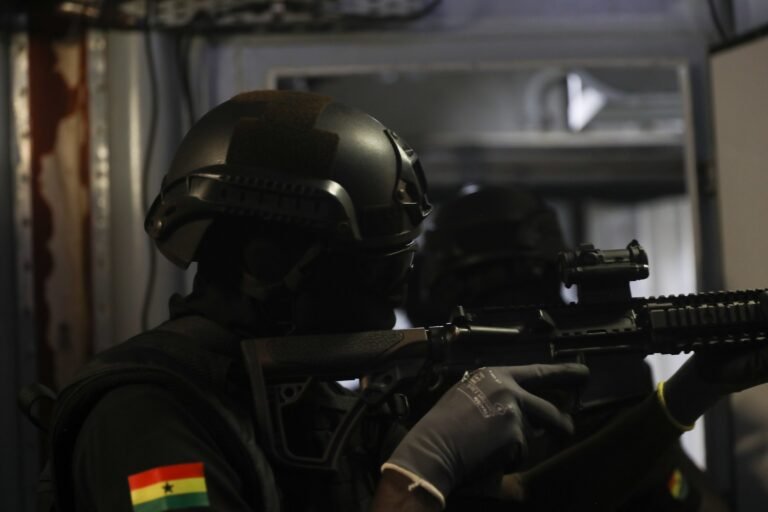
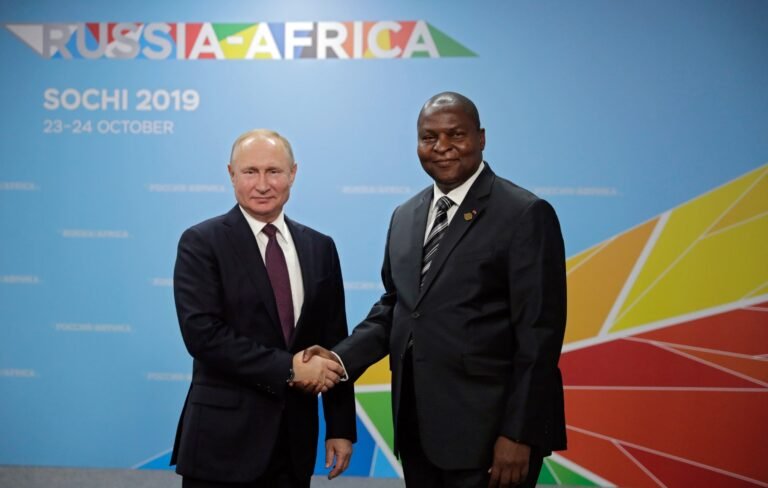
The arrival of the Wagner Group in CAR from approximately 2018 onward changed the operational dynamics without changing the structural logic. Wagner, operating initially under the cover of a Russian military training mission, moved into active combat roles alongside the Central African Armed Forces (FACA), helping the Touadéra government recover territory from the Coalition of Patriots for Change rebel coalition that had formed in 2020. In exchange, Russian-connected entities received access to mining concessions, gold, diamonds, and uranium in the areas that Wagner helped secure. The pattern was not unique to CAR; it has been replicated in Mali, Burkina Faso, Libya, and Sudan with variations. Security in exchange for resources is a transaction as old as the first armed camp that offered a mining company protection for a percentage of the yield.
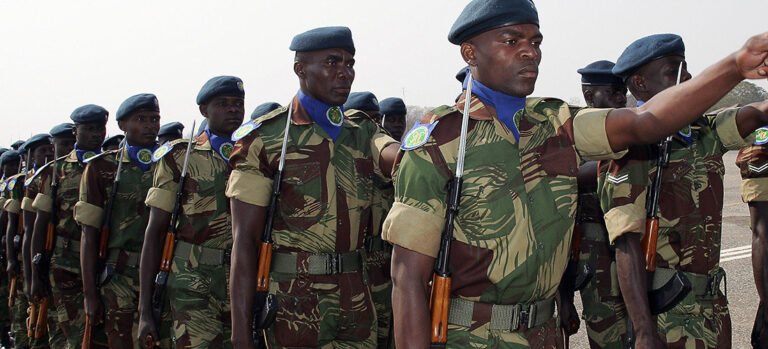
What has changed in CAR since Wagner’s operational involvement is the territorial reach of the government, extended into areas previously held by armed groups, and the reported severity of human rights abuses attributed to Wagner fighters, documented extensively by the UN Panel of Experts on the Central African Republic and by human rights organisations including Human Rights Watch and Amnesty International. Summary executions, torture, forced displacement, and looting have been attributed to Wagner and FACA joint operations in multiple provinces. The extension of state reach has come at a cost to civilian populations that the international community has been unable to constrain and the government has lacked either the will or the capacity to prevent.
The Diamond Chain
CAR’s diamond sector illustrates the resource extraction dynamic with particular clarity. The country sits on significant alluvial diamond deposits, primarily in the west and southwest. The Kimberley Process Certification Scheme banned its diamond exports, the international mechanism designed to prevent conflict diamond financing, from 2013 to 2016, and compliance-zone trading resumed only partially thereafter. The artisanal miners who extract the majority of CAR’s diamonds operate in conditions of near-total informality: without safety protections, without price transparency, without legal access to formal financial systems, and without security of tenure over their mining sites. The diamonds that leave their hands travel through a chain of intermediaries before entering formal export channels, a chain at which each node extracts a margin. At the same time, the miner, at the base, receives the least and bears the greatest risk.
The political settlement that CAR needs- a genuine power-sharing arrangement among armed groups, a governance framework that extends meaningful state authority beyond Bangui, a revenue system that captures and redistributes resource rents to the population- is structurally blocked by the same parties that benefit from the current disorder. Armed group leaders have economic interests in maintaining the informal mining and timber extraction economies that conflict enables. External actors, Russian mining interests, Cameroonian and Chadian traders, Lebanese diamond merchants, have commercial interests in a regulatory environment that remains too weak to enforce formal pricing and taxation. The CAR government itself, dependent on the security that Wagner provides, has limited leverage to impose conditions on its protectors.
The lesson CAR encodes for the continent is not one of exceptional failure. It is a demonstration of what happens when the post-colonial state structure is built around resource extraction without governance infrastructure, and then left to manage that contradiction without the fiscal resources, security capacity, or institutional depth to do so. The chaos is legible once you understand what it is protecting. Addressing it requires not just peacekeeping and humanitarian aid, both of which CAR receives in substantial measure, but a fundamental renegotiation of who captures value from CAR’s resources, and whether the Banguian state and the communities whose land sits above those resources will ever be primary beneficiaries of what the ground beneath them contains.