Yoweri Museveni has governed Uganda since 1986, longer than most Ugandans have been alive. His grip on the state is institutional, financial, and coercive in ways that formal political analysis tends to understate. When Robert Kyagulanyi Ssentamu, known universally as Bobi Wine, announced his candidacy for the 2021 presidential election, he was not primarily mounting a political campaign. He was posing a question that Museveni’s Uganda had long avoided: what happens when a generation that grew up entirely inside one man’s system decides it will no longer inherit it?
The question carried particular weight because of who was asking it. Bobi Wine was not a lawyer, a general, or a technocrat. He was a musician from Kamwokya, one of Kampala’s most densely populated working-class neighbourhoods, who had built one of East Africa’s largest popular audiences through ghetto gospel and dancehall that spoke the language of his community’s daily precarity. His songs addressed corruption, police brutality, land grabbing, and the systematic exclusion of ordinary Ugandans from the economy that their labour sustained. He was not a political outsider who discovered music. He was a musical insider who discovered that his platform constituted a form of political power that the state had not adequately accounted for.
From Music to Mandate
His entry into formal politics began in 2017 with a by-election victory in Kyadondo East constituency, where he ran as an independent against an NRM-backed candidate. The margin of victory was significant enough to register as a signal rather than an anomaly. What it signalled was that Bobi Wine’s popular audience was convertible into electoral support, that the political affect he had accumulated through music could be mobilised around candidates and causes in ways that bypassed the NRM’s patronage networks. For a government that had spent three decades managing political competition through financial inducement and institutional control, this was a genuinely novel problem.
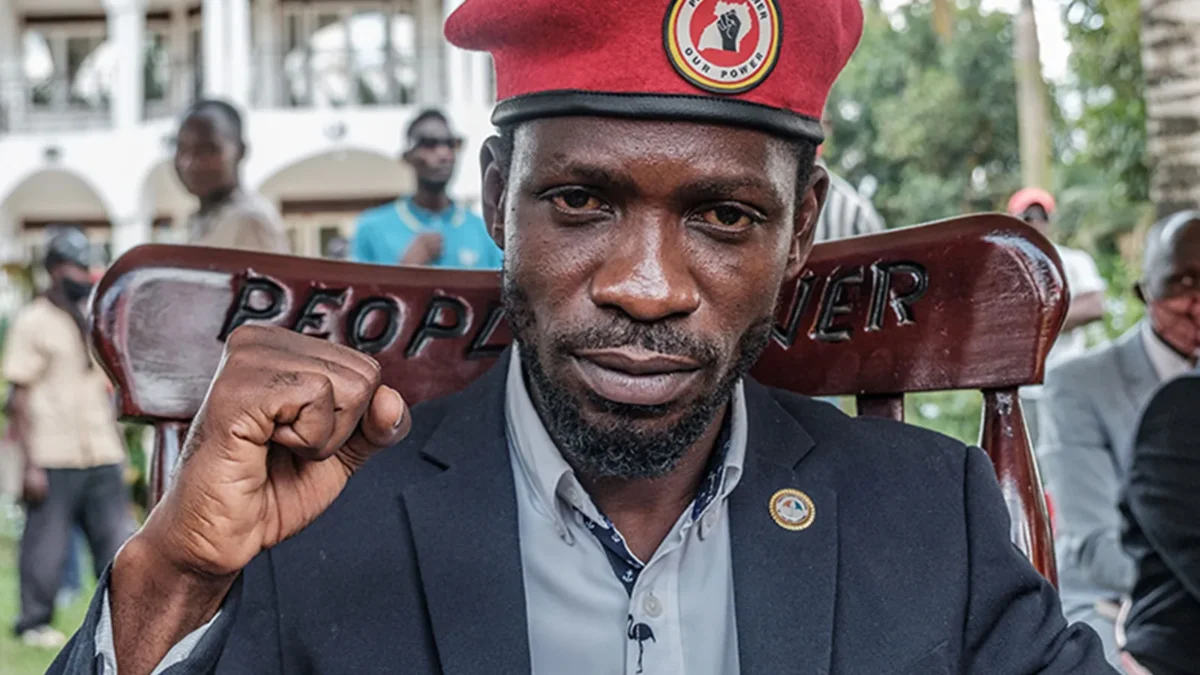
The People Power movement that coalesced around him in the lead-up to 2021 was not a conventional political party. It was an identification, a declaration that a constituency existed, primarily young, primarily urban, primarily excluded from the formal economy, that recognised itself in Bobi Wine’s biography and his message. “We are removing a dictator,” he said consistently, with a directness that Ugandan opposition politics had historically avoided in favour of technocratic critiques of NRM governance. The directness was strategic: it named what was actually happening rather than performing the fiction that Uganda’s elections were competitive within a functioning democratic framework.
The State Answers with Force
The state’s response confirmed what his candidacy claimed. Campaign rallies were blocked or dispersed by security forces. In August 2018, following the death of a police officer in campaign-related violence in Arua, Bobi Wine was arrested, held incommunicado, and, according to his testimony before Ugandan and international audiences, tortured while in military detention. The Ugandan government denied the torture allegation. The subsequent medical examination conducted in the United States, where he flew for treatment, documented injuries consistent with his account. The international attention generated by his treatment, Congressional hearings in Washington, statements from EU member state governments, and civil society campaigns demonstrated that Museveni’s management of political opposition had acquired a visibility cost it had not previously carried.
The 2021 election was conducted under conditions that international observers documented extensively as falling below democratic standards. Internet and social media were shut down in the days before and after the vote. Opposition polling agents were excluded from counting centres. The official result declared Museveni the winner with 58.6 per cent against Bobi Wine’s 34.8 per cent. Bobi Wine rejected the result, citing evidence of systematic manipulation, and filed a petition with the Supreme Court, which was subsequently dismissed. He announced he would not contest the ruling through further legal channels, arguing that the judiciary operated under government influence. He was right to be sceptical: every previous presidential election petition filed in Uganda had failed.
The Generational Fault Line
What Bobi Wine’s political journey reveals about Uganda extends beyond the familiar narrative of opposition suppression. It reveals the specific vulnerability of a system built around one man’s authority when that authority no longer commands the consent, even the reluctant consent, of a generation that constitutes the numerical majority. Museveni’s NRM governs a country where more than seventy per cent of the population is under thirty. That generation has no memory of the instability that Museveni’s arrival ostensibly resolved. They know only the NRM’s governance, its failures of education, healthcare, and economic inclusion, its corruption, its systematic criminalisation of dissent. Bobi Wine did not manufacture their dissatisfaction. He gave it a face, a soundtrack, and a vocabulary.
The longer arc of Uganda’s politics will not be determined by one election. But the political grammar that Bobi Wine introduced, the insistence on naming power honestly, the translation of cultural identity into political mobilisation, the assertion that popular consent is not optional even in a system designed to operate without it, has been absorbed by a generation that will still be there long after any individual leader is gone. The sound system has been built. The question is when, and how, its full power will be heard.