When Egyptian military aircraft landed at Mogadishu’s Aden Adde International Airport in September 2024, carrying weapons and armoured vehicles for the Somali National Army, the immediate framing was straightforward: Egypt was supporting a fragile state’s security forces. The actual architecture of what was happening was more complex. Cairo was not acting in Somalia’s interests. It was acting in Cairo’s interests, deploying military engagement in the Horn of Africa as an instrument of pressure on Addis Ababa over the Grand Ethiopian Renaissance Dam, a dispute about Nile water that has been building for over a decade and has now escaped its riverine geography.
The Dam Behind the Deployment
The GERD context is essential. Ethiopia began construction of the dam on the Blue Nile in 2011. When fully operational, it will be Africa’s largest hydroelectric power station, generating approximately 5,000 megawatts of electricity and fundamentally altering the flow regime of the Nile into Egypt. For Egypt, a country that receives over ninety per cent of its freshwater from the Nile and whose 105 million people live almost entirely in the river’s narrow floodplain, the dam represents an existential water security threat. Egypt has articulated this position at every available international forum, sought mediation through the African Union, approached the UN Security Council, and explored legal mechanisms under international water law. None of these avenues has produced a binding resolution, because Ethiopia regards the GERD as a sovereign development project on a river that originates within its territory, and no international legal framework unambiguously overrides that position.
Denied a diplomatic resolution, Egypt has moved into the strategic toolkit available to states that cannot resolve disputes through formal channels. Its deepening engagement with Somalia is best understood as the opening of a second front, a way of creating leverage against Ethiopia by cultivating relationships with Ethiopian neighbours and rivals. Somalia and Ethiopia share a long and contested border, historical tensions over the Ogaden region, and an ongoing dispute about the maritime territory that separates their coastlines. Ethiopia’s military intervention in Somalia through AMISOM and subsequent peacekeeping frameworks has given Addis Ababa significant influence over Somali security dynamics. Cairo’s military engagement directly complicates that influence.
The September 2024 weapons delivery was not Egypt’s first move in this geopolitical sequence. Cairo had been developing its Somali relationship for several years, building on historical ties and capitalising on Mogadishu’s periodic frustrations with Ethiopian influence in Somali affairs. The timing of the accelerated military cooperation in 2024 corresponded precisely with the period when the GERD began operating at increased capacity and when Ethiopia signed a controversial memorandum of understanding with Somaliland, the self-declared independent region in northern Somalia, granting Ethiopia potential access to Somaliland’s Red Sea coast in exchange for unspecified support. Mogadishu’s fury at the Ethiopia-Somaliland MOU created exactly the alignment of interests that Egypt needed: a Somali government actively seeking regional partners as a counterbalance to Ethiopian influence.
A Crowded Map
The Horn of Africa is thus managing multiple overlapping geopolitical competitions simultaneously. The Nile water dispute between Egypt and Ethiopia has become a regional proxy conflict. The Ethiopia-Somaliland MOU has rearranged the Horn’s diplomatic geometry. Eritrea, which shares a volatile history with both Ethiopia and Somalia, has its own calculations about regional power balance. Djibouti, hosting military bases from France, the United States, China, Japan, and Italy, is the most internationalised point on the map. And the Red Sea’s broader security architecture, already destabilised by Houthi missile attacks on commercial shipping from 2023 onward, adds a maritime dimension to what is already a complex continental equation.
Somalia’s Calculation
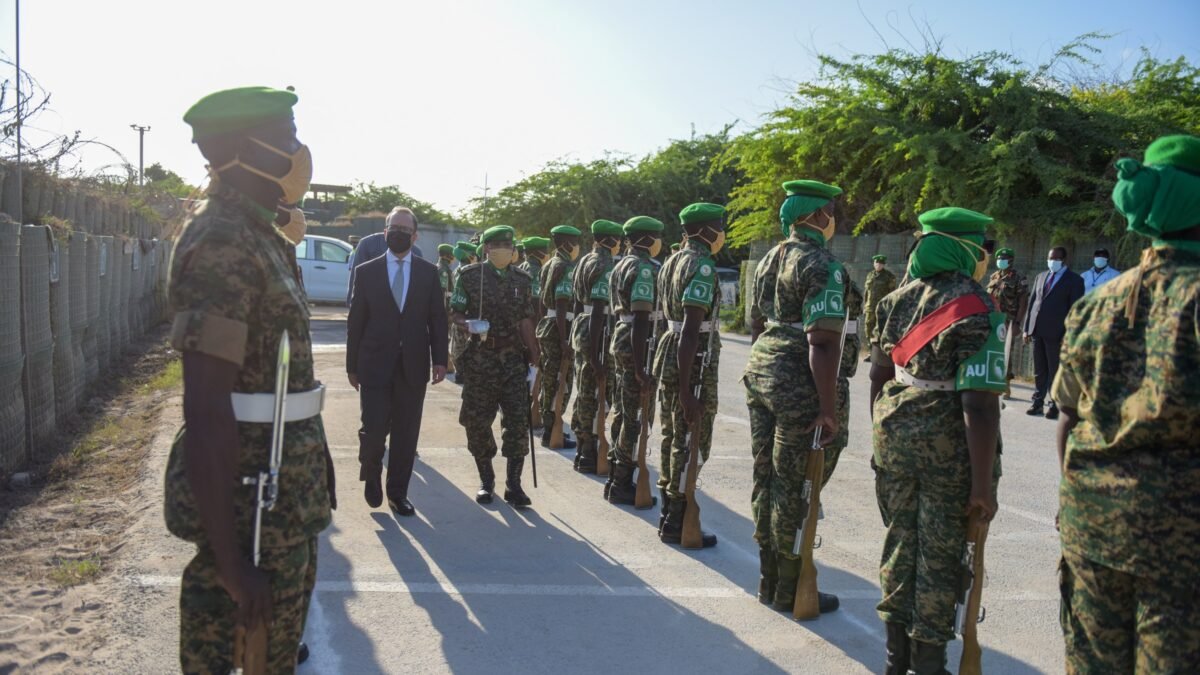
For Somalia, the Egyptian relationship carries both benefits and risks. The weapons and equipment that Egypt is providing represent genuine material support for the Somali National Army’s ongoing operations against al-Shabaab, which controls significant territory in southern and central Somalia and continues to mount attacks on Mogadishu and other urban centres. Any credible security capability that the SNA acquires is useful, regardless of the geopolitical logic behind its provision. But Somalia’s diplomatic positioning, the explicit alignment with Egypt against Ethiopia, risks closing off channels with Addis Ababa that Mogadishu may need as its security situation evolves. ATMIS, the AU Transition Mission in Somalia that replaced AMISOM, includes Ethiopian forces. If the Somalia-Ethiopia diplomatic rupture deepens, the continuity of that security contribution becomes uncertain.
The Nile dispute that is driving this regional reconfiguration will not be resolved through proxy military positioning. The technical and hydrological questions about dam operations, filling schedules, and downstream flow guarantees require negotiated agreements between Egypt, Ethiopia, and Sudan, the three riparian states with the most direct stake in the outcome. Those negotiations have failed repeatedly, not because the technical solutions are unavailable but because the political trust required to implement them does not exist. Egypt’s regional manoeuvring in Somalia reflects, among other things, the frustration of a state that has run out of conventional diplomatic options and is improvising with the instruments it has left.
What the Egypt-Somalia-GERD triangle reveals about African geopolitics is a lesson the continent has been learning and relearning since independence: water, land, and energy are not technical problems. They are power problems, and where the formal mechanisms for managing power disputes are weak or absent, the disputes find informal, regional, and ultimately military expression. Africa needs water diplomacy infrastructure, binding frameworks, joint technical commissions with real authority, dispute resolution mechanisms with enforcement capacity, that can manage the transboundary resource conflicts that climate change will multiply. The Nile basin is the most urgent test case. What happens there will shape how the continent manages every comparable dispute that follows.