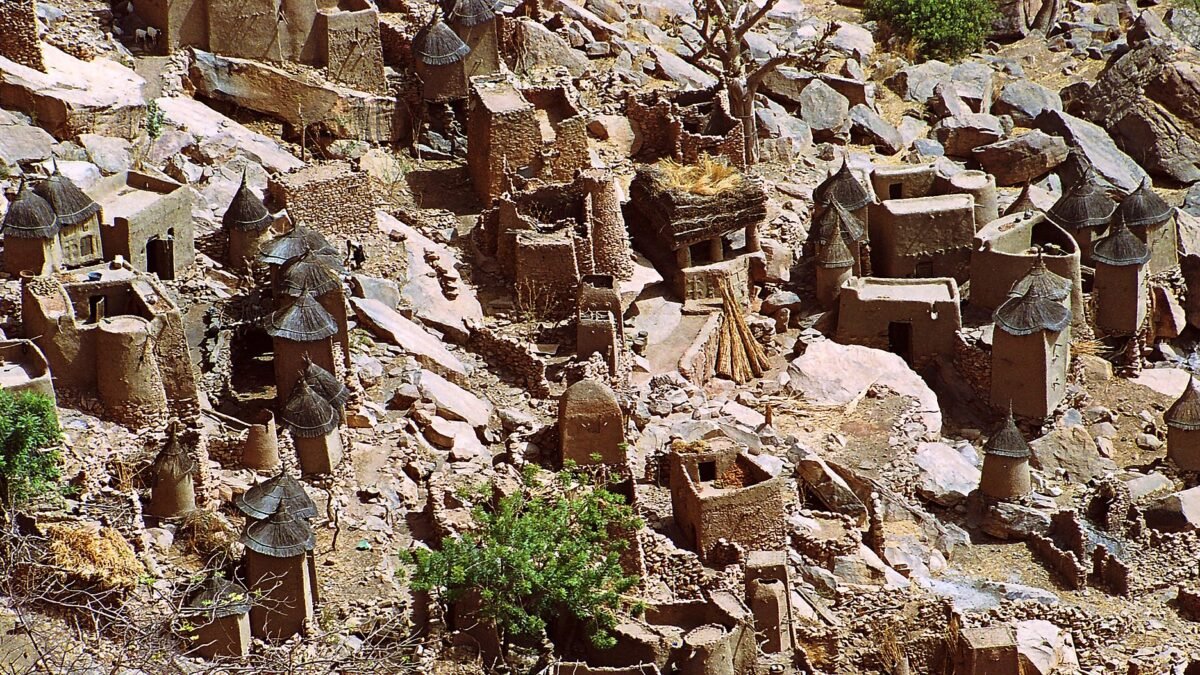
The Dogon people of Mali’s Bandiagara Escarpment calculate the universe in sixty-year cycles. The Sigui, their most sacred ceremony, performed only once across that entire span, is not merely a ritual. It is a civilisational act: a society’s declaration that it has endured, renewed itself, and maintained the chain of knowledge across a generation. The ceremony moves village by village across the escarpment over a period of seven years, a slow processional that stitches the community’s past to its present in the language of dance, mask, and collective memory. The last complete Sigui cycle concluded in the 1960s. The next should begin in the 2020s. Whether it will, in the conditions that Mali’s Dogon country has faced in the years of jihadist incursion, Fulani-Dogon communal violence, and state security failure, is a question with civilisational stakes.
The Dogon case is not simply an ethnographic tragedy. It is a strategic signal. What is happening in the Bandiagara region illuminates the relationship between civilisational knowledge systems and political violence in ways that standard security analysis consistently misses. The jihadist expansion that has moved south and east from Mali’s northern regions since 2012 is not only a security phenomenon; it is a cultural confrontation, in which the cosmological and ceremonial life of communities like the Dogon is targeted not as collateral damage but as a strategic objective. Disrupting the transmission of indigenous knowledge is a form of territorial conquest that leaves no rubble, creates no refugee column visible to satellite imagery, and generates no casualty count that triggers international response thresholds.
A civilisation that misses its ceremonial moment does not simply lose a tradition. It loses the mechanism through which knowledge crosses generations, and once that chain is broken, sixty years of accumulated meaning cannot be reconstructed from archives or oral summaries alone.
When the Mechanism Breaks
The conflict in Dogon country is multi-layered and has been catastrophically misread by international observers. The communal violence between Dogon farmers and Fulani herders, which produced the Ogossagou massacre of March 2019, in which over 160 Fulani civilians were killed in a single attack attributed to Dogon hunters, was reported as an ethnic conflict over grazing resources. That reading is not wrong, but it is incomplete. Underneath the immediate competition over land and water is a structural disruption: the collapse of the traditional conflict resolution mechanisms that allowed Dogon and Fulani communities to coexist across centuries of ecological competition. Those mechanisms were maintained partly through the ceremonial and governance structures that the security crisis has dismantled. When the ceremony cannot be performed, the authority structure attached to the ceremony cannot function. When the authority structure cannot function, violent alternatives fill the governance vacuum.
The Epistemological Chain
The Dogon’s astronomical knowledge, documented by French anthropologist Marcel Griaule in the 1930s and 1940s and subsequently contested and refined by subsequent scholarship, includes awareness of Sirius B, the white dwarf companion of the brightest star visible from Earth, at a time when Western telescopes had not yet confirmed its existence. Whatever the precise interpretation of how that knowledge was acquired and maintained, the Dogon demonstrate that non-literate, non-institutionalised knowledge systems can sustain sophisticated cosmological understanding across generations through ceremonial transmission. The Sigui is how that transmission works, not as metaphor, but as the actual mechanism by which each generation receives and validates what the previous generation knew. Break the ceremony, and you break the epistemological chain.
Mali’s security crisis has not waited for a convenient pause. The displacement of communities from the Bandiagara Escarpment’s peripheral villages, the restriction of movement imposed by the security environment, and the targeting of community gatherings by armed groups have created conditions in which the Sigui’s seven-year procession, which requires movement between villages, the gathering of initiated elders, and the participation of the full community, cannot be conducted safely in the manner the ceremony’s structure demands. A civilisation that must defer its generational ritual because the conditions for conducting it safely do not exist is a civilisation in an existential encounter with time that no security force, no UN resolution, and no development programme is currently designed to address.
A Continental Pattern
This is where the Dogon case extends beyond its own geography. Across the Sahel, across Central Africa, across the Great Lakes region, indigenous knowledge systems tied to ceremonial cycles, seasonal governance, and territorial memory are under pressure from the same combination of forces: conflict-driven displacement, climate disruption of the ecological conditions that ceremonies address, and the replacement of indigenous governance structures by either state bureaucracy that does not recognise them or armed groups that actively suppress them. The loss is not quantifiable in the frameworks that international development and humanitarian systems use. It does not appear in HDI scores or displacement statistics. It appears, instead, in the gradual thinning of the cultural fabric that makes communities cohesive enough to govern themselves, resist external predation, and maintain the identity that makes resistance meaningful.
The Sigui is not a curiosity of Sahelian anthropology. It is a civilisational clock, and the communities whose clock it represents are living in the moment when it either ticks forward or stops. What happens in that moment, in the Bandiagara Escarpment and in the countless analogous sites across the continent where indigenous knowledge confronts the combined pressures of conflict and climatic disruption, will shape the cultural inheritance of Africa long after the current security crisis has passed into historical memory. Civilisations that miss their moments do not always recover them. That is the war against time, and it is being lost quietly, in villages where no one is counting.