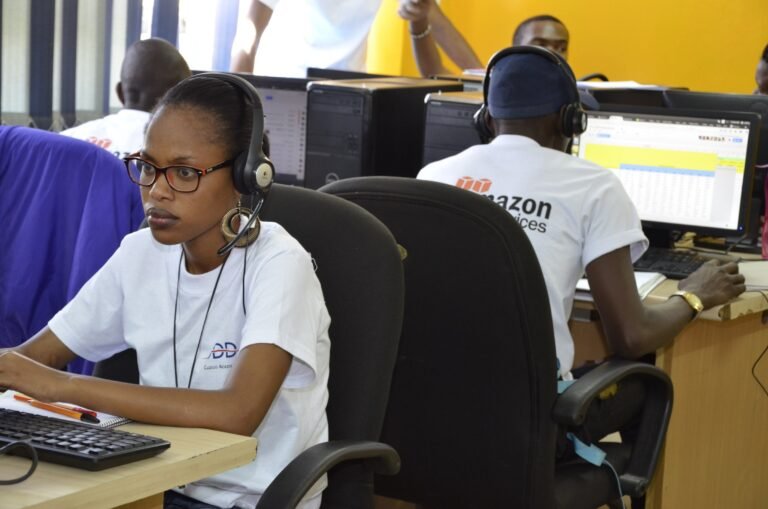

The World Economic Forum’s early projections about artificial intelligence eliminating five million jobs by 2020 were wrong in their specifics and right in their direction. Automation has reshaped labour markets in ways that do not announce themselves as job elimination but manifest as category shifts; human tasks are now algorithmic, and sectors that were labour-intensive now require fewer hands and different skills. For Africa, which enters this transition with youth unemployment at structural crisis levels and educational systems that have not yet resolved the gaps created by colonial-era design, the question is not whether artificial intelligence will transform the continent’s economies. It will. The question is whether Africa’s artificial intelligence policy will be designed to serve African sovereign interests or to reproduce the dependency architectures of previous technological transitions.
Adoption Is Already Here
The adoption cases are real and instructive. Nigeria’s healthcare system faces a doctor-to-patient ratio estimated at approximately 1:4,000, a gap that no training programme will close within a generation. AI-assisted diagnostic tools that reach patients through mobile phones are not a substitute for that workforce, but they are a form of distributed medical capacity that the infrastructure gap makes necessary rather than supplementary. Rwanda’s partnership with Zipline for drone delivery of blood and medical supplies to remote health facilities has demonstrated, at operational scale, that AI-enabled logistics can resolve distribution problems that road infrastructure would take decades and billions to address. In financial services, fraud detection systems deployed across African banking infrastructure have materially reduced losses in markets where the absence of physical branch networks makes digital-first exposure unavoidable. These are not aspirational case studies. They are operational realities in 2025.
Agriculture, which remains the economic base for the majority of Africans and a security-critical sector for governments whose legitimacy is partly measured by food prices, is the domain in which Africa’s artificial intelligence deployment has the most direct sovereign implications. Smallholder farmers managing rain-fed crops in climates that are increasingly unpredictable need yield forecasting, pest prediction, soil quality assessment, and market price information. AI systems that provide these functions are not eliminating agricultural labour; they are improving the productivity of labour that will otherwise make decisions with inadequate information and absorb climate risk that better-resourced farming systems can offset. The question of who owns the data generated by these systems, the transaction histories, the yield records, the soil profiles, is the African artificial intelligence sovereignty question in its most concrete form. Data extracted from African agricultural systems and processed by foreign cloud infrastructure is a resource flow that mirrors the extraction patterns of the colonial commodity economy.
The Displacement Problem
The concern about automation displacement is not hypothetical. Ethiopia’s textile manufacturing sector, which attracted foreign investment partly due to low labour costs, faces automation pressures that the early manufacturing-led development trajectory assumed it would not encounter at this stage. Botswana’s retail sector, where unions are documenting the displacement of checkout and inventory workers by automated systems, is experiencing a version of the same challenge. For a continent that has not yet completed the industrialisation phase that provided the employment absorption capacity for Asian development transitions, automation arriving before that absorption capacity exists creates a political economy problem of considerable severity. Youth cohorts that cannot find formal employment are not stable constituencies.
The infrastructure gap beneath Africa’s AI ambition is real but consistently underestimated in discussions. An erratic power supply is not a minor operational inconvenience for data centre economics; it is a capital-cost multiplier that makes locally hosted AI infrastructure more expensive than cloud alternatives in power-stable geographies. Connectivity gaps that affect rural populations disproportionately reproduce the existing inequality map in digital form. Countries like Rwanda, Ghana, and Kenya that have made deliberate public investment in digital infrastructure have created the baseline conditions that make AI deployment viable across a broader social range. Countries that have not made those investments face AI adoption that serves urban, educated, connected populations and excludes the majority, which is to say, they face AI deployment that amplifies existing inequality rather than disrupting it.
Ownership, Not Adoption

Africa’s regulatory architecture for artificial intelligence is the decisive question of sovereignty. Nations that do not write their own digital policy frameworks will have them written by the commercial and geopolitical interests of those who build and deploy the systems. The European Union’s AI Act, whatever its implementation challenges, represents a jurisdictional assertion, a claim that the rules governing AI systems operating in EU territory will reflect EU values and interests rather than the preferences of the US or Chinese companies that build them. Africa needs an equivalent assertion, calibrated to African political economies, African data sovereignty interests, and African definitions of what AI systems should be permitted to do and to whom. Without it, Africa’s adoption of artificial intelligence will be a form of digital colonialism dressed in the vocabulary of innovation.
The developmental window is real. Africa’s demographic structure, the youngest population of any major world region, with over 60 per cent under twenty-five in many states, is the human capital base from which an African AI sector could be built. Universities and technical institutes that train the population in AI development, rather than only in AI application, create the possibility of African-owned systems rather than African-consumed ones. The distinction between producing AI and consuming it is the distinction between technological sovereignty and digital dependency. It is not automatic. It requires sustained investment in research infrastructure, in mathematics and computer science education from the secondary level upward, and in the startup and enterprise ecosystem that converts technical capability into economic output. These are known requirements. They are political choices.