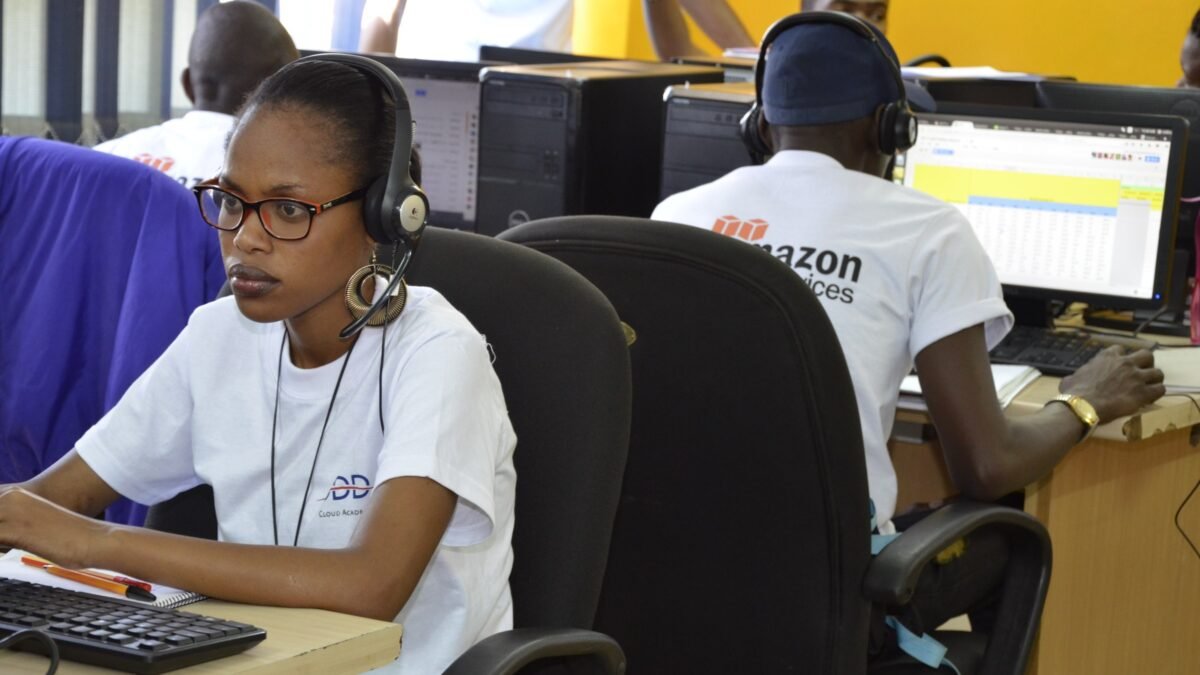
Before a large language model can refuse to generate violent or exploitative content, a human has to look at examples of that content and label it, over and over, thousands of times. Hence, the system learns what to reject. A significant share of that labelling, for some of the world’s most widely used AI systems, was done in Nairobi, by Kenyan workers employed through outsourcing firms contracted by American technology companies, for wages that in several documented cases fell under two dollars an hour. The technology those workers helped make usable, and in some cases safe enough to release publicly, now generates billions of dollars in valuation for companies in San Francisco. The workers who trained it hold no equity, no royalty, and in several cases documented by labour investigations and lawsuits, no ongoing employment once the training contracts ended.
The Labour Nobody Sees in the Product

Artificial intelligence is often described, including in this publication’s own past coverage of the technology’s African adoption gap, as a question of infrastructure and ownership at the level of models and compute. There is a layer beneath that one, more mundane and more exploitative, that receives far less attention: the human annotation and content moderation labour that makes a raw model into a usable, safety-tested product. Someone has to review the toxic, violent, or sexually exploitative material a model might otherwise reproduce, label it as such, and do so at a volume and speed that makes the underlying system reliable. That work was outsourced heavily to Kenya over the past several years, following a business logic identical to the one that sent call-centre and business-process outsourcing work to the Philippines and India a generation earlier: skilled English-speaking labour, available at a fraction of the cost a company would pay in its home market.
Sama, a San Francisco-headquartered outsourcing firm with major operations in Nairobi, became the most publicly documented case after reporting revealed its workers had reviewed graphic and traumatic content to help train content-moderation systems for a major AI developer, for wages workers and labour advocates argued did not reflect the psychological toll of the work or the value the resulting product generated. Workers described developing symptoms consistent with post-traumatic stress after months spent reviewing the worst material available on the internet, filtered specifically so an AI system and the paying customers who would eventually use it never had to see it. Several former workers subsequently pursued legal claims against the outsourcing arrangement in Kenyan courts, arguing the work amounted to exploitative labour practices masked by a technology-sector label.
The work was filtered specifically so an AI system, and the paying customers who would eventually use it, never had to see it.
Who Actually Captures the Value
Follow the money through the supply chain and the asymmetry is stark. The AI company that commissions the labelling work captures a trained, safety-certified model that can be licensed, embedded in products, and valued by investors at multiples of the entire outsourcing contract’s cost. The outsourcing firm captures the margin between what the client pays per labelled item and what the Kenyan workers are paid to do the labelling. The workers themselves capture an hourly wage, and in the more troubling cases documented by reporting and litigation, an exposure to psychological harm with limited employer-provided mental health support. None of the three parties in that chain shares equally in what the finished product is worth, and the party bearing the most direct human cost of producing it captures the smallest share of the value by a wide margin.
What a Different Arrangement Would Require
Kenya has genuine leverage in this relationship that has gone largely unused so far: the specific combination of English-language fluency, education levels, and lower wage floors that made it attractive to outsourcing firms in the first place is not easily replicated at the same cost elsewhere, which means the country could, in principle, negotiate labour standards, minimum wage floors specific to psychologically hazardous digital work, and portions of downstream value as a condition of hosting this industry, the way jurisdictions negotiate local content requirements in extractive industries. That has not happened at scale. Kenyan labour law has only recently begun to catch up to gig and outsourced digital work as a category requiring specific protection, and the AI companies commissioning the labour have faced reputational pressure from investigative reporting more consistently than they have faced binding regulatory requirements from the government whose citizens are doing the work.
The comparison worth sitting with is the one AI companies do not volunteer: the same firms marketing their products as advancing human welfare built the safety features underpinning that marketing on labour conditions that, applied to any other industry, would draw immediate scrutiny as exploitative outsourcing. Nairobi became a hub for that work because it offered skill at low cost, precisely the value proposition every extractive arrangement on the continent has offered a foreign buyer for a century. The raw material this time is not a mineral. It is attention, judgement, and psychological endurance, extracted at a price that reflects Kenya’s weak bargaining position in a global labour market, not the value of what was actually produced.