


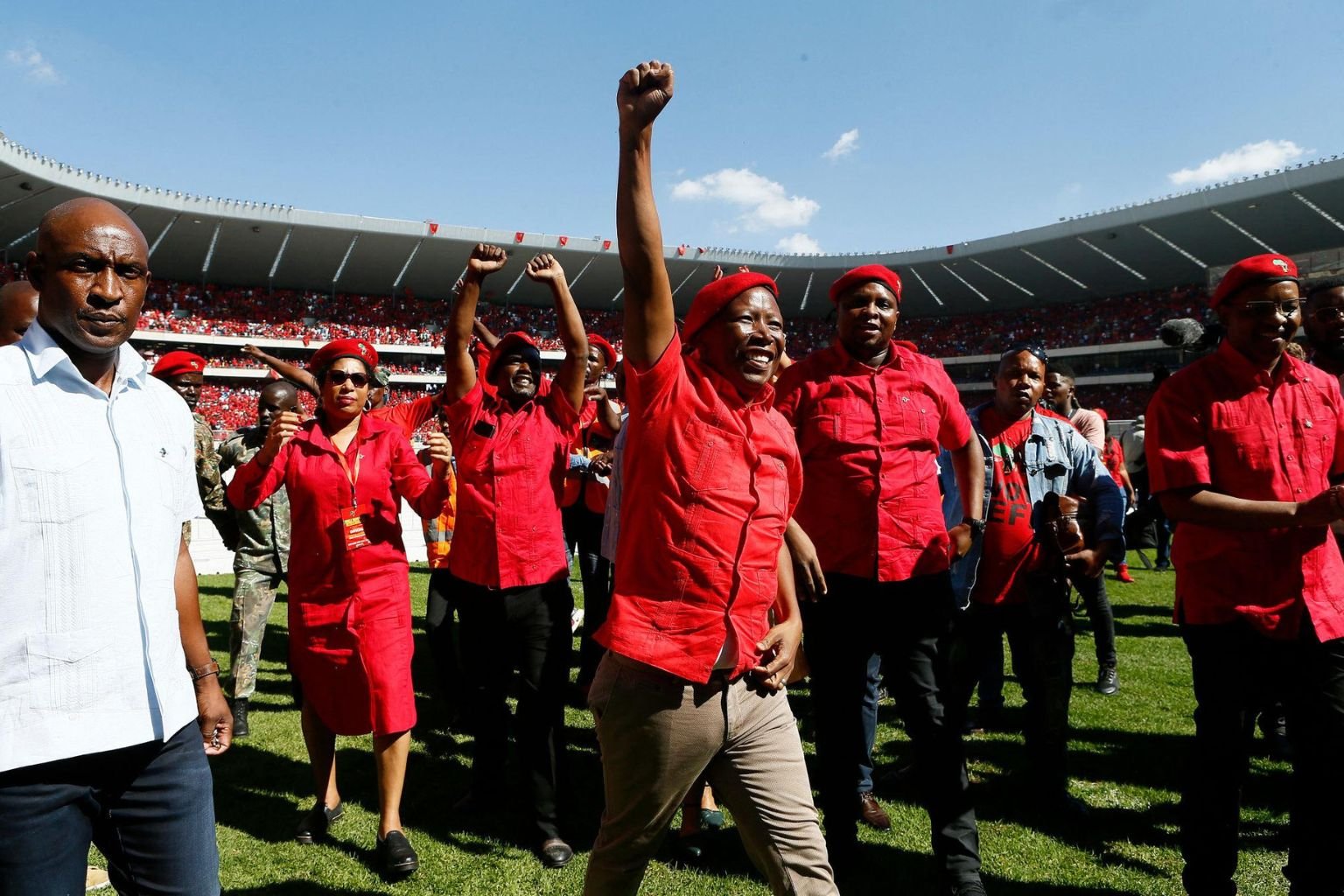
South Africa’s recent political upheaval has turned a historical protest song into a global flashpoint.
In late 2025, Julius Malema, a firebrand leader of the Economic Freedom Fighters (EFF), revived the apartheid era struggle chant “Dubul’ibhunu” (“Shoot the Boer” or “Kill the Boer”) at public rallies.
Internationally, the chant was seized upon by figures like Elon Musk and former U.S. President Donald Trump to claim a “white genocide” in South Africa. Back home, however, South Africans are wrestling with very different questions: how to address vast inequalities left by apartheid (where 7% of land was set aside for whites in 1913), how to implement a new 2024 land expropriation law, and how to navigate the EFF’s role as a rising opposition into 2026. The result is a deeply African conversation about history and justice that has been distorted abroad, a discussion about post-colonial protest language and realpolitik that is too important to be reduced to soundbites.
For South Africans, Malema’s chant harks back to the anti-apartheid era, a time when liberation music was not meant to be taken literally. Indeed, a 2022 Equality Court in Johannesburg ruled that Malema’s singing of Dubul’ibhunu was not hate speech under local law. Supporters insist it is a symbolic protest, not an actual death threat. But abroad, global far-right audiences have distorted it. Tesla CEO Musk (himself South African born) in early 2025 amplified Malema’s chant, warning of a “white genocide”. In May 2025, Trump showed Cyril Ramaphosa a video of Malema singing “Kill the Boer, kill the farmer,” insisting Afrikaners are under siege. These incidents have forced South Africa to respond on the world stage even as its own people debate land reform, inequality and reconciliation. In short, a localised struggle slogan has become an international geopolitical controversy. This feature unpackages the scene: tracing Malema and the EFF’s 2026 prospects, the stalled land reform debate, the legal status of the chant, and the broader lessons about how post-colonial protest language travels in today’s polarised world.
South Africa’s Election Shake Up and Land Reform Crossroads

South African President Cyril Ramaphosa addresses the National Assembly in Cape Town after the June 2024 election, when no party won a majority. The ANC (ruling party) fell below 50%, forcing new coalitions. This unprecedented result has dramatically raised the stakes for debates about land and inequality. In January 2025, Ramaphosa signed the new Expropriation Act into law, updating an Apartheid-era statute and explicitly allowing (under strict conditions) the seizure of property, including farmland, in the “public interest” without compensation. The government says the law is a necessary step to redistribute land decades after the 1913 Natives Land Act had confined Black people to just 7% of the territory. But its passage immediately sparked alarm both at home and abroad. Critics warned it could unsettle property rights and scare off investors, while Trump’s U.S. administration branded it “discriminatory” and briefly halted aid to South Africa. (Trump even fast-tracked refugee status for dozens of white South African farmers, citing unproven “genocide” claims.) Domestically, meanwhile, the debate has turned to implementation: Parliament’s Land Committee has pushed to ring-fence funds to clear decades of backlog in land claims and to tighten oversight, amid reports of corruption and elite capture in some redistribution programs.
The bottom line is that land reform remains politically charged but unresolved. For many South Africans, the new law signals genuine progress toward correcting historical injustice. As one observer notes, it was meant to “fast-track land reform and correct the deep, unresolved injustices of dispossession”. Yet others point to the glacial pace of actual transfers: only a fraction of the land has changed hands since 1994, and millions still live without secure tenure. Supporters of expropriation say the piecemeal redistribution, so far, has amounted to about 24% of farmland by some estimates, and that it is far too slow. Critics say instead that practical obstacles (bureaucracy, lack of funding, legal challenges) have stalled the process, leading to a deadlock. Either way, both sides agree South Africa cannot ignore its skewed land ownership: today, whites (7.3% of the population) still own roughly 72% of the farmland. This inequality, underscored in the 2022 census, is why land reform dominates the political agenda alongside jobs and crime. (For perspective, South Africa’s Gini inequality index remains among the world’s highest.)

Into this context comes Malema’s chant. The EFF has long made land expropriation and wealth redistribution its signature issues. In fact, in the wake of the 2024 election, analysts warned that Malema could become a “kingmaker” if alliances were needed. With Ramaphosa’s ANC weakened, EFF demands seizing white-owned farms without compensation and nationalising mines gained legitimacy during coalition negotiations. But they also stoked fear in some quarters, both local and foreign. The ANC was painted as too slow by Malema’s base, and as too extreme by its opponents. Internationally, the new law and Malema’s rhetoric together fueled a narrative (spread by media and hard-right activists) that South Africa was criminalising whites. President Ramaphosa had to insist in April 2025 that “nobody can take land” by force and that crime victims remain overwhelmingly black. His point: tackling crime and poverty should be South Africa’s priority, not imagined threats to the white minority.
Malema’s EFF Poised for 2026 Amid Uncertainty
Julius Malema at a political rally in Cape Town. Since forming the EFF in 2013, he has personified the party’s fiery style. The EFF’s predominantly young, urban Black South African voter base swelled in recent years. The party now holds roughly 10–11% of parliamentary votes, making it the third-largest after the ANC and the main opposition. Its 2024 electoral gains (29 seats out of 400) underlined its appeal: Malema’s pledge to solve “the racial issue” and alleviate economic stagnation resonated with tens of thousands of voters frustrated by poverty and unemployment. One analyst noted wryly that in a society where almost half of black youth are jobless, the EFF has “accurately … pointed out that we haven’t solved the racial issue in this country”. In short, Malema’s left-populism captured a segment of voters who felt left behind by the ANC and were sceptical of traditional politics.
Yet the EFF’s surge carries internal risks. The party is famously centred on Malema’s personality and rhetoric. As the Mail & Guardian reported, since its founding, “the EFF has been built around Malema’s leadership. He dominates public messaging… and remains the primary link between the party and its supporters”. That hyper-centralisation has driven discipline and visibility, but it means there is no prominent second-tier figure to carry the torch. In early 2026, this weakness became stark. Malema is embroiled in a 2018 firearms conviction (shooting a rifle at an EFF anniversary rally). He has appealed the verdict, but courts may still impose a sentence. Legal experts expect any term to be under 12 months to avoid triggering disqualification from Parliament. But the uncertainty is causing jitters. One analyst warns plainly: “If he is sent to prison, it will affect the electoral performance of the EFF because the personality of Julius Malema has been overbearing on the EFF… I don’t see the EFF surviving without Julius Malema”. Even within the party, sources concede there is no clear succession plan. Malema’s appeal campaign has had to double as an effort to frame himself as a political martyr.
This tumult coincides with key elections in 2026, namely, the nationwide municipal polls. The EFF is targeting gains in major cities and metros, hoping to ride growing dissatisfaction with local services. But the campaign itself has been partially built around Malema’s own narrative as “Commander-in-Chief”. Party strategists privately worry that if Malema’s authority were suddenly removed, it would expose a leadership vacuum. Publicly, the EFF has only doubled down on solidarity: it lauds Malema’s defiance of the judiciary and argues he is being targeted for confronting elites. As one senior EFF figure put it, under deputy leader Godrich Gardee, “a dead EFF” would follow the party insists that Gardee, or any other cadre, cannot replicate Malema’s success without him. In summary, the EFF enters 2026 both stronger (in numbers and audacity) and more fragile (in structure) than ever.
The ‘Kill the Boer’ Chant: History and Controversy

To outsiders, the phrase “Dubul’ibhunu” sounds shockingly aggressive. But in South Africa, it carries a particular meaning. The chant originated in the 1980s as part of the ANC and allied movements’ repertoire under apartheid. In that era, “boer”, literally “farmer” in Afrikaans, came to be used generically for oppressive whites. Freedom fighters like ANC Youth League chairperson Peter Mokaba sometimes led crowds in this refrain, seeing it as a metaphor for resisting white minority rule. Historian Thula Simpson explains that the words were part of “the theatre of mass insurrection,” comparing it to warlike music aiming morale, not actual murder orders. In fact, the lyric “Shoot the Boer” was meant as a rallying cry against the apartheid state, not a literal battle plan. (Other anti-apartheid songs used even more violent imagery, for example, carrying an AK-47 was likened to holding an “Afrika” in verse as a symbol of overthrowing the regime.)
By the 2000s, many South Africans regarded such chants as outdated. The ANC itself stopped performing them. But they never entirely disappeared. In 2010, Malema, then still in the ANC’s youth wing, famously sang it at a political rally, sparking a lengthy legal battle. In 2011, the Equality Court did find Malema guilty of hate speech for singing “Dubul’ibhunu”, yet on appeal, that conviction was overturned. More recently, South African courts have treated the issue differently: in 2022, the Equality Court ruled that Malema’s singing of the slogan did not meet the legal definition of hate speech. The judges found that “boer” was not necessarily a protected class and that the context (an ANC “freedom struggle” anniversary rally) carried a symbolic meaning. In practice, this means the chant can be used under the law as a form of protest.
Malema and his supporters fiercely defend it. He often argues (both in court filings and media interviews) that “Kill the Boer” is a metaphorical lyric from history, not a literal genocidal order. In February 2025, after Musk tweeted a video of Malema singing it, Malema responded that critics misunderstood the ANC’s songs: they were meant to signify triumph over oppression. Backing him up, many liberation struggle veterans point out that former President Jacob Zuma once led crowds in the same anthem, a stark reminder that the song predates Malema and is embedded in collective memory, not personal vendetta. Indeed, Al Jazeera noted that even today “the song continues to be sung in democratic South Africa,” mainly as a symbolic expression.
On the flip side, some South Africans are uneasy. They worry the chant reinforces racial divisions at a time when unity is precarious. Moderates, including some ANC elders, prefer to focus on policy solutions rather than inflammatory slogans. But there is no straightforward agreement: as one South African columnist put it, “You can condemn Malema’s politics or the song, but dismissing their historical context is simplistic.” The truth is, domestic opinion remains split. Civil society forums and churches have urged dialogue, not silencing, on this issue. They stress that addressing crime against all farmworkers and distributing land fairly are the real issues, not chasing hashtags. Still, the chant’s resurfacing has forced South Africa into an uncomfortable international spotlight, underscoring that local protest language can be easily misread abroad.
Global Reverberations: Musk, Trump and Far-Right Narratives
The chant’s ripple effects have been explosive outside South Africa. In early 2025, Elon Musk reignited the debate on social media. The billionaire, a native of Pretoria, posted old footage of Malema singing “Kill the Boer” and tweeted that it showed “a major party actively promoting white genocide”. He lamented that so few people outside Africa knew of this, framing it in the language of Western identity politics. American far-right figures promptly echoed him. By May 2025, ex-President Trump posted a clip of Malema’s performance during a White House meeting with President Ramaphosa, slamming South Africa’s land reform as “a bloodbath” for white farmers. Senator Marco Rubio even circulated the Malema video on Twitter, warning that the chant “incites violence” and urging Afrikaner emigration.
Critics from Africa and beyond roundly condemned this narrative. South African officials pointed to data showing that only a handful of farm murders occur each year, and the victims are both Black and white, to argue that there is no systematic targeting of whites. The government and independent analysts stressed that Trump and others had misunderstood both the song and the facts. (For example, the crosses along a highway that Trump showed Ramaphosa were actually a one-time memorial protest by farmers in 2020, not mass graves.)
Meanwhile, the episode fed a larger trend in far-right circles. Musk’s own AI chatbot Grok took up the theme, spontaneously spouting the ‘white genocide’ conspiracy when asked unrelated questions. Media watchdogs noted that Musk and right-wing pundits like Tucker Carlson had helped mainstream the fringe idea that South Africa is persecuting whites. This, in turn, tied the Malema incident to the global surge of cultural clashes: anti-immigrant groups in Europe and the US have shown a keen interest in African political slogans. In their hands, “Kill the Boer” was recast as a new rallying cry of “reverse racism” to justify crackdowns on immigration and race-based policies. Notably, mainstream outlets like The Guardian have labelled “white genocide in South Africa” as a far-right conspiracy theory, warning that it distorts South African realities to fit a nativist agenda.
On the South African side, civic leaders responded cautiously. They criticised foreign interference, for instance, funding to AfriForum (a white-minority lobby) increased as a result of these claims, but they also used the moment to reiterate messages of unity. President Ramaphosa appealed to his international counterparts to work “with us on our issues,” not to “vilify” the entire country over slogans. Many South Africans of all races stressed that their democracy can discuss radical ideas internally without needing global permission. In short, the chant controversy has become a rallying symbol not just for South African protestors, but also a cautionary tale about how fragile symbols can be hijacked in geopolitics.
Post-Colonial Protest Language in a Fraught World
The “Kill the Boer” episode is emblematic of a broader phenomenon: liberation-era symbols caught in today’s polarised global culture wars. Around the world, activists from formerly colonised societies use provocative language to denounce historical oppressors. Such slogans have intended meanings within their contexts. But in our interconnected media environment, they can be ripped out of context and reinterpreted through Western cultural filters. In recent years, we have seen similar frictions, for example, Palestinian chants like “From the river to the sea” often provoke alarm in Israel-supporting audiences, even though many Palestinians say it calls for freedom, not extermination. Likewise, Latin American leftists have slogans dating to anti-imperialist struggles that sound threatening when translated literally.
Experts caution that when these protest lines enter global discourse, far-right groups often twist them to stoke fear. In this case, commentators note the irony: a song that stood against racial tyranny is being treated as an incitement of racial hate. Social scientists call this a “symbolic clash” between the legacies of colonialism and the rise of nativist nationalism. Many African analysts point out that Western audiences typically have no living memory of apartheid; they see only buzzwords. As one scholar summarised: “Outsiders are quick to classify any anti-colonial language as terrorist or hate speech, ignoring the very real grievances that gave birth to it”. While such interpretations may resonate with some US or European voters, they miss the nuance of South Africa’s experience.
For South Africa, the debate has thus become twofold: domestically, how to use historical protest imagery responsibly; and internationally, how to prevent misrepresentation. Civil society groups here emphasise empathy: they urge other countries to understand that cry of dispossession, rather than reflexively condemning it. At the same time, South African politicians of all stripes realise they must pitch their narratives to a global audience, lest divisive tropes overshadow the real issues. As one commentator advised, “We must be careful not to let foreign tabloid talk drown out our own discussion about land and justice.”
Navigating the Future Dialogue and Reform
Looking forward to 2026, South Africans face a clear imperative: channel energy into concrete solutions rather than confrontational slogans. The EFF’s rise shows that deep frustrations persist, but polls also indicate many Black South Africans want incremental, constructive change. The new Expropriation Act has given reform legal teeth, but implementing it reasonably will require broad political buy-in. Experts suggest empowering parliamentary oversight and community land boards (as proposed in the Equitable Access to Land Bill) to ensure grassroots voices are heard. International observers from the AU to donors have underscored that all parties must commit to negotiation and to the rule of law, rather than resorting to threats.
Malema and the ANC alike will need to adapt their tactics. The ANC government has already moderated some public rhetoric to reassure investors and neighbours that new laws will be transparent. The EFF, for its part, may tone down some of its more incendiary language to broaden its appeal. Some analysts expect EFF leaders to emphasise policy proposals (such as farm workers’ rights and food security) rather than repeating the exact chant, especially if the courts sideline Malema. 2026 local elections could thus turn on bread-and-butter issues of who can deliver services, jobs and land rather than slogans. In the best case, South African voters of all backgrounds will judge parties on their programs to address poverty and inequality, rather than on polarising catchphrases.
In the end, the “Kill the Boer” saga may fade as rapidly as it flared, but it leaves lessons. It reminds Africans that their own history and language must be explained on their terms. It reminds the world that liberation rhetoric often needs contextual understanding, not alarmist framing. If South Africa can stay focused on rebuilding trust by blending bold land reform with inclusive nation building, it could emerge stronger in the coming years. For now, African voices are asserting that dialogue and democratic process must conquer the loudest chants.