


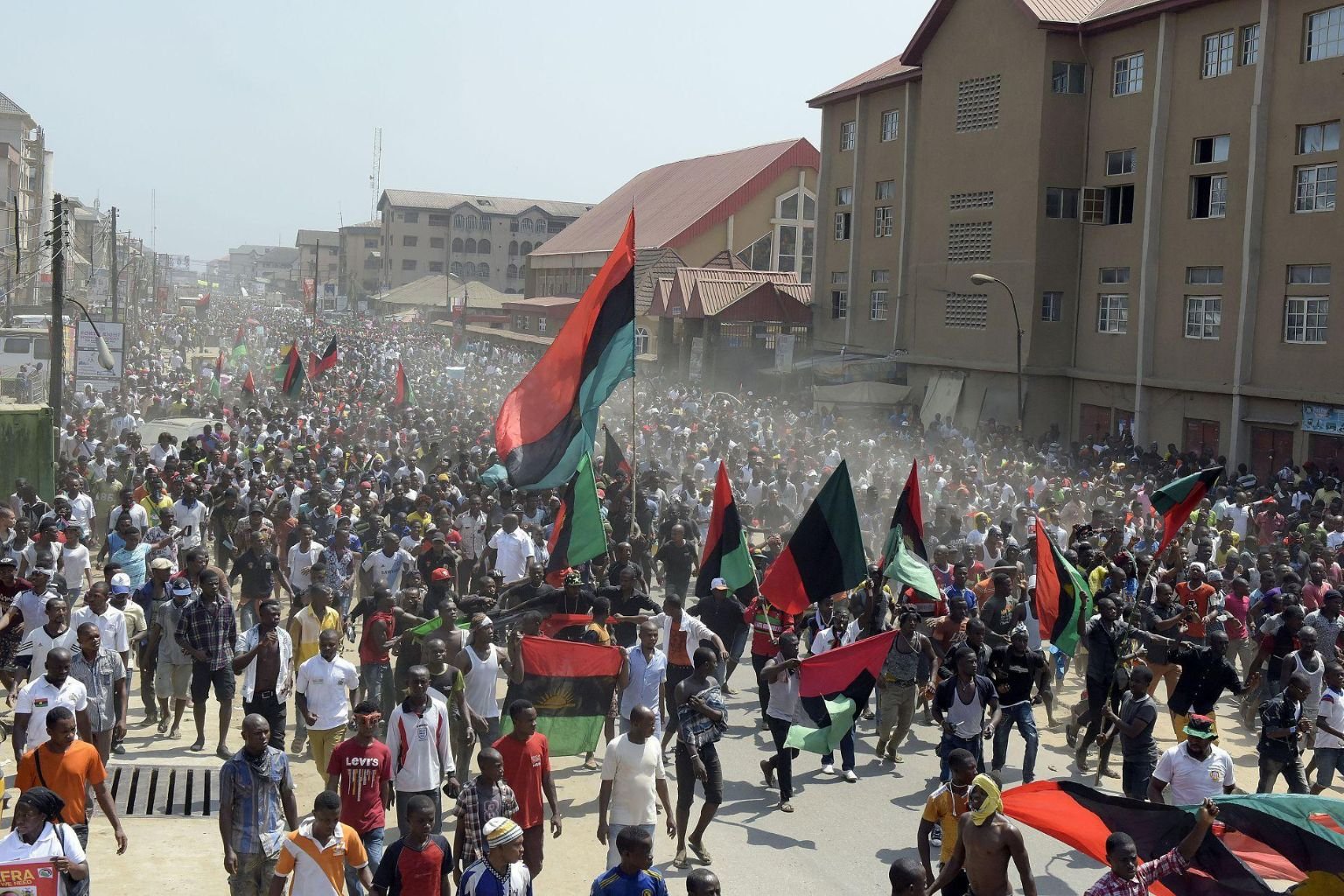
The room is tense, a judge presides, robes starched, expression unreadable. Opposing counsel are poised: one for the state, the other for the secessionists. The gallery seethes with a quiet desperation, the air heavy with history. Outside, a chorus rises like dust in dry season: “We want Biafra!”
Inside, the silence grows thick not of peace, but of unresolved war. The gavel waits, as if it, too, remembers. Finally, a question cuts through the theatre like a machete through underbrush:
“But my Lord… who exactly are the Biafrans?”
The Root of the Question
Fifty-seven years have passed since Colonel Chukwuemeka Odumegwu Ojukwu declared the Republic of Biafra in May 1967. It was no act of rebellion for rebellion’s sake. It was, in Ojukwu’s own framing, a survival response, a declaration born from the ashes of failed protection, systemic pogroms, and the profound betrayal of Eastern lives in post-independence Nigeria.
Yet even in its most righteous fury, the Biafran project carried a crucial flaw: the assumption of a singular identity.
Colonialism had drawn Nigeria’s boundaries like a drunken surveyor, stitching together hundreds of distinct ethnicities with a flag and a forced anthem. The Eastern Region, which later became Biafra, was not a homogeneous entity. Alongside the dominant Igbo lived the Ijaw, Efik, Ibibio, Itsekiri, and Ogoni nations within a nation within an uninvited experiment.
And so, Biafra was declared by geography, but not always by consent.
As Dr Obinna Ijeoma, a political historian at the University of Nigeria, Nsukka, explains,
"Biafra isn't just a political dream. It's a reaction to humiliation."
An Identity Built on Divergence

Starving children shelter inside a relief aircraft during the Biafran War, a conflict that turned hunger into a weapon and trauma into memory.Ojukwu’s government tried to consolidate. But beneath the war drums, another tension simmered: ethnic mistrust. For many minority groups, the idea of Biafra felt less like liberation and more like annexation. As the Nigerian army attacked from the outside, internal dissent quietly sharpened.
By 1968, the Biafran war machine was no longer just battling federal forces; it was splintering along fault lines of identity, representation, and resentment. Allegations of favouritism, marginalisation, and monopolised command structures dogged the Biafran leadership. For some, the dream of Biafra had morphed into an Igbo-centric hegemony.
Dr Ifeoma Okeke, an ethnic conflict analyst at the Centre for African Dialogue, puts it starkly: “Secession without consensus is a house of cards. Identity politics will undo it before the first passport is printed.”
Today, such tensions still whisper through marketplaces, political corridors, and family dining rooms. A persistent stereotype clings to the Igbo identity: ambitious, acquisitive, and dominant. As one southern proverb dryly puts it: “The Igbo man will not just eat with you, he may buy your kitchen.”
It is an unfair generalisation, yet deeply embedded, forged in the crucible of war and post-war dispossession. After the conflict, Igbo citizens returned to other southern states only to find their lands seized, their properties confiscated, and their neighbours emboldened by victory.
Was it war spoils or post-war prejudice? “All is fair in war,” they say, but memory never forgets.
A Phoenix in a Red Cap: Kanu’s Resurrection of the Flame

Could you fast forward to 2015? A new face rose from the embers of Biafran memory Nnamdi Kanu, a London-educated agitator and founder of the Indigenous People of Biafra (IPOB). Kanu was no quiet intellectual. With incendiary rhetoric, military-style broadcasts, and a devoted online following, he reanimated the ghost of secessionism.
By 2017, his message, once dismissed as fringe, had grown teeth. Marches, clashes, arrests. The Nigerian state, rattled, detained Kanu under charges of treason. The move backfired.
“Like a blacksmith’s hammer to hot iron,” said Segun Olorunfemi, a constitutional lawyer based in Lagos, “the state’s actions forged Kanu into a warlord in the eyes of his followers.”
But not everyone was convinced of his strategic capability. “Kanu may be charismatic,” Olorunfemi added, “but charisma without political architecture is just performance.”
His arrest only deepened IPOB’s radicalisation. Youthful, unemployed, and disillusioned, many Igbos now saw Biafra not as history, but as the future.
Who Exactly Are the Biafrans Today?
This remains the fundamental question that Nigeria has yet to answer with honesty. Biafra is not just a region. It is not just the Igbo. Nor is it merely IPOB. It is an identity in flux, forged in trauma, refracted through politics, and evolving in diaspora WhatsApp groups and refugee TikTok videos.
The movement’s strength today is also its Achilles heel: it wears many faces, speaks in many tongues, and pulses with unresolved contradictions. Can a multi-ethnic, multi-faith region truly cohere into a single sovereign entity without confronting its own ghosts?
Because if Biafra is only Igbo, the movement may gain volume but lose viability.
And if Biafra must include all Easterners, then it needs a new kind of covenant, one built not on the memory of betrayal, but on the audacity of unity.
Implications for Nigeria’s Fragile Unity

The Biafran question is no longer about war. It is about identity politics, resource control, memory, and constitutional reform. Nigeria’s central government faces an existential crisis not just in the East, but mirrored in other secessionist shadows: the Oduduwa Republic movement in the Southwest, the rise of regional militias, and an increasingly disenchanted middle class.
The longer Nigeria ignores the question of who the Biafrans are, the deeper the country sinks into political quicksand.
What to Watch
- Next IPOB legal appeal: Kanu’s trial remains in limbo. A judgment could rekindle or suppress the movement.
- Proposed constitutional conference: Watch for Eastern governors pushing reforms on regional autonomy.
- Diaspora funding: IPOB receives significant donations from the UK, US, and Germany. Any financial crackdown could destabilise the movement.
One cannot bury a shadow. The Biafran question haunts not because it was never answered but because Nigeria pretended it was. And in every courtroom metaphor, every burst of protest, every map redrawn in anger or hope, the gavel still waits.
