


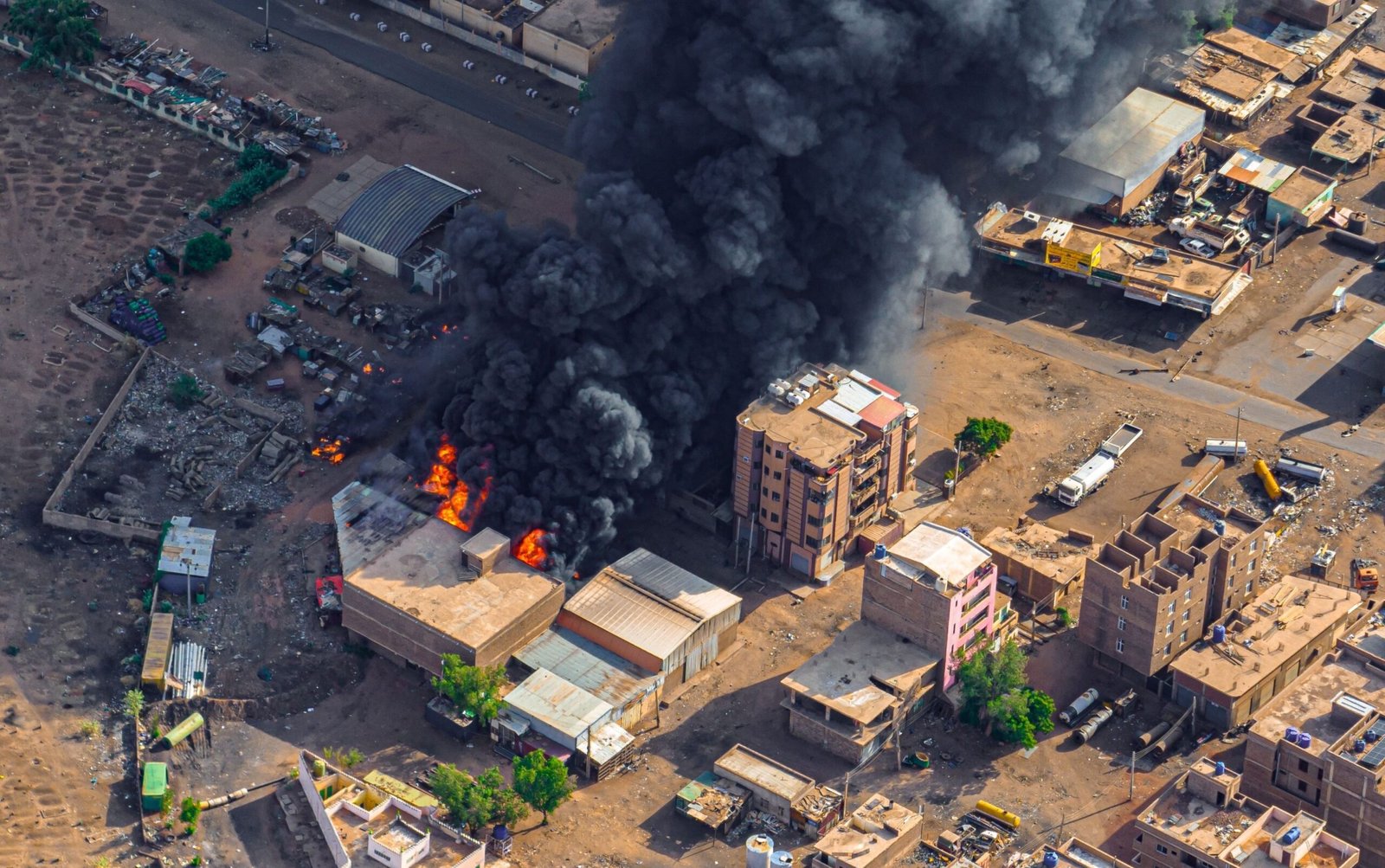
The nation once called the breadbasket of the Nile now gnaws at its own bones. Markets lie hollow, harvests rot uncollected, and mothers trade heirlooms for a handful of grain.
Yet amid this ruin, Sudan’s generals and their patrons are dining on conflict’s spoils, exporting gold through shadow routes, levying informal taxes at checkpoints, and auctioning loyalty for hard currency. What began as a power struggle between the army (SAF) and the Rapid Support Forces (RSF) has evolved into a full-fledged war business. Each shell fired in Khartoum feeds an economy of scarcity; each ceasefire broken resets the price of life. The hunger in Sudan is not only the absence of food, but it is the deliberate monetisation of suffering.
When Profit Becomes the Price of War
Nearly nine million people have been driven from their homes, food prices have soared beyond reach, and famine warnings stretch from Darfur to the Nuba Mountains. Yet the fighting persists because it pays. The RSF and SAF are not simply at war with each other; they are competing merchants in a marketplace of misery.
“A protracted famine is taking hold in Sudan,” warns Jean-Martin Bauer, WFP’s Director of Food Security and Nutrition Analysis, as the agency cuts rations amid a funding shortfall. The humanitarian implosion is inseparable from the combatants’ revenue engines: a wartime gold economy and sanctions-busting logistics that tie Sudan’s battlefields to Red Sea trade, Gulf refineries, and regional power politics.
For Africa’s investors, policymakers, and partners, Sudan is no longer a “local war.” It is a convergence of two systems: a war-economy gold extraction, illicit exports, foreign arms and drones, and a regional chessboard of Egypt-Ethiopia water and security anxieties, UAE-Saudi maritime ambitions, and South Sudan’s oil lifeline through Sudanese territory to the Red Sea. Each system reinforces the other, raising risk premia for shipping and insurance, rerouting oil and commodities, and fraying Africa’s already-thin humanitarian safety net.
The real battlefield is gold. The real frontline is Port Sudan. And the real cost in bread, insurance, and bond yields is being paid across the Red Sea corridor.
Macro, Prices, and Collapse
Sudan’s macro signals are a distress flare. The IMF’s 2025 dashboard projects real GDP growth of 0.4% and consumer prices at roughly 100% inflation, a rate that erodes household purchasing power and magnifies food insecurity. The World Bank documents a sharp depreciation of the pound in late 2024, with a widening gap to the parallel market rate.
Hunger data are even starker: WFP estimates 24.6 million facing acute hunger and about 2 million at risk of famine, while funding gaps force ration cuts at precisely the wrong time of year.
Gold, Drones, and Sanctions Evasion
Gold is the conflict’s bloodstream. Even before 2023, SAF and RSF manoeuvred for control of mines, refineries, and export channels. Chatham House notes that competition over gold assets helped drive the war, as gold provides liquid hard-currency revenues in a sanctions-fragmented world.
Open-source and NGO investigations have repeatedly traced Sudanese conflict gold toward the UAE. SWISSAID’s 2024 analysis shows 435 tonnes of gold were smuggled from Africa in 2022 and underscores Dubai’s centrality; Chatham House adds that African gold comprised 58% of the UAE’s 2022 gold imports, amounting to about $34.5 billion, highlighting the gold’s outsized macro relevance.
Sudanese and international media reports through 2024–2025 describe a wartime surge in artisanal output and smuggling, with estimates that a large share of Sudan’s production is diverted off the books to external hubs.
On the battlefield, the RSF has expanded its strike capability with long-range drones, as verified by independent researchers in imagery. At the same time, the government accuses the UAE of clandestine support, allegations the UAE denies. Whatever the provenance, a drone war layered atop an illicit gold economy deepens the fog around sanctions compliance.

Data Highlights:
- Between 50% and 70% of Sudan’s gold production is smuggled out of the country.
- SWISSAID calculated that at least 400 tonnes of gold have been smuggled out of Sudan between 2012 and 2024, according to the African Gold Report
- In 2024, official production reached 64 tonnes with exports of approximately 28 tonnes valued at $1.57 billion.
- The UAE is the primary destination for both declared and smuggled gold exports from Sudan, African Gold Report, Swissinfo
From Minehead to Marketplace
The logistics are ruthlessly simple. In RSF-held areas, miners and intermediaries pay protection or enter into partnerships; bullion is transported overland to border nodes, then to refineries and trading houses in the Gulf. New facilities and “alternative destinations” have been mooted as governments and traders react to reputational pressure and regulatory scrutiny.
Illicit supply chains thrive because enforcement is asymmetric. Academic and policy research has described Dubai as a recurrent hub for sanction evasion via precious metals; Washington has sanctioned Sudan-linked enablers in the past. But fragmented diplomacy and conflicting interests across the Red Sea limit policy bite.
Famine, Siege, and Access Denied
UN agencies call Sudan “a humanitarian catastrophe,” with over 25 million in need. OCHA notes that nearly 9 million people are internally displaced; ReliefWeb collates estimates that total displacement across the region has surpassed 14 million people.
Food security agencies confirm famine in several zones and project additional famine areas absent sustained access. WFP has cut rations and warned that hunger is accelerating south of Khartoum and across Darfur. “People are getting weaker and weaker and are dying as they have had little to no access to food for months,” Bauer said in June and August statements.
In Darfur, the siege of El Fasher has become emblematic of the war’s brutality and its deliberate starvation tactics, with relentless shelling and medical collapse.

Data Highlights:
- Crisis Overview Panel – Three critical statistics:
- 13 million people displaced total (as of April 2025), UNHCR
- 24.6 million people are facing acute food insecurity (about half the population), according to the UN World Food Programme
- 638,000 people are facing catastrophic levels of hunger (IPC Phase 5), UN World Food Programme
- Displacement Distribution – Pie chart showing:
- Refugee Destinations – Horizontal bar chart showing flows to Chad, Egypt, South Sudan, Ethiopia, Central African Republic, and others
- Famine Zones & Risk Areas – Detailed list including:
- Famine confirmed in Zamzam, Abu Shouk, and Al Salam camps in North Darfur, plus Western Nuba Mountains, UN World Food Programme, UNICEF
- Recent famine confirmations in El Fasher and Kadugli (November 2025), Wikipedia
- 17 additional areas at risk of famine, UN World Food Programme
- Crisis Timeline – Visual timeline from April 2023 conflict outbreak through November 2025 famine expansion
Egypt, Ethiopia, the Gulf and a Chokepoint Called the Red Sea
Sudan’s conflict intersects two strategic maps. The first is the Nile GERD axis linking Egypt and Ethiopia. Cairo’s security doctrine treats instability on its southern flank as a direct threat, while Addis Ababa’s GERD hydropolitics and border frictions complicate any unified approach to Khartoum. The second is the Red Sea corridor, where maritime security, port concessions, and logistics finance draw in the UAE and Saudi Arabia.
Since late 2023, Houthi attacks on merchant shipping have sharply increased war-risk premia. Even when volumes are resilient, insurance costs spike, and voyage plans detour around the Cape, driving up freight costs and adding volatility for East African importers. For Sudan, such shocks translate into more expensive aid pipelines and commercial staples.
South Sudan’s Oil As A Fragile Lifeline Through a War Zone
South Sudan’s economy rides on a pipeline that exits at Port Sudan. The war has periodically halted flows through attacks and infrastructure damage; repairs have restored throughput, only for new disruptions to loom, with operators warning of potential shutdowns as recently as August–September 2025. Every outage ripples through revenue, FX, and government payrolls in Juba and through hard-currency liquidity in Port Sudan.
Mediation, Drones, and Leverage
Two realities can be actual at once. First, multiple governments with leverage over Egypt, Saudi Arabia, the UAE, and the U.S. say there is no military solution and have floated a roadmap: a humanitarian truce, a permanent ceasefire, and a transition. Second, those same stakeholders are mired in mutual suspicion over alleged support for different Sudanese factions and divergent prioritisation of Red Sea interests.SIPRI’s latest transfer datasets underscore how the broader MENA arms market shapes regional coercive capacity even when formal embargoes are in place, while ACLED’s incident tracking illustrates a conflict increasingly shaped by drones and sieges rather than set-piece battles.
Five Investor-Relevant Signals
- War-Risk Premiums: Insurance surcharges on Red Sea routes remain sensitive to attacks and to the credibility of ceasefire agreements.
- Pipeline Interruptions: Any renewed shutdown of the South Sudan corridor would impair regional FX liquidity and heighten Sudanese fiscal stress.
- Gold Compliance Risk: Enhanced due diligence on African gold streams to the Gulf is now mainstream, with SWISSAID, Chatham House and media scrutiny raising reputational stakes.
- Inflation and Exchange Rates: With inflation projected at ~100%, any aid delays or import disruptions pass through quickly to prices.
- Humanitarian Access: Siege warfare and access denials lead to higher mortality and political pressure to escalate sanctions, which in turn affect trade compliance.
What a Realistic Path Forward Requires
- First, an operational ceasefire that enables predictable humanitarian access. Without consistent corridors, famine spreads and the war economy profits. WFP and OCHA’s calls are unambiguous: funding and access now.
- Second, coordinated gold governance that spans both sides of the Red Sea. That means tightening refiner due diligence, harmonising KYC/AML across trading hubs, and fast-tracking verification for ASM supply chains. Precedent exists in other commodities; the missing piece is enforcement parity between African exporters and destination markets.
- Third, a sequenced political process with regional guarantees. The Quad roadmap (U.S., Saudi Arabia, UAE, Egypt) sketches staging posts; Africa’s institutions can add legitimacy if they align leverage rather than compete with it.
El Fasher as a Microcosm
El Fasher’s siege encapsulates every structural risk: systematic obstruction of aid, urban warfare, and the use of starvation as a method of war. Accounts from survivors describe food prices beyond reach and medical systems in collapse. For analysts and investors, the signal is not only moral but also predictive: zones of siege become zones of control for illicit revenue and forced taxation.
Policy and Market Outlook: The Next 180 Days
Sudan’s conflict is a storm testing the strength of regional vessels. As an East African proverb cautions, “When the boat has no captain, every wave becomes a mountain.” Over the next six months, four waves will determine whether Sudan’s neighbours can steady the vessel or whether the Red Sea corridor remains adrift.
- Humanitarian Finance as a Market Signal.
Donor pipelines are the ballast that steadies the ship. When WFP’s supplies falter, households lose anchor and food prices surge with each gust of inflation. Replenished funding before the lean season would keep the economy from capsizing; failure risks turning a humanitarian gap into a market maelstrom.
"You have heard the figure, nine million have been internally displaced, equivalent to the entire population of Switzerland."
UN Relief Chief (OCHA)- Red Sea Shipping and Insurance Costs.
The Bab al-Mandab is the narrow strait where small ripples become tidal surges. War-risk premiums on shipping are already eroding margins across East Africa. Without a ceasefire that calms the waters, insurers will keep treating this artery as a danger zone, pushing costs higher from Cairo to Nairobi. - Commodity Compliance and Gold Governance.
Gold is the cargo that can either enrich or sink the vessel. The RSF’s smuggling routes feed directly into Gulf refineries, but rising scrutiny is tightening the ropes. Traders who fail to strengthen their due diligence may find themselves tossed overboard by regulators. - Regional Guarantees: Paper vs. Practice.
The Quad roadmap is the chart; what is missing is the captain’s hand. Without deadlines and consequences, it is little more than driftwood. A credible enforcement regime would provide the rudder, aligning incentives and steering Sudan away from further wreckage.
The Cost of Looking Away
African proverbs remind us that when elephants fight, it is the grass that suffers. In Sudan, the “grass” is not only the people. However, they bear the highest cost but also the institutional soil of African markets: insurance lines, FX buffers, shipping schedules, and compliance reputations. A war financed by gold and fought in drone shadows cannot be quarantined inside national borders when its logistics run along shared seas and pipelines.
There is still agency. A ceasefire that sticks, an access framework that holds, and a gold governance regime that bites would reverse the famine curve and stabilise corridors. It would also begin to unwind the incentives that make war profitable because it would finally be costlier to move illicit bullion than to move food. The alternative is already visible on the Red Sea: higher risk, thinner margins, and a region learning the hard way that the price of indifference is always paid in arrears.


